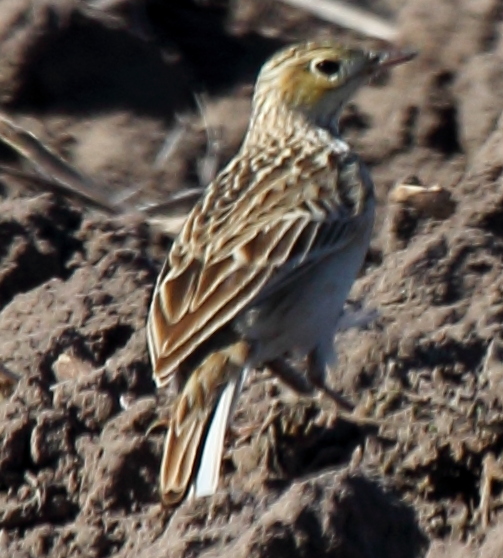
Abyssinian Longclaw
Macronyx flavicollis
Order: Passeriformes / Family: Motacillidae

Wikimedia Commons
About the Abyssinian Longclaw
The Abyssinian Longclaw (Macronyx flavicollis) is a striking bird endemic to the highland regions of Ethiopia. Known for its vivid yellow throat and breast, contrasted with a black necklace-like band, this bird is a distinctive member of the family Motacillidae. It primarily inhabits the Ethiopian Highlands, where it plays a crucial role in the ecosystem by controlling insect populations and serving as prey for larger birds of prey. The Abyssinian Longclaw, often found in pairs or small groups, is particularly significant as an indicator species for the health of its grassland habitat. Its presence is closely tied to the availability of open, undisturbed grasslands at altitudes ranging from 1,800 to 3,000 meters. The seasonal behaviors of the Abyssinian Longclaw are largely dictated by rainfall patterns. During the wet season, from June to September, these birds become more active, engaging in breeding activities and displaying increased vocalizations. This period coincides with the growth of lush vegetation, which supports an abundance of insects, the primary diet of the Abyssinian Longclaw. As the dry season approaches, their activity levels decrease, and they may be seen foraging more frequently as insect availability declines. The ecological role of the Abyssinian Longclaw extends beyond its immediate environment. By maintaining healthy grassland ecosystems, this species indirectly supports local agriculture, which relies on these areas for grazing livestock. The bird's feeding habits help control populations of agricultural pests, thus promoting a balanced ecosystem. Its existence is a testament to the unique biodiversity of the Ethiopian Highlands, highlighting the importance of conserving this region's fragile habitats.
The Abyssinian Longclaw belongs to the family Motacillidae, within the order Passeriformes. These birds typically live average 5-7 years with a max recorded of 9 years..
How to Identify a Abyssinian Longclaw
Adult Abyssinian Longclaws are easily recognized by their bright yellow underparts, contrasting sharply with a prominent black band across the chest. The upperparts are mottled brown, providing effective camouflage in their grassland habitats. Juveniles resemble adults but have duller coloration and lack the distinctive black chest band, making them more challenging to identify. There is little sexual dimorphism in this species, as males and females appear similar, both exhibiting the characteristic yellow and black plumage. In the field, observers should note the Abyssinian Longclaw's unique flight pattern, characterized by steady flapping interspersed with short glides. When perched, the bird often adopts an upright stance, showcasing its bright throat. Although it shares its range with several pipit species, the Abyssinian Longclaw can be distinguished by its vibrant yellow breast and throat, features not found in the duller-colored pipits. The flight silhouette of the Abyssinian Longclaw is relatively slender, with a slightly forked tail, which is less pronounced than in similar birds. This, combined with its definitive coloration, aids in quick identification in the field.
Having trouble telling birds apart? Upload a photo to our bird identification tool for an instant species match.
Abyssinian Longclaw Habitat and Range
Preferred Habitat
The Abyssinian Longclaw is a specialist of high-altitude grasslands, predominantly found in the Ethiopian Highlands. These areas are characterized by open, rolling plains with sparse tree cover, allowing for ample foraging opportunities. The bird's preferred altitude range is between 1,800 and 3,000 meters, where it benefits from the cooler climate and reduced competition from lowland species. Seasonal habitat shifts are minimal for the Abyssinian Longclaw, as it remains largely resident, though it may move slightly in response to local food availability. Unlike many other bird species, the Abyssinian Longclaw is rarely found in urban areas, as it requires the undisturbed grasslands that are increasingly threatened by agricultural expansion and human encroachment. Its presence in rural settings is largely confined to natural grasslands and occasionally in lightly grazed pastures.
Geographic Range
The Abyssinian Longclaw is endemic to Ethiopia, where it occupies the high-altitude grasslands of the Ethiopian Highlands. Its breeding range is limited to this region, with no evidence of long-distance migration. Within Ethiopia, the bird is most commonly found in the central and northern highlands, including the Simien Mountains, Bale Mountains, and the lesser-known Chercher Mountains. Though the species does not undertake significant migrations, it may move locally in response to seasonal changes in food availability. Population density is highest in the lush, undisturbed grasslands that provide optimal foraging and nesting sites. Despite its limited range, the Abyssinian Longclaw is widespread within its preferred habitats across Ethiopia.
Want to know which birds visit your area? Browse our backyard birds by location guides for region-specific species lists.
What Does the Abyssinian Longclaw Eat?
The diet of the Abyssinian Longclaw primarily consists of insects and other small invertebrates, which it actively forages for on the ground. Common prey items include beetles, grasshoppers, and caterpillars, with occasional consumption of small seeds. During the wet season, the availability of insects increases significantly, allowing the Abyssinian Longclaw to take advantage of this abundance to fulfill its dietary needs. Foraging typically occurs in the early morning and late afternoon, when temperatures are cooler and insect activity is higher. The Abyssinian Longclaw employs a methodical foraging technique, walking deliberately through grasslands while scanning for movement before quickly pouncing on prey. In times of scarcity, such as during the dry season, the bird may supplement its diet with more plant material, though insects remain the primary food source.
Abyssinian Longclaw Behavior and Social Structure
Abyssinian Longclaws are generally solitary or found in pairs, though they may form small groups outside the breeding season. They are territorial birds, often defending their chosen grassland patches vigorously against intruders. During the breeding season, males engage in elaborate courtship displays, which include singing from prominent perches and performing short flight displays to attract females. Despite their territorial nature, Abyssinian Longclaws may form loose flocks during the non-breeding season, likely as a strategy to improve foraging efficiency and predator detection. Daily activity patterns are influenced by temperature and food availability, with peak activity during the cooler parts of the day. In response to predators, Abyssinian Longclaws rely on their camouflage and remain motionless until the threat passes, only taking flight if necessary. Their vigilance and keen eyesight are crucial for detecting potential threats in their open habitat.
Abyssinian Longclaw Nesting and Reproduction
The Abyssinian Longclaw constructs its nest on the ground, typically concealed within dense grass to provide protection from predators. The nest is a cup-shaped structure made from a combination of grasses, rootlets, and occasionally lined with softer materials like feathers. Nest location is carefully chosen to minimize detection by predators. The typical clutch size ranges from two to four eggs, which are incubated primarily by the female for approximately 14 days. Both parents participate in feeding the young, which fledge approximately two weeks after hatching. The Abyssinian Longclaw generally produces one to two broods per year, depending on environmental conditions and food availability. Parental roles are well-defined, with the male often responsible for defending the territory while the female tends to the nest.
Abyssinian Longclaw Sounds and Vocalizations
The primary song of the Abyssinian Longclaw is a series of melodious whistles, often delivered from a prominent perch. The song is characterized by its clear, rising notes followed by a series of descending trills. In addition to its song, the Abyssinian Longclaw produces various call notes, including a distinctive, sharp 'tsee' used as an alarm call. During the dawn chorus, males are particularly vocal, using their song to establish territory and attract mates. The Abyssinian Longclaw's vocalizations play a crucial role in communication, serving both social and territorial functions.
Interesting Facts About the Abyssinian Longclaw
- 1The Abyssinian Longclaw's bright yellow throat is a key feature distinguishing it from other similar species in its range.
- 2This species is endemic to Ethiopia, meaning it is found nowhere else in the world, highlighting its unique ecological significance.
- 3Despite its conspicuous coloration, the Abyssinian Longclaw is adept at hiding in grasslands, relying on its plumage for camouflage.
- 4Abyssinian Longclaws are known for their melodious song, which can be heard echoing across the grasslands during the breeding season.
- 5The Abyssinian Longclaw's nesting habits, including ground nesting in dense grasses, help protect its young from predators.
- 6The species' dependence on high-altitude grasslands makes it particularly vulnerable to habitat changes, emphasizing conservation needs.
- 7Abyssinian Longclaws contribute to their ecosystem by controlling insect populations, providing an essential ecological service.
Abyssinian Longclaw Conservation Status
The Abyssinian Longclaw is currently listed as Near Threatened on the IUCN Red List, with a population trend that is decreasing. The primary threat to this species is habitat loss due to agricultural expansion, overgrazing, and human settlement. Conservation efforts focus on preserving the high-altitude grasslands of the Ethiopian Highlands, which are essential for the survival of the Abyssinian Longclaw. Protected areas and community-based conservation initiatives aim to mitigate habitat destruction and promote sustainable land use practices. Despite these efforts, the long-term outlook for the Abyssinian Longclaw remains uncertain, highlighting the need for continued conservation action.