
Sao Tome Short-tail
Amaurocichla bocagii
Order: Passeriformes / Family: Motacillidae

Wikimedia Commons
About the Sao Tome Short-tail
The Sao Tome Short-tail, Amaurocichla bocagii, is an intriguing member of the family Motacillidae, found exclusively on the island of São Tomé in the Gulf of Guinea. This island endemic has adapted to the lush, tropical environments that define its home. The Sao Tome Short-tail plays a critical role in its ecosystem, primarily through seed dispersal and insect population control. It thrives in humid montane forests that blanket the island, particularly those that maintain dense understory vegetation. The bird's ecological significance extends to its role as a bio-indicator, reflecting the health of its forest habitat.
This species' presence signifies a thriving forest ecosystem, as it relies on pristine environments free of significant deforestation or pollution. The Sao Tome Short-tail is a year-round resident, showing little to no migratory behavior due to the island's stable climate conditions. Seasonally, it may shift slightly in elevation, descending during wetter periods when food resources become more abundant in the forest understory.
The Sao Tome Short-tail's conservation is of critical importance, given its limited range. The bird's habitat is under threat from human activities such as logging and agricultural expansion. Efforts to preserve the island's forests are essential for maintaining the population of this species. The Sao Tome Short-tail's adaptability to its environment and its role in maintaining forest health underscore the need for comprehensive conservation strategies.
The bird's behavior is intricately tied to its ecological role. Its feeding on insects and fruit plays a part in controlling insect populations and facilitating seed dispersal. The Sao Tome Short-tail's presence in São Tomé's montane forests adds to the island's rich biodiversity, making it a key species for study and conservation efforts.
The Sao Tome Short-tail belongs to the family Motacillidae, within the order Passeriformes. These birds typically live average lifespan is about 5 years, with some individuals living up to 8 years..
How to Identify a Sao Tome Short-tail
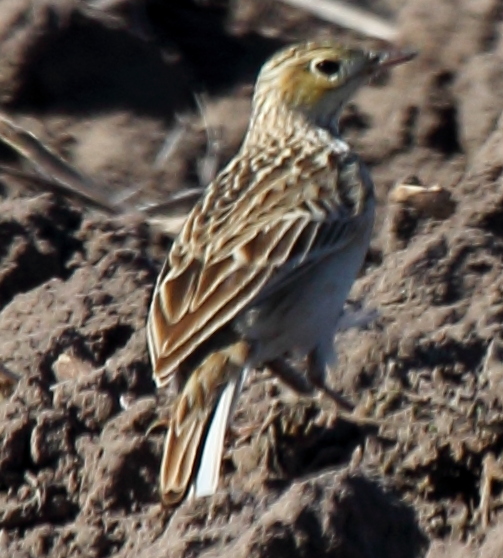
The Sao Tome Short-tail is a small bird, measuring approximately 14 cm in length. Its most notable feature is its short tail, which sets it apart from other birds in its habitat. The adult plumage is predominantly olive-brown with a slightly lighter underbelly. The wings have subtle barring, adding to its camouflage in the dense forest.
Juveniles bear a resemblance to adults but have more muted colors and less pronounced barring. The sexes are similar, making it difficult to differentiate males from females in the field. The Sao Tome Short-tail's silhouette in flight is compact, with rapid wingbeats and a distinctive short-tailed appearance.
While the Sao Tome Short-tail shares its environment with other small forest birds, its unique tail and coloration help distinguish it. Compared to other species, it lacks the vivid colors found in many tropical birds, favoring a more subdued palette that blends with the forest understory.
Having trouble telling birds apart? Upload a photo to our bird identification tool for an instant species match.
Sao Tome Short-tail Habitat and Range
Preferred Habitat
The Sao Tome Short-tail primarily inhabits montane forests on the island of São Tomé. These forests, rich in biodiversity, provide the dense understory that this species favors. The bird is typically found at elevations ranging from 600 to 1,500 meters, where the forest canopy is thick and the humidity high.
Seasonal shifts in habitat are minimal, though the Sao Tome Short-tail may move to lower elevations during the rainy season when food becomes more plentiful. While it is not commonly found in urban areas, its presence is an indicator of healthy forest environments. The dense, humid conditions of the montane forests are essential for the Sao Tome Short-tail's survival.
Geographic Range
The Sao Tome Short-tail is endemic to the island of São Tomé, located in the Gulf of Guinea off the coast of Central Africa. This bird's range is confined to the island's montane forests, where it occupies a niche environment. Due to its restricted range, it does not exhibit migratory behavior and is considered a resident species throughout the year.
Population density is highest in areas where the forest remains intact and undisturbed by human activities. The bird's limited distribution makes it vulnerable to habitat changes, emphasizing the importance of conservation efforts on São Tomé.
Want to know which birds visit your area? Browse our backyard birds by location guides for region-specific species lists.
What Does the Sao Tome Short-tail Eat?
The Sao Tome Short-tail has an omnivorous diet, feeding primarily on insects and small arthropods. It forages by gleaning insects from leaves and bark, demonstrating a preference for the forest understory's dense foliage.
In addition to insects, this bird consumes a variety of fruits and seeds, particularly during the wetter months when these resources are more abundant. The Sao Tome Short-tail's diet shifts seasonally, reflecting the availability of food in its environment. Its foraging behavior is generally solitary, although it may occasionally join mixed-species flocks.
Sao Tome Short-tail Behavior and Social Structure
The Sao Tome Short-tail exhibits a solitary or pair-based lifestyle, rarely forming large flocks. It is territorial, often defending its feeding and nesting areas from intruders. During the breeding season, males engage in courtship displays to attract females, showcasing their plumage and vocal abilities.
The bird is most active during the early morning and late afternoon, times when it forages and engages in vocal communication. Its response to predators involves swift retreat into dense foliage, utilizing its natural camouflage. The Sao Tome Short-tail's daily activities revolve around feeding, territorial defense, and occasional social interactions.
Sao Tome Short-tail Nesting and Reproduction
The Sao Tome Short-tail constructs cup-shaped nests using materials such as leaves, moss, and small twigs. These nests are typically positioned in the fork of a tree or shrub, providing stability and concealment.
Clutch size usually consists of 2 to 3 eggs, with both parents sharing incubation duties over approximately two weeks. After hatching, the fledging period lasts about two to three weeks, with both parents contributing to feeding and protecting the chicks. The Sao Tome Short-tail generally raises one brood per year, though favorable conditions may lead to a second.
Sao Tome Short-tail Sounds and Vocalizations
The primary song of the Sao Tome Short-tail is a series of melodious whistles, characterized by a rhythmic, rising quality. These songs serve both territorial and mating purposes, echoing through the dense forest.
Call notes are sharper and serve as communication between mates or as alarm calls in response to threats. The bird participates in the dawn chorus, its song mixing with the symphony of other forest inhabitants. Its vocalizations are less complex than some tropical songbirds, yet they play a crucial role in its daily interactions.
Interesting Facts About the Sao Tome Short-tail
- 1The Sao Tome Short-tail is one of the few bird species found exclusively on São Tomé, highlighting its ecological importance.
- 2Despite its small size, the Sao Tome Short-tail has a surprisingly loud song that carries well through its forest habitat.
- 3The bird's short tail is not just a distinguishing feature, but also aids in maneuverability through the dense forest.
- 4The Sao Tome Short-tail's diet adapts to seasonal availability, showcasing its ecological flexibility.
- 5Conservation of the Sao Tome Short-tail is critical, as it serves as an indicator of the health of São Tomé's montane forests.
Sao Tome Short-tail Conservation Status
The Sao Tome Short-tail is currently classified as Vulnerable by the IUCN. The population trend shows a decline, primarily due to habitat loss from logging and agriculture. Conservation efforts focus on protecting the island's remaining forest habitats and implementing sustainable land use practices. Historically, the bird's population has fluctuated with changes in forest cover. Preserving the montane forests of São Tomé is vital for the Sao Tome Short-tail's survival, necessitating cooperation between local communities and conservation organizations.
Other Motacillidae Species



Birds Similar to the Sao Tome Short-tail
These species are often confused with the Sao Tome Short-tail due to similar appearance or overlapping range.
