
American Pipit
Anthus rubescens
Order: Passeriformes / Family: Motacillidae

Wikimedia Commons
About the American Pipit
The American Pipit, scientifically known as Anthus rubescens, is a small, slender songbird recognized for its remarkable adaptability across diverse habitats. This species holds a unique position in the avian world, bridging the gap between shorebirds and songbirds. Found primarily across North America, the American Pipit is a common sight in open terrains such as tundra, agricultural fields, and coastal beaches. Its presence in these areas highlights its ecological significance as a link in the food web, preying on insects and contributing to the control of pest populations.
During the breeding season, American Pipits migrate to the Arctic and alpine tundra, notably in regions like Alaska and the Rocky Mountains. Here, they thrive on the vast, open landscapes, where they construct their nests on the ground, expertly camouflaged among rocks and vegetation. Their migration patterns are impressive, spanning thousands of miles to winter in the warmer climates of the southern United States and Central America. This seasonal movement plays a crucial role in distributing plant seeds and nutrients across vast distances, showcasing their ecological importance.
In winter, the American Pipit's adaptability is further evidenced by its presence in varied habitats, including coastal mudflats and inland plowed fields. These areas provide an abundant supply of invertebrates, which form the bulk of their diet. The bird's ability to thrive in such diverse environments underscores its resilience and adaptability to changing climates and landscapes. Its role in these ecosystems is vital, as it helps maintain the delicate balance between predator and prey, ensuring the health and sustainability of these habitats.
The American Pipit belongs to the family Motacillidae, within the order Passeriformes. These birds typically live average lifespan is 2-3 years, with a maximum recorded of 6 years..
How to Identify a American Pipit
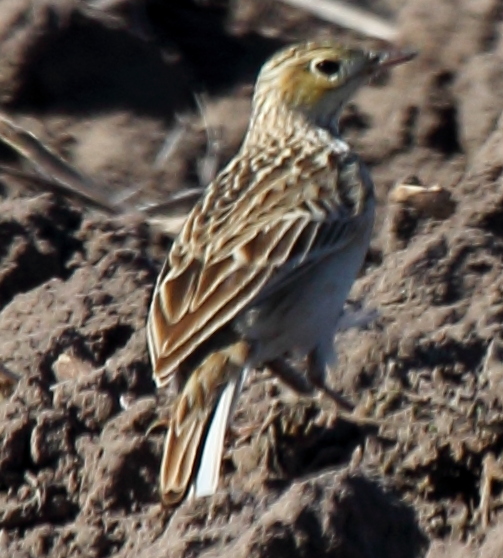
The American Pipit presents a modest appearance with buff-brown upperparts and a paler, streaked underside. Adult plumage features a prominent white eye-ring and a slender, pointed bill ideal for foraging insects. Juveniles resemble adults but tend to display finer streaking on their underparts. Interestingly, there is little sexual dimorphism, meaning males and females look similar, which can complicate field identification.
Distinguishing the American Pipit from similar species can be challenging. It is often confused with the Sprague's Pipit, yet the Sprague's has a more pronounced buffy wash on the underparts and a longer tail. Observing the bird in flight can aid identification: the American Pipit typically exhibits a jerky, undulating flight pattern. Its tail, often noted for its consistent bobbing motion when perched, serves as a useful field mark.
The American Pipit's perching posture is upright, allowing observers to notice the characteristic tail movements and streaking along the flanks. These features, combined with its soft, musical calls, help distinguish it from other small, ground-dwelling birds.
Having trouble telling birds apart? Upload a photo to our bird identification tool for an instant species match.
American Pipit Habitat and Range
Preferred Habitat
The American Pipit thrives in open, expansive habitats where it can forage freely. During breeding, it favors Arctic and alpine tundra environments, such as those found in Alaska's North Slope and the mountain ranges of British Columbia. Here, the barren landscapes provide ample nesting sites and an abundance of insects.
In winter, the American Pipit exhibits remarkable adaptability, occupying coastal beaches, mudflats, and agricultural fields in the southern United States and Mexico. This shift from alpine to lower elevations is driven by the search for food and milder climates. While primarily found in rural settings, the American Pipit occasionally ventures into urban areas, especially in parks and open spaces, during migration.
Its preference for open terrain, devoid of dense vegetation, highlights its reliance on visibility for predator avoidance and food detection. Despite this, it is not uncommon to see the American Pipit in varied settings, reflecting its versatility and resilience in exploiting available resources.
Geographic Range
The American Pipit's breeding range extends across the northern reaches of North America, from the tundra landscapes of Alaska and northern Canada to the alpine zones of the Rocky Mountains. During these months, their distribution is sparse but encompasses a vast geographical area.
Come fall, they embark on an extensive migration southward, traveling across North America to wintering grounds that stretch from the southern United States to Central America. States like Texas and Florida often report significant numbers of these birds during this period. Migration corridors are well established along the Mississippi Flyway, which provides a vital path for safe passage and ample food supply.
Wintering populations are notably dense in coastal areas, where food resources are plentiful. Despite their widespread distribution, localized population densities can vary, with some regions hosting large flocks and others observing only scattered individuals. These patterns reflect both environmental conditions and the availability of resources across their migratory and wintering ranges.
Want to know which birds visit your area? Browse our backyard birds by location guides for region-specific species lists.
What Does the American Pipit Eat?
The American Pipit's diet primarily consists of insects and other invertebrates, which it actively hunts on the ground. During the breeding season in the Arctic tundra, it consumes a variety of prey, including beetles, flies, and spiders, which are abundant in these habitats. The bird's slender bill is ideally adapted for probing into soil and crevices to extract these small creatures.
As winter approaches and the American Pipit migrates to milder climates, its diet diversifies. In addition to insects, it incorporates seeds and small berries, which provide necessary energy during colder months. This dietary flexibility is crucial for survival, given that insect availability can fluctuate with temperature changes.
Foraging typically occurs in open fields and mudflats, where the bird uses a rapid walking pace to cover ground efficiently. Observers often note its distinctive tail bobbing behavior while feeding, a characteristic trait that aids in flushing out hidden prey. Feeding primarily takes place during the day, with peak activity in the morning and late afternoon, aligning with the availability of prey.
American Pipit Behavior and Social Structure
The American Pipit exhibits a range of fascinating behaviors that reflect its adaptability and resourcefulness. Socially, the species is generally seen in small flocks, especially during migration and winter, where group dynamics play a key role in predator avoidance and foraging efficiency. Despite their social tendencies, American Pipits maintain small territories during the breeding season, often engaging in subtle displays to deter intruders.
Courtship involves aerial displays, where males perform song flights to attract females. These flights are characterized by a series of undulating movements accompanied by melodic calls. Once paired, American Pipits exhibit strong monogamous bonds, with both sexes participating in nest building and chick rearing.
Their daily activity patterns are largely diurnal, with foraging beginning shortly after dawn and continuing throughout the day. In the presence of predators, American Pipits rely on their cryptic coloration and swift flight to evade capture. Alarm calls are common, serving to alert conspecifics of potential danger.
Flocking behavior becomes prominent outside the breeding season. Large gatherings can occur at prime feeding sites, with individuals constantly communicating through a series of soft calls. This social structure not only provides safety in numbers but also facilitates information sharing about food sources and threats.
American Pipit Nesting and Reproduction
The nesting habits of the American Pipit reflect its adaptation to open, often harsh environments. Nests are typically constructed on the ground, cleverly hidden among rocks and vegetation to avoid detection by predators. The nest itself is a shallow cup made from grasses, mosses, and lichens, providing both insulation and camouflage.
Clutch size generally ranges from 3 to 7 eggs, with 5 being most common. The eggs are oval-shaped and speckled, blending seamlessly with their surroundings. Incubation lasts approximately 13 to 15 days, a period during which the female remains mostly on the nest while the male supplies food.
Once hatched, the chicks grow rapidly, fledging in about two weeks. During this critical phase, both parents are actively involved in feeding and defending the young. The fledglings are dependent on their parents for several weeks post-fledging, gradually developing foraging skills and independence.
The American Pipit typically raises one brood per year, although favorable conditions can lead to a second. Breeding success largely depends on weather conditions and food availability, factors that dictate the timing and success of the nesting cycle.
American Pipit Sounds and Vocalizations
The American Pipit's vocalizations are an integral part of its communication repertoire. Its primary song consists of a series of high-pitched, melodious notes that rise and fall in quick succession. This song is often delivered during flight, serving as both a territorial display and a courtship signal.
Apart from the main song, American Pipits produce a variety of call notes. These include a soft, descending 'pip-it' call, from which its name derives, used in social interactions and to maintain flock cohesion. Alarm calls are more abrupt and serve to alert others of potential threats, such as predators or human disturbance.
During the dawn chorus, American Pipits can be heard singing persistently, contributing to the symphony of bird songs that characterize early morning in their habitats. The quality of their song is often compared to that of a canary, albeit softer and more rhythmic, adding a melodic element to their presence in the wild.
Interesting Facts About the American Pipit
- 1The American Pipit can travel over 3,000 miles during migration, from Alaska to Central America.
- 2In the Arctic tundra, the American Pipit competes with lemmings and other ground-nesting birds for prime nesting sites.
- 3During the breeding season, American Pipits can sing up to 10 different song variations, showcasing their vocal versatility.
- 4The American Pipit's bobbing tail motion is thought to be a form of communication, signaling to other birds in the flock.
- 5Unlike many other songbirds, the American Pipit forages primarily on the ground, using its long legs to cover large distances.
- 6American Pipits can survive in temperatures as low as -40°F in their Arctic breeding grounds, thanks to their insulated nests.
- 7Their migratory paths often follow mountain ranges and coastlines, which provide necessary resources and navigational aids.
American Pipit Conservation Status
The American Pipit currently holds a status of Least Concern according to the IUCN, with populations considered stable overall. However, specific threats include habitat alteration due to agriculture and climate change, which can impact their breeding and wintering grounds. Conservation efforts focus on habitat preservation, particularly in breeding areas within the Arctic and alpine regions. Monitoring programs aim to track population trends and assess the impact of environmental changes. Historically, the species has shown resilience to fluctuations in numbers, thanks to its wide distribution and adaptability. Continued conservation measures are essential to ensure that the American Pipit remains a common sight across its range. Protecting key habitats and addressing climate-related impacts will be crucial in maintaining healthy populations for future generations.
Other Motacillidae Species


Birds Similar to the American Pipit
These species are often confused with the American Pipit due to similar appearance or overlapping range.

