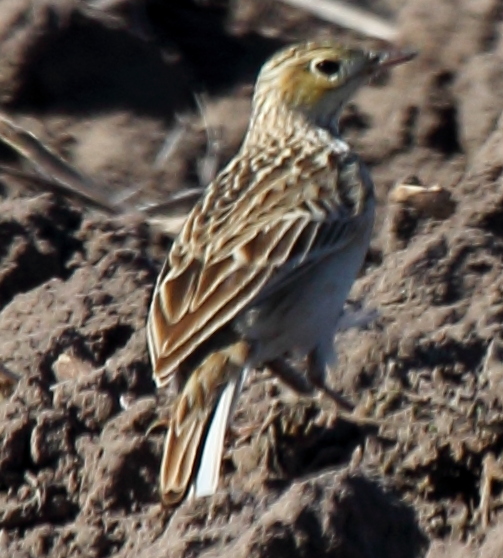
Australian Pipit
Anthus australis
Order: Passeriformes / Family: Motacillidae

Wikimedia Commons
About the Australian Pipit
The Australian Pipit, Anthus australis, stands as a prominent member of the Motacillidae family, showcasing adaptability across a wide range of environments. This bird thrives predominantly in open terrains, including grasslands and agricultural fields, spanning from the coastal regions to the arid interiors of Australia and Tasmania. Noteworthy for its terrestrial lifestyle, the Australian Pipit is often seen foraging on the ground, where it blends seamlessly with its surroundings due to its streaked brown plumage. Its ecological role is significant, as it aids in controlling insect populations, thus maintaining ecosystem balance. During the breeding season, which stretches from August to February, the Australian Pipit exhibits notable changes in behavior and territory defense. Pairs establish breeding territories, often returning to the same location annually, highlighting their site fidelity. Outside the breeding season, these birds may form loose flocks, roaming over larger areas in search of food. The Australian Pipit plays an integral role in its ecosystem by acting as a prey species for larger birds and mammals, thereby contributing to the food web. Its presence across diverse habitats, from the coastal heathlands and grasslands to the arid outback, underscores its adaptability and ecological significance. Observers can find this bird in both rural and urban settings, where it often forages on the edges of roads and fields. Such adaptability, coupled with a broad diet, allows the Australian Pipit to thrive in a range of environments, making it a fascinating subject for bird enthusiasts and researchers alike.
The Australian Pipit belongs to the family Motacillidae, within the order Passeriformes. These birds typically live typically 3-5 years, with some living up to 7 years..
How to Identify a Australian Pipit
The Australian Pipit exhibits a slender, long-tailed profile, making it easily recognizable. Adults display a streaked brown upper body with a paler underside, providing effective camouflage in their natural habitat. The bird's buff-colored breast with distinct streaking helps distinguish it from similar species. Juveniles appear similar to adults but may have slightly paler plumage, lacking the well-defined streaks of the mature birds. Male and female Australian Pipits are largely similar in appearance, making sexual dimorphism minimal. When comparing to similar species such as the Eurasian Skylark, the Australian Pipit is more uniformly streaked and lacks the Skylark's crest. In flight, the Australian Pipit's silhouette is characterized by its slender body and long tail, which it often flicks while foraging. Its perching posture is upright, often on rocks or fence posts, which aids in scanning for prey and predators alike. This combination of field marks makes the Australian Pipit a distinguishable species for bird watchers.
Having trouble telling birds apart? Upload a photo to our bird identification tool for an instant species match.
Australian Pipit Habitat and Range
Preferred Habitat
The Australian Pipit inhabits a wide range of open environments, including grasslands, agricultural fields, and coastal heathlands. It is commonly found from sea level up to 1,500 meters in elevation. This bird shows a preference for areas with sparse vegetation, which facilitates ground foraging. During the breeding season, the Australian Pipit often selects undisturbed grassy areas for nesting. In urban settings, it can be observed in parks and open spaces adjacent to human activity. Seasonal habitat shifts are minimal, as this species is largely sedentary. However, some local movements occur in response to food availability and climatic conditions. The bird's presence in both rural and urban areas underscores its adaptability and resilience.
Geographic Range
The Australian Pipit is predominantly found across mainland Australia and Tasmania. Its range extends from the coastal regions of New South Wales and Queensland to the arid interior of Western Australia and the Northern Territory. Although largely sedentary, some populations may exhibit nomadic behavior in response to environmental conditions. The bird's range also includes parts of Papua New Guinea and nearby islands, where it occupies similar open habitats. Population density is highest in regions with abundant grassland and agricultural areas, such as the southeastern states of Victoria and South Australia. The Australian Pipit's adaptability to various environments ensures its widespread distribution across the continent.
Want to know which birds visit your area? Browse our backyard birds by location guides for region-specific species lists.
What Does the Australian Pipit Eat?
The Australian Pipit primarily feeds on insects and other small invertebrates, which it actively forages for on the ground. Its diet includes beetles, grasshoppers, ants, and spiders, varying with seasonal availability. During wetter months, the bird may consume more insects, while seeds and plant material make up a larger portion of its diet during drier periods. The Australian Pipit employs a 'stop-start' foraging technique, characterized by short bursts of running, followed by pauses to scan and pick prey from the ground. This method allows it to efficiently exploit a variety of food sources across its range. Feeding activity peaks during the early morning and late afternoon when insects are most active, although the bird may forage throughout the day.
Australian Pipit Behavior and Social Structure
The Australian Pipit displays a range of behaviors adapted to its open habitat lifestyle. It is predominantly solitary or found in pairs during the breeding season, establishing and defending territories to attract mates and rear young. Courtship displays involve the male performing aerial songs and displaying on elevated perches to attract females. Outside the breeding season, the Australian Pipit may join loose flocks, enhancing foraging efficiency and predator vigilance. It exhibits a unique tail-wagging behavior while foraging, a characteristic trait that aids in identifying the species. When threatened by predators, the Australian Pipit relies on its cryptic plumage and a swift, low flight to evade capture. Its daily activity pattern primarily involves active foraging during daylight hours, with peak activity in the cooler parts of the day. The bird's social structure, territoriality, and adaptive behaviors are key elements of its ecological success.
Australian Pipit Nesting and Reproduction
The Australian Pipit constructs its nest on the ground, typically hidden among grass tussocks or low vegetation. Nests are cup-shaped and built from grasses and plant stems, lined with finer materials for insulation. The female lays a clutch of 3-4 eggs, which she incubates for about 14 days. During this period, the male plays a supportive role, providing food and defending the territory. Once hatched, the chicks remain in the nest for approximately 14-15 days before fledging. Both parents share in feeding and caring for the young until they become independent. The Australian Pipit typically raises one to two broods per year, depending on environmental conditions and food availability. Nesting success is influenced by predation rates and habitat quality, with well-concealed nests having higher survival rates.
Australian Pipit Sounds and Vocalizations
The Australian Pipit's primary song is a series of high-pitched, melodic notes delivered during flight or from a perch. This song is rhythmic and can be likened to a soft, repetitive whistle, serving both to attract mates and establish territory. Call notes consist of short, sharp 'seep' sounds, often used for communication between individuals or to signal alarm. Alarm calls become more frequent in the presence of predators, alerting other pipits to potential danger. During the dawn chorus, the Australian Pipit contributes with its distinctive song, adding to the symphony of bird calls that define Australia's open landscapes.
Interesting Facts About the Australian Pipit
- 1The Australian Pipit can often be seen performing a characteristic tail-wagging behavior while foraging, a trait that aids in identifying the species.
- 2Despite being ground-dwelling, the Australian Pipit is capable of strong flight, which it uses to escape predators and during courtship displays.
- 3The species displays remarkable site fidelity, often returning to the same breeding territories year after year.
- 4Australian Pipits have been known to mimic calls of other bird species, adding complexity to their vocalizations.
- 5Their diet shifts seasonally, allowing them to exploit a wide range of food sources throughout the year.
- 6The Australian Pipit's song is a key component of the dawn chorus, contributing to the rich acoustic landscape of its habitat.
- 7These birds are highly adaptable, thriving in environments ranging from coastal heathlands to arid interiors.
Australian Pipit Conservation Status
The Australian Pipit is currently listed as Least Concern by the IUCN, with a stable population trend. Its widespread distribution and adaptability to various habitats contribute to its resilience. However, primary threats include habitat loss due to agricultural expansion and urbanization. Conservation efforts focus on preserving open grassland habitats and mitigating the impact of land development. Historically, the population has remained relatively stable, although localized declines may occur in response to habitat degradation. Continued monitoring and habitat conservation are essential to ensure the long-term survival of this adaptable species.