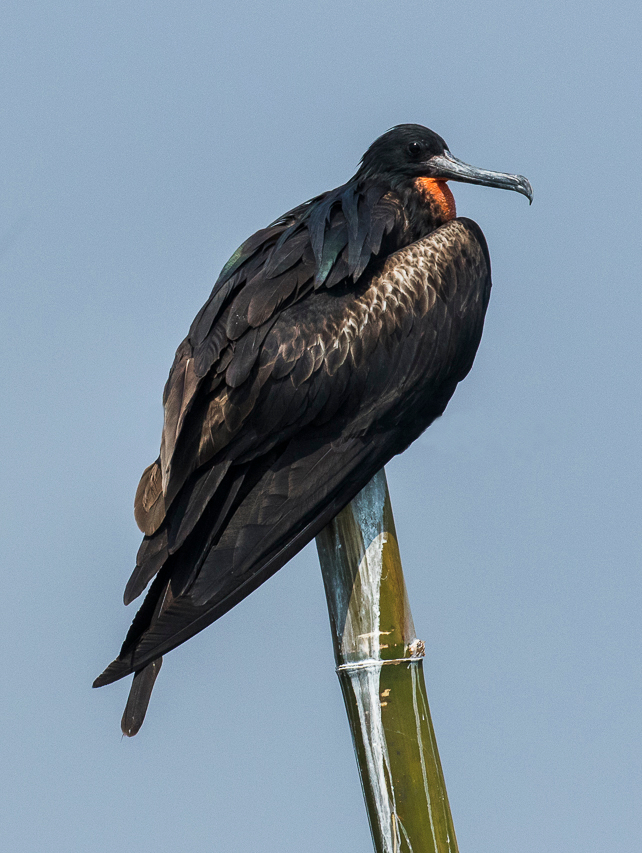
Ascension Frigatebird
Fregata aquila
Order: Suliformes / Family: Fregatidae

Wikimedia Commons
About the Ascension Frigatebird
The Ascension Frigatebird, Fregata aquila, commands attention with its long wings and forked tail, features that make it a masterful aerial navigator. Found primarily on Ascension Island, located in the South Atlantic Ocean, this seabird represents a critical component of the island's ecosystem. The bird's role extends beyond mere presence; it influences the dynamics of its prey populations and competes with other seabirds, thus maintaining ecological balance.
As a member of the Fregatidae family, the Ascension Frigatebird is renowned for its distinctive feeding behavior, often involving kleptoparasitism, where it harasses other seabirds to steal their catch. This strategy supports its survival in the nutrient-scarce tropical oceans surrounding Ascension Island. The bird's significance is heightened by its limited breeding range, which is confined to the rocky outcrops and sparse vegetation of the island.
Ecologically, the Ascension Frigatebird plays a vital role in nutrient cycling. Its guano enriches the nutrient-poor volcanic soils of the island, supporting plant life that provides cover and nesting sites for other species. During the breeding season, these birds gather in large colonies, creating dynamic interactions and contributing to the island's biodiversity.
Throughout the year, the Ascension Frigatebird exhibits seasonal behaviors that reflect its adaptation to the tropical climate. During the breeding season, which peaks around May and June, these birds engage in elaborate courtship displays. Outside of this period, they can be seen soaring over the open ocean, often thousands of kilometers away from their breeding grounds, demonstrating their extensive range and adaptability.
The Ascension Frigatebird belongs to the family Fregatidae, within the order Suliformes. These birds typically live typically around 30 years, with some individuals reaching 40 years..
How to Identify a Ascension Frigatebird
The Ascension Frigatebird is large with a wingspan reaching up to 2.3 meters, making it one of the most noticeable seabirds. Adults exhibit a predominantly black plumage that shimmers with a metallic sheen under sunlight. Males are distinguished by their striking red gular sac, which they inflate during courtship displays. Females, slightly larger, possess a white breast patch and lack the vibrant gular sac, distinguishing them from their male counterparts.
Juvenile Ascension Frigatebirds differ from adults with their paler plumage, featuring white heads and underparts which gradually darken as they mature. This coloration can cause confusion with juvenile frigatebirds of other species, but the specific pattern and size help in accurate identification.
In flight, the Ascension Frigatebird's silhouette is unmistakable. The elongated wings and deeply forked tail create a unique profile against the sky. When perched, these birds display a characteristic posture, often resting on rocky outcrops or sparse vegetation with an alert demeanor, scanning for potential prey or competitors.
Having trouble telling birds apart? Upload a photo to our bird identification tool for an instant species match.
Ascension Frigatebird Habitat and Range
Preferred Habitat
The Ascension Frigatebird inhabits tropical marine environments, primarily within the confines of Ascension Island. This bird prefers nesting on steep rocky cliffs and barren volcanic slopes, where it has access to the open ocean's thermal currents. These areas, often devoid of dense vegetation, allow for easy take-off and landing, crucial for a bird of its size.
While the Ascension Frigatebird is predominantly found in coastal environments, it is not uncommon to observe these birds soaring over the vast open ocean. They rarely venture into urban areas or inland regions, maintaining a strong affinity for their marine habitats.
Seasonal shifts in habitat are minimal due to the bird's year-round residency on Ascension Island. However, during non-breeding periods, they may expand their foraging range extensively, exploiting the rich fishing grounds created by oceanic upwellings.
Geographic Range
The Ascension Frigatebird's breeding range is restricted to the isolated Ascension Island, part of the British Overseas Territories. This remote location provides a safe haven from mainland predators but also limits the bird's geographic distribution.
During non-breeding periods, the Ascension Frigatebird exhibits remarkable dispersal abilities, often traveling vast distances across the tropical Atlantic Ocean. While they do not follow traditional migratory patterns, individuals have been recorded far from their breeding sites, sometimes reaching the coastlines of Brazil and West Africa.
Population density of the Ascension Frigatebird is highest around Ascension Island, where they establish large breeding colonies. Their presence on the island is critical for maintaining a stable population, as they rely heavily on this habitat for reproduction and chick rearing.
Want to know which birds visit your area? Browse our backyard birds by location guides for region-specific species lists.
What Does the Ascension Frigatebird Eat?
The Ascension Frigatebird primarily feeds on fish and squid, which it captures near the ocean surface. It employs a technique known as surface dipping, swooping down to snatch prey with its hooked bill while in flight. This feeding strategy is complemented by kleptoparasitism, where the bird harasses other seabirds, such as boobies and terns, forcing them to relinquish their catch.
The bird’s diet shows little seasonal variation due to the consistent availability of marine resources around Ascension Island. However, during the breeding season, adults may increase their feeding frequency to meet the nutritional demands of their chicks.
Prey size typically ranges from small fish to medium-sized squid, with the Ascension Frigatebird's adept maneuverability allowing it to exploit a wide range of prey types across the ocean's surface. Their foraging activity peaks during the cooler parts of the day, such as early morning and late afternoon, when prey is more abundant near the surface.
Ascension Frigatebird Behavior and Social Structure
The Ascension Frigatebird exhibits highly social and gregarious behavior, particularly during the breeding season when they form large colonies. These colonies are sites of complex social interactions, with birds engaging in elaborate courtship displays that include gular sac inflation and aerial acrobatics to attract mates.
Once paired, the birds demonstrate strong pair bonds, with both parents investing heavily in nest building and chick rearing. They are highly territorial around their nests, often engaging in aggressive displays to ward off intruders.
Outside the breeding season, Ascension Frigatebirds spend much of their time soaring over the open ocean, utilizing thermals and their exceptional gliding ability to cover vast distances with minimal energy expenditure. Despite their aggressive feeding tactics, they are rather timid when confronted by potential predators, opting to retreat rather than engage.
Daily activity patterns of the Ascension Frigatebird include long periods of flight interspersed with resting and preening sessions, usually at secure roosting sites. They display heightened activity during the cooler hours, aligning their foraging with optimal prey availability.
Ascension Frigatebird Nesting and Reproduction
Ascension Frigatebirds construct simple nests made primarily of sticks and guano, placed on rocky ledges or flat volcanic surfaces. Their nest sites are typically located in inaccessible areas, providing protection from terrestrial predators and harsh weather conditions.
The typical clutch size consists of a single egg, which both parents incubate for about 50-55 days. This cooperative incubation is crucial due to the harsh environmental conditions of their breeding grounds. Once hatched, the chick remains in the nest for approximately 150 days before fledging.
Parental care extends beyond fledging, with parents continuing to feed and protect their young until they are capable of independent flight and foraging. The species is known for its low reproductive rate, with only one brood per year, emphasizing the importance of high parental investment to ensure chick survival.
Ascension Frigatebird Sounds and Vocalizations
The Ascension Frigatebird is relatively silent compared to many other bird species. Its vocalizations are primarily limited to soft grunts and whistles used during courtship displays and interactions within breeding colonies. These sounds lack the musicality of songbirds, instead serving functional communication roles within the colony.
Alarm calls are rare and subdued, given the bird's preference for retreat over confrontation. During the dawn chorus, the breeding colonies become more active, with increased vocal exchanges often accompanying the visual displays of inflated gular sacs and wing flapping.
The lack of a complex song repertoire aligns with the Ascension Frigatebird’s solitary oceanic lifestyle, where visual cues are more important than acoustic signals.
Interesting Facts About the Ascension Frigatebird
- 1The Ascension Frigatebird can travel over 2,000 kilometers without landing, riding air currents and thermals to conserve energy.
- 2Unlike most seabirds, the Ascension Frigatebird lacks waterproof plumage, relying on aerial agility rather than diving for food.
- 3Ascension Frigatebirds can live up to 30 years in the wild, a testament to their adaptability and survival skills in challenging environments.
- 4The bird’s red gular sac, used in courtship displays, can take several years to fully develop in young males, adding to their breeding success.
- 5Ascension Island, the only breeding ground for this species, was once heavily impacted by human activity, but restoration efforts have helped the frigatebird population stabilize.
- 6Ascension Frigatebirds have one of the longest periods of parental care among birds, with chicks relying on parents for food for up to a year.
- 7Their aerial piracy tactics are so effective that they often steal more than half of their food from other seabirds.
Ascension Frigatebird Conservation Status
The Ascension Frigatebird is listed as Vulnerable on the IUCN Red List. Its population faces pressures from invasive species, habitat loss, and human disturbances. Historical declines were largely due to introduced predators on Ascension Island, which have since been eradicated through conservation efforts, allowing some population recovery. Current threats include habitat degradation and climate change, which impact the availability of suitable nesting sites and prey abundance. Conservation measures focus on habitat protection, invasive species management, and continuous monitoring of population trends. Despite these efforts, the Ascension Frigatebird's restricted range and limited breeding sites make it inherently vulnerable to environmental changes, necessitating ongoing conservation vigilance to ensure its long-term survival.