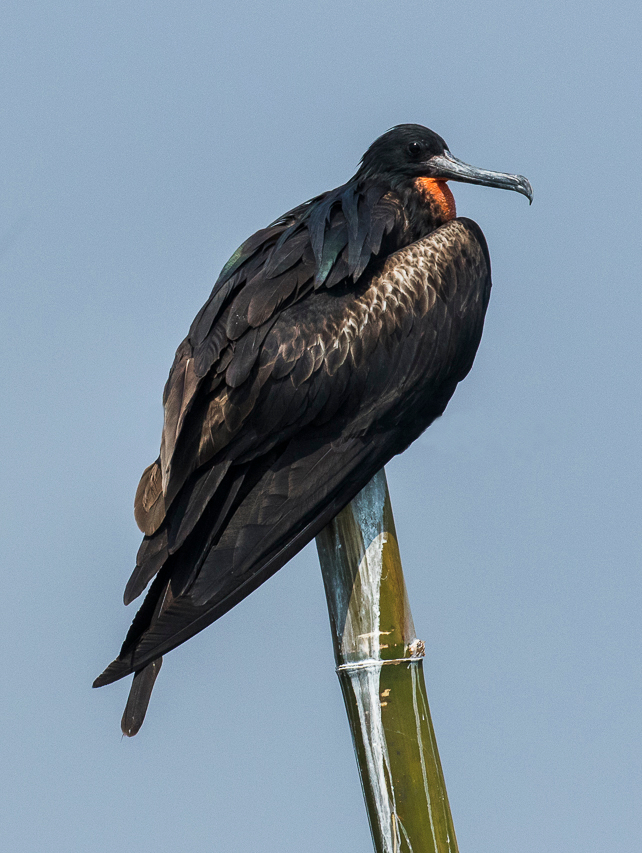
Great Frigatebird
Fregata minor
Order: Suliformes / Family: Fregatidae

Wikimedia Commons
About the Great Frigatebird
The Great Frigatebird, Fregata minor, is a remarkable seabird known for its incredible ability to soar effortlessly over vast oceanic expanses. Belonging to the family Fregatidae, this bird exhibits a unique combination of grace and predatory prowess, characteristics that distinguish it in tropical and subtropical marine environments. Often sighted in the tropical Pacific and Indian Oceans, including the Galapagos Islands, the Great Frigatebird thrives in coastal regions, where its presence as an apex aerial predator plays an essential role in the marine ecosystem. The species is most famous for its kleptoparasitic behavior, wherein it harasses other seabirds to regurgitate their catch. This opportunistic feeding strategy highlights its ecological niche and adaptive success in competitive marine environments. Despite its predatory habits, the Great Frigatebird also contributes to nutrient cycling within its habitat, impacting the distribution and availability of resources for other marine organisms. During breeding seasons, colonies of Great Frigatebirds become bustling centers of activity. On remote islands like Christmas Island and Henderson Island, these birds engage in elaborate courtship displays. Males inflate their bright red gular pouches, creating a striking visual spectacle that is essential for attracting mates. The breeding success of the Great Frigatebird depends heavily on these displays and the availability of suitable nesting sites. Throughout the year, the Great Frigatebird exhibits distinct seasonal behaviors, including extensive post-breeding dispersal over open oceans. Unlike many seabirds, the Great Frigatebird rarely rests on water due to its poorly waterproofed plumage. Instead, it utilizes rising thermals and wind currents to remain airborne for extended periods. This adaptation not only conserves energy but also enables the bird to cover large distances in search of food and favorable environmental conditions. As a symbol of both beauty and resilience, the Great Frigatebird plays a pivotal role in maintaining the ecological balance of its marine habitat. Its presence serves as an indicator of ocean health, reflecting changes in fish populations and environmental conditions. Conservation efforts aimed at protecting this species contribute to broader marine conservation initiatives, underscoring the interconnectedness of oceanic ecosystems and the need for comprehensive environmental stewardship.
The Great Frigatebird belongs to the family Fregatidae, within the order Suliformes. These birds typically live typically 30 years, with some living up to 40 years..
How to Identify a Great Frigatebird
The Great Frigatebird is easily recognizable by its large size and distinctive silhouette. Adults boast an impressive wingspan reaching up to 2.3 meters, with long, pointed wings and a deeply forked tail, which assist in their extraordinary flight capabilities. Males are primarily black, with a vivid red gular pouch that they inflate during courtship displays. In contrast, females exhibit a striking white breast and belly, providing a stark contrast to their otherwise dark plumage. Juveniles differ from adults by having a white head and more extensive white markings on their underparts, which gradually darken as they mature. These features help differentiate them from similar species like the Magnificent Frigatebird, which lacks the distinct white belly in females. While in flight, the bird's slim profile and elongated wings are its defining characteristics. Their flight pattern is buoyant and almost effortless, often gliding on thermals with minimal wing flapping. When perched, which occurs infrequently, the Great Frigatebird appears hunched, with wings neatly folded along its body and tail fanned. This posture is quite different from their typical airborne elegance, providing a unique vantage point for observing their distinctive features.
Having trouble telling birds apart? Upload a photo to our bird identification tool for an instant species match.
Great Frigatebird Habitat and Range
Preferred Habitat
The Great Frigatebird predominantly inhabits tropical and subtropical regions, favoring remote islands and coastal areas. These habitats provide the open sea and isolated nesting sites essential for their lifestyle. Examples include the Galapagos Islands, Seychelles, and parts of Australia, where they establish large breeding colonies. The species is often found at sea, soaring above the ocean surface, sometimes several hundred kilometers from the nearest land. Unlike many seabirds, the Great Frigatebird does not rest on the water, instead relying on the air currents of the open ocean. Seasonal habitat shifts are minimal, as the bird is largely sedentary within its tropical range. However, juveniles and non-breeding individuals may disperse widely, exploring new areas in search of food and safe resting sites. The Great Frigatebird is rarely seen in urban settings, as its reliance on marine environments dictates its presence away from human developments.
Geographic Range
The Great Frigatebird's range spans tropical and subtropical oceans worldwide, with notable breeding populations in the Pacific and Indian Oceans. Key breeding sites include the Galapagos Islands, Christmas Island, and the Hawaiian Islands. These regions provide the isolated nesting sites necessary for reproductive success. Outside the breeding season, the Great Frigatebird disperses widely across the ocean. While they do not undertake long-distance migrations akin to some seabird species, they can cover vast oceanic distances during non-breeding periods. Population density is highest near major breeding colonies, where suitable nesting and feeding conditions abound. However, their wide-ranging dispersal sees them occasionally across the waters of the South Pacific and Indian Oceans, extending as far as the eastern coasts of Africa and the western shores of the Americas.
Want to know which birds visit your area? Browse our backyard birds by location guides for region-specific species lists.
What Does the Great Frigatebird Eat?
The diet of the Great Frigatebird primarily consists of fish and squid, which it captures near the ocean surface. The bird employs a variety of foraging techniques, the most distinctive being kleptoparasitism, where it harasses other seabirds to steal their catch. This strategy allows it to exploit the hunting efforts of species like boobies and terns. When hunting independently, the Great Frigatebird exhibits impressive agility, skimming the water's surface to snatch prey with its bill. Its keen eyesight allows it to spot fish shoals or squid from high altitudes, swooping down with precision. Seasonal diet changes are minimal, as the bird's reliance on marine resources remains constant year-round. However, fluctuations in prey availability may influence local feeding behaviors and foraging areas. The Great Frigatebird typically hunts during daylight hours, taking advantage of optimal lighting conditions for spotting prey.
Great Frigatebird Behavior and Social Structure
Socially, the Great Frigatebird displays complex interactions, especially during the breeding season. Colonies are bustling with activity, with males engaging in elaborate courtship displays to attract females. The inflated red gular pouch and accompanying drumming sounds are central to these displays, creating a dramatic visual and auditory spectacle. Territorial behavior is pronounced during breeding, with males defending their display sites aggressively. Despite this, the Great Frigatebird is relatively non-aggressive outside of the breeding context, often seen soaring alone or in loose flocks. Their response to predators, such as raptors or humans, involves quick evasive maneuvers, utilizing their agile flight capabilities. Daily activity patterns revolve around foraging, with birds spending significant time aloft, sometimes remaining airborne for days. Although largely solitary in flight, they exhibit communal roosting behavior, congregating on suitable perches at night.
Great Frigatebird Nesting and Reproduction
The Great Frigatebird constructs nests primarily on remote islands, utilizing bushes or low trees to support their simple stick nests. These nests are often part of large colonies, sometimes shared with other seabird species. Nesting sites are chosen for their isolation from predators and proximity to food resources. The clutch size typically consists of a single egg, which both parents incubate over a period of approximately 55 days. After hatching, the chick remains in the nest for several months, relying entirely on parental care for food and protection. Fledging occurs at around 4-6 months, but young birds continue to receive parental assistance for several weeks post-fledging. The Great Frigatebird produces one brood per year, with reproductive success closely linked to environmental conditions and food availability.
Great Frigatebird Sounds and Vocalizations
The Great Frigatebird's vocalizations are most prominent during courtship displays. Males produce a rhythmic drumming sound by vibrating their inflated gular pouch, accompanied by mechanical clicks created with their bills. These sounds serve to attract females and assert dominance over display territories. Call notes outside of the breeding season are rare, as the bird is generally silent while soaring. Alarm calls, when given, consist of sharp cackles or squawks used to warn of potential threats. Unlike songbirds, the Great Frigatebird lacks a true song, relying instead on these distinct sounds for communication. The absence of a dawn chorus behavior reflects their pelagic lifestyle, where vocal communication is less critical than in terrestrial environments.
Interesting Facts About the Great Frigatebird
- 1The Great Frigatebird can remain airborne for over a week without landing, thanks to its ability to sleep while flying.
- 2Its wingspan can exceed 2.3 meters, making it one of the longest-winged birds relative to body weight.
- 3The Great Frigatebird's gular pouch is one of the most striking courtship features in the avian world.
- 4Despite its maritime lifestyle, the Great Frigatebird cannot swim and avoids landing on water.
- 5Breeding colonies can consist of thousands of individuals, creating a spectacular sight on remote islands.
- 6The species exhibits sexual dimorphism, with males and females displaying markedly different plumage.
- 7Frigatebirds have the largest wingspan-to-body-weight ratio of any bird, enhancing their soaring efficiency.
Great Frigatebird Conservation Status
The IUCN currently lists the Great Frigatebird as Least Concern, with a generally stable population trend. However, localized threats like habitat destruction, human disturbance, and introduced predators on breeding islands pose significant challenges. Conservation efforts focus on habitat protection and the eradication of invasive species from key breeding sites. Historical population changes have seen declines in some regions due to these threats, but ongoing conservation initiatives aim to support population resilience. Protecting the Great Frigatebird also benefits broader marine ecosystems, emphasizing the species' role as an ecological indicator.