
Magnificent Frigatebird
Fregata magnificens
Order: Suliformes / Family: Fregatidae

Wikimedia Commons
About the Magnificent Frigatebird
The Magnificent Frigatebird (Fregata magnificens) is a master of the skies, effortlessly cruising over tropical and subtropical oceans. As a member of the Fregatidae family, this seabird is renowned for its aerial prowess, boasting one of the largest wingspans relative to body weight among birds. Found primarily along the Atlantic and Pacific coasts of the Americas, from the southern United States to northern Argentina and across the Caribbean, this species plays a significant role in coastal ecosystems. The Magnificent Frigatebird is especially notable for its kleptoparasitic behavior, often seen harassing other seabirds to steal their catch. This opportunistic feeding strategy highlights its adaptability and ecological significance. During the breeding season, which typically occurs on isolated islands and coastal mangroves, males display their striking red gular sacs to attract mates. These displays, coupled with their aerial feats, make them a symbol of tropical seascapes. Outside the breeding season, Magnificent Frigatebirds are known to travel long distances, sometimes crossing entire ocean basins. Their ecological role extends beyond their striking appearance and fascinating behavior. As apex aerial predators, they help maintain balanced fish and seabird populations, indirectly supporting the health of coral reef systems by controlling prey species that may otherwise overgraze algae. The seasonal movements of the Magnificent Frigatebird reflect a deep understanding of the ocean's rhythms, allowing them to exploit seasonal upwellings and fish spawning events. Their presence often indicates the health of marine environments, serving as an indicator species for conservationists. The bird's reliance on thermals and their ability to stay aloft for extended periods without flapping showcases an evolutionary marvel, perfectly adapted to life on the wing. Encounters with these birds often leave observers in awe of their grace and dominance of the airspace over vast ocean expanses.
The Magnificent Frigatebird belongs to the family Fregatidae, within the order Suliformes. These birds typically live average lifespan is around 15-25 years, with some individuals living up to 40 years..
How to Identify a Magnificent Frigatebird
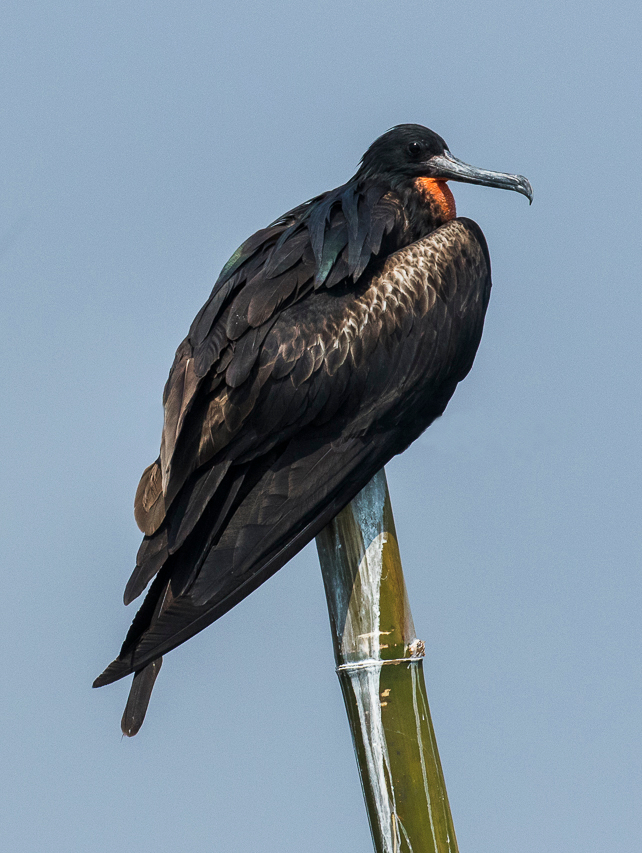
Magnificent Frigatebirds are easily identified by their striking silhouette, featuring long, angular wings and a deeply forked tail. Adult males exhibit a glossy black plumage with an unmistakable red gular sac, which they inflate during courtship displays. Females, while also predominantly black, can be distinguished by their white breast and shoulder patches. Juveniles have a white head and underparts, gradually acquiring the adult's black plumage over several years. In flight, their slender bodies and expansive wings give them a distinctive, buoyant flight pattern. Perched, their long wings often extend beyond their tail, an unusual feature among birds. Confusion may arise with other frigatebird species, but the Magnificent Frigatebird's size and range typically set it apart. Observers should note the absence of webbed feet, a unique trait among seabirds, which underscores their reliance on aerial hunting rather than swimming.
Having trouble telling birds apart? Upload a photo to our bird identification tool for an instant species match.
Magnificent Frigatebird Habitat and Range
Preferred Habitat
Magnificent Frigatebirds inhabit tropical and subtropical oceanic waters, often found soaring above coastlines, coral reefs, and lagoons. They prefer nesting on remote islands with sparse vegetation, particularly mangroves and shrubs. While primarily coastal, they occasionally venture inland when following rivers or wind patterns. These birds avoid densely wooded areas, relying instead on open skies. Seasonal habitat shifts are influenced by breeding cycles and food availability, with some populations undertaking transoceanic journeys to exploit distant feeding grounds.
Geographic Range
The breeding range of the Magnificent Frigatebird extends along the tropical Atlantic and Pacific Oceans, including the Gulf of Mexico, Caribbean islands, and the Galápagos Islands. During the non-breeding season, they disperse widely across tropical and subtropical waters, sometimes reaching as far north as California and as far south as Brazil. Key migration corridors include the coastlines of Central and South America, with notable population densities near the Yucatán Peninsula and the Amazon River mouth.
Want to know which birds visit your area? Browse our backyard birds by location guides for region-specific species lists.
What Does the Magnificent Frigatebird Eat?
The diet of the Magnificent Frigatebird primarily consists of fish and squid, which they snatch from the ocean surface. They may also feed on crustaceans and jellyfish. Seasonal changes in prey abundance lead to shifts in their diet, with some populations relying heavily on flying fish during certain periods. The bird's foraging technique involves agile aerial maneuvers and precise timing to capture prey without landing. Opportunistic kleptoparasitism, where they harass other seabirds to drop or regurgitate their catch, supplements their diet. They typically feed during daylight hours, capitalizing on the abundance of surface-dwelling prey.
Magnificent Frigatebird Behavior and Social Structure
Magnificent Frigatebirds exhibit solitary and social behaviors, often seen alone or in pairs but also forming loose colonies during breeding. Their courtship displays are elaborate, with males inflating their red gular sacs and performing aerial acrobatics to attract females. These birds are non-territorial in feeding areas but show competitive behavior at breeding sites. Flocking patterns vary seasonally, with larger gatherings at food-rich locales. Despite their aerial dominance, they are vulnerable to predators when nesting, relying on dense foliage and remote locations for protection. Their daily activity revolves around soaring and foraging, with minimal time spent on land.
Magnificent Frigatebird Nesting and Reproduction
Nesting for the Magnificent Frigatebird occurs on isolated islands, with nests built in shrubs or trees, often using sticks and vegetative debris. The typical clutch consists of a single egg, with both parents sharing incubation duties over approximately 50 days. Post-hatching, the chick remains in the nest for around 4 to 6 months, receiving extensive parental care. Only one brood is raised per year, reflecting the significant investment required for successful fledging. Parental roles are clearly defined, with females providing the majority of post-fledging care.
Magnificent Frigatebird Sounds and Vocalizations
While the Magnificent Frigatebird is generally silent, it possesses a repertoire of sounds primarily used during breeding. Males produce a low, rattling drum sound when displaying, created by vibrating the gular sac. Females and chicks communicate through soft croaks and hisses, especially during feeding. Alarm calls are harsh and abrupt, alerting colony members to potential threats. The lack of a melodic song distinguishes them from many other avian species, aligning with their largely solitary lifestyle.
Interesting Facts About the Magnificent Frigatebird
- 1The Magnificent Frigatebird's wingspan can exceed 7 feet, yet it weighs only about 3 pounds.
- 2Frigatebirds have the lowest wing load of any bird, allowing them to soar for weeks over the ocean.
- 3They cannot swim, land on water, or take off from it, a rarity for seabirds.
- 4Their gular sac, used in courtship, can take weeks to deflate after the breeding season.
- 5The Magnificent Frigatebird can stay aloft for up to two months, gliding on thermals and wind currents.
- 6Frigatebirds lack the waterproofing seen in most seabirds, which helps reduce their weight and aids in flight.
- 7They can live over 30 years, a testament to their successful adaptation to marine life.
Magnificent Frigatebird Conservation Status
The Magnificent Frigatebird is currently classified as Least Concern by the IUCN, with populations considered stable. However, threats such as habitat destruction, climate change, and human disturbance pose ongoing risks. Conservation efforts focus on protecting breeding habitats and minimizing human impact on nesting sites. Historically, populations have fluctuated with environmental changes, underscoring the need for continued monitoring and habitat preservation.
Other Fregatidae Species


Birds Similar to the Magnificent Frigatebird
These species are often confused with the Magnificent Frigatebird due to similar appearance or overlapping range.
