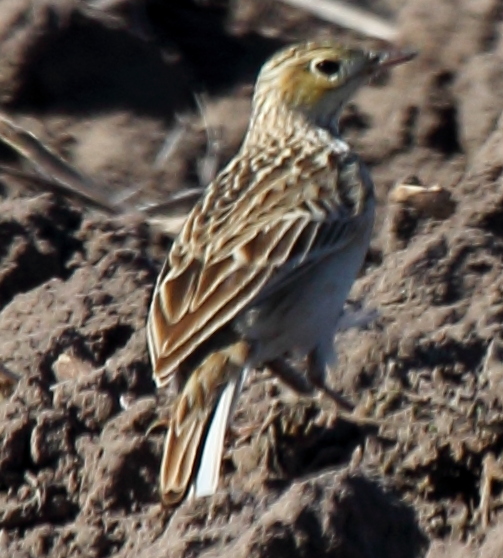
Australasian Pipit
Anthus novaeseelandiae
Order: Passeriformes / Family: Motacillidae

Wikimedia Commons
About the Australasian Pipit
The Australasian Pipit, Anthus novaeseelandiae, is a small passerine bird that inhabits a wide range of environments across Australasia. This species plays a significant role in its ecosystem, acting as both predator and prey. The pipit is known for its adaptability, thriving in diverse habitats from grasslands to coastal areas. Found predominantly in New Zealand and Australia, it has also been recorded in nearby islands. The bird's presence is a common sight in open fields and along roadways, where it can be observed foraging for insects. Its ecological role involves controlling insect populations, thus maintaining a balance within its habitat.
The Australasian Pipit exhibits notable seasonal behaviors, adjusting its diet and foraging patterns in response to environmental conditions. During warmer months, the pipit primarily consumes insects and other invertebrates, while in colder seasons, it may supplement its diet with seeds. This adaptability ensures its survival across a broad range of climates and terrains. The pipit also serves as prey for larger birds of prey, mammals, and reptiles, highlighting its integral position within the food web.
As a species, the Australasian Pipit is not currently under threat, and it holds a stable position within its range. Its presence is a key indicator of environmental health, as the species is sensitive to habitat changes. Conservation efforts focus on preserving open habitats and mitigating threats such as habitat destruction and predation by invasive species. The pipit's widespread distribution and adaptability make it a resilient member of the avian community, contributing to its prominence in the regions it inhabits.
The Australasian Pipit belongs to the family Motacillidae, within the order Passeriformes. These birds typically live average 3-5 years, with a maximum recorded of 8 years.
How to Identify a Australasian Pipit
The Australasian Pipit, or Anthus novaeseelandiae, can be identified by its streaked brown upperparts and lighter underparts, providing excellent camouflage in its grassy habitats. Adults exhibit a subtle pale eyebrow stripe and a finely streaked crown, with variations in plumage intensity depending on geographic location. Juveniles resemble adults but often have fresher, more defined streaking. There are no significant differences between male and female pipits.
When observing the pipit in flight, look for its distinct undulating pattern, typical of many pipits. Its long legs and tail are noticeable as it flies low over open ground. The pipit's perching posture is characteristic, often accompanied by a constant tail-bobbing motion. This behavior, along with its ground-dwelling habits, aids in distinguishing it from similar species such as the Skylark, which has a more robust build and a crested appearance.
Confusion may arise with other pipit species, especially during migration, but the Australasian Pipit's unique combination of subtle plumage features and behaviors serve as reliable identification markers. Its preference for open habitats over woodland or dense shrubbery also helps in differentiating it from forest-dwelling relatives.
Having trouble telling birds apart? Upload a photo to our bird identification tool for an instant species match.
Australasian Pipit Habitat and Range
Preferred Habitat
The Australasian Pipit occupies a variety of habitats, preferring open landscapes such as grasslands, coastal dunes, and agricultural fields. It can be found from sea level up to alpine zones, demonstrating its adaptability to different elevations. In New Zealand, it is common in pastoral lands and tussock grasslands, while in Australia, it is often seen in open woodlands and along the edges of wetlands.
Seasonal habitat shifts are minimal, but during breeding seasons, pipits may favor areas with low vegetation, providing both cover and visibility for foraging and nesting. In urban areas, they are occasionally spotted in parks and large gardens, though they are less common in densely populated settings. The pipit's presence in rural regions is more pronounced, where vast expanses of suitable habitat support higher densities.
Overall, the Australasian Pipit is a versatile species, able to exploit a range of environments, but it shows a clear preference for open, grassy areas where it can forage with ease and spot approaching predators.
Geographic Range
The Australasian Pipit is primarily found in New Zealand and across mainland Australia, including Tasmania. In New Zealand, it inhabits both the North and South Islands, as well as several offshore islands. In Australia, it is widespread across the continent, from the temperate southern regions to the tropical north, excluding the most densely forested areas.
While the pipit is generally sedentary, it may exhibit some local movements driven by food availability and environmental conditions. During breeding seasons, which vary depending on the region, pipits concentrate in suitable open habitats where they can establish territories. In some areas, such as the arid central and western parts of Australia, the pipit is less common, but it can still be found in suitable patches of habitat.
Population density hotspots include the grassy plains of Canterbury in New Zealand and the agricultural regions of southeastern Australia. These areas provide the ideal mix of open space, food resources, and nesting opportunities for the pipit to thrive.
Want to know which birds visit your area? Browse our backyard birds by location guides for region-specific species lists.
What Does the Australasian Pipit Eat?
The Australasian Pipit is primarily insectivorous, with its diet consisting mainly of small invertebrates such as beetles, grasshoppers, and ants. During the warmer months, the abundance of these prey items allows the pipit to feed extensively on them. Insects are captured through a combination of ground foraging and short flights to catch airborne prey.
As seasons change and insect availability decreases, the pipit adapts by incorporating seeds and other plant materials into its diet. This dietary flexibility is crucial for its survival during less favorable conditions. The pipit employs a methodical foraging technique, walking or hopping across open ground while scanning for prey. Its keen eyesight and quick reflexes enable it to capture elusive insects efficiently.
Feeding occurs throughout the day, with peak activity in the early morning and late afternoon when temperatures are cooler, and prey is more accessible. The pipit's diet plays a crucial role in controlling insect populations, contributing to its ecological significance within its habitat.
Australasian Pipit Behavior and Social Structure
Australasian Pipits exhibit a range of behaviors that reflect their adaptability and ecological niche. Socially, they are generally solitary or found in pairs, particularly during the breeding season. However, outside of breeding times, they may form loose flocks, especially in areas with abundant food resources.
Territorial behavior is pronounced during the breeding season, with males vigorously defending their territories through song and display flights. These courtship displays often involve a combination of singing and aerial maneuvers, intended to attract mates and deter rivals. The pipit's song is a series of high-pitched notes that carry well across its open habitats.
When faced with predators, the Australasian Pipit relies on its camouflage and swift flight to evade danger. It employs a characteristic 'freeze and flush' tactic, remaining motionless until the last moment before taking flight. Daily activity patterns are dictated by environmental conditions, with pipits being most active during cooler parts of the day. At night, they roost on the ground, often in sheltered locations such as among tussocks or under shrubs.
Australasian Pipit Nesting and Reproduction
Nesting for the Australasian Pipit begins with the construction of a simple cup-shaped nest, typically built on the ground in a well-hidden location. Nests are made from grasses, leaves, and other plant materials, often lined with finer grasses or hair to provide insulation and comfort for the eggs and chicks.
Preferred nesting sites are in open areas with low vegetation, allowing parents a clear view of approaching threats while providing enough cover to conceal the nest. The clutch size usually ranges from three to four eggs, which are speckled and blend well with the surrounding environment.
The incubation period lasts about 14 days, with both parents sharing responsibilities. Once hatched, the chicks remain in the nest for approximately 14 to 16 days before fledging. Parental roles are shared, with both the male and female pipits involved in feeding and protecting the young. Typically, the Australasian Pipit can raise two broods per year, depending on environmental conditions and food availability.
Australasian Pipit Sounds and Vocalizations
The primary song of the Australasian Pipit is a series of high-pitched, melodious notes delivered in rapid succession. This song serves as both a territorial proclamation and a courtship display. The rhythm is consistent, with a sweet, warbling quality that carries well over grasslands and open fields.
In addition to its song, the pipit produces a variety of call notes, including a sharp 'tsip' used for communication between mates and to signal alarm. When agitated or threatened, the pipit emits a more urgent, buzzy call to alert others of potential danger.
During the dawn chorus, the pipit's song is particularly noticeable, as it joins other early risers in a symphony that marks the start of a new day. This vocal activity is a highlight for birdwatchers and a reliable indicator of the pipit's presence in a given area.
Interesting Facts About the Australasian Pipit
- 1The Australasian Pipit is known for its tail-bobbing behavior, which is a key identifier when observing the bird in the field.
- 2Despite its small size, the Australasian Pipit can cover large territories, often exceeding 2 hectares per individual in open habitats.
- 3Pipits have been observed using roads as foraging grounds, taking advantage of insects drawn to the heat of the asphalt.
- 4The Australasian Pipit is one of the few native bird species that have adapted well to New Zealand's modified agricultural landscapes.
- 5During courtship, male pipits perform elaborate aerial displays, showcasing their agility and stamina to potential mates.
- 6In some regions, the Australasian Pipit is known by local names such as 'Ground Lark' due to its ground-dwelling habits and lark-like appearance.
- 7The species' adaptability allows it to thrive in environments ranging from coastal dunes to high-altitude alpine areas.
Australasian Pipit Conservation Status
The Australasian Pipit is currently listed as a species of Least Concern by the IUCN, with stable population trends. Its broad distribution and adaptability to various habitats contribute to this positive status. However, threats such as habitat destruction, particularly through agricultural expansion and urban development, pose risks. Conservation efforts focus on maintaining open habitats and mitigating the impact of invasive species such as feral cats and rodents, which can predate on eggs and chicks. Historical population changes have shown some regional declines, but overall, the pipit's resilience has allowed it to maintain its numbers. Ongoing monitoring and habitat preservation are crucial to ensuring the Australasian Pipit continues to thrive across its range. Public awareness and community involvement in conservation projects further support the species' long-term survival.