
Berthelot's Pipit
Anthus berthelotii
Order: Passeriformes / Family: Motacillidae

Wikimedia Commons
About the Berthelot's Pipit
Berthelot's Pipit, Anthus berthelotii, is an intriguing bird species native to the Macaronesian region, specifically the Canary Islands and Madeira. This small passerine, belonging to the Motacillidae family, plays a significant ecological role in its native habitat. Its presence is a testament to the unique biodiversity of these volcanic archipelagos. The islands' diverse terrains, ranging from rugged coastlines to mountainous regions, provide vital ecosystems for this species. As a ground-dwelling bird, Berthelot's Pipit thrives in open areas with low vegetation, where its camouflaged plumage offers protection from predators.
Berthelot's Pipit holds ecological importance as an insectivore, controlling insect populations and contributing to the balance of its ecosystem. In the Canary Islands, where specific habitats harbor endemic species, the pipit contributes to the overall health of these fragile environments. The bird favors arid and semi-arid landscapes, often seen foraging in volcanic plains and rocky fields. Its adaptability to various altitudinal zones, from sea level to higher elevations, underscores its versatility and resilience.
Throughout the year, Berthelot's Pipit exhibits distinct seasonal behaviors that reflect its adaptability. During the breeding season, typically from March to June, the pipit becomes highly territorial. Males perform aerial displays and sing to establish and defend their territories. Outside of the breeding season, these birds may form small flocks, likely to enhance foraging efficiency and predator detection. The pipit's ability to thrive in the unique landscapes of the Canary Islands highlights the evolutionary processes that shape island biodiversity.
The Berthelot's Pipit belongs to the family Motacillidae, within the order Passeriformes. These birds typically live typically 4-6 years, with some individuals living up to 8 years..
How to Identify a Berthelot's Pipit
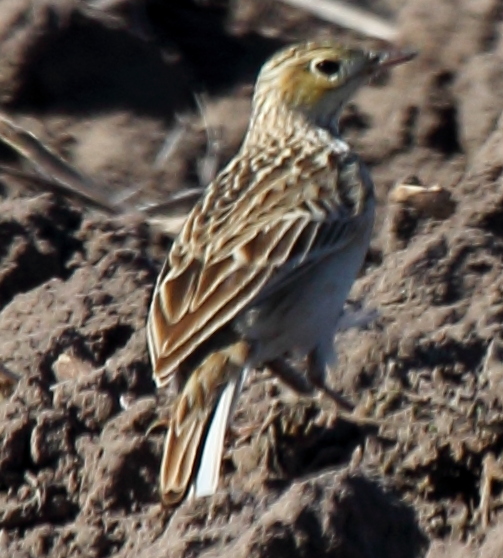
Berthelot's Pipit is a small songbird, approximately 13-14 cm in length, with a wingspan of 21-23 cm. Its plumage is primarily grayish-brown, heavily streaked with darker brown, providing effective camouflage against the stony, volcanic ground of its habitat. The underparts are paler, with subtle streaking on the breast. Notably, the bird has a distinctive white supercilium, or eyebrow stripe, which contrasts with its dark eye line, aiding in identification.
Adult males and females appear similar in plumage, though males may exhibit slightly brighter coloration, particularly during the breeding season. Juveniles resemble adults but often have more pronounced streaking on the back and lighter underparts. Unlike some pipit species, Berthelot's Pipit lacks significant sexual dimorphism, making visual sexing challenging without behavioral observation.
In flight, Berthelot's Pipit displays a characteristic undulating pattern, typical of pipits and wagtails. Observers can recognize the bird's silhouette by its slender shape and relatively long tail. When perched, the pipit often flicks its tail, a behavior that can aid in distinguishing it from similar species. While there may be confusion with other pipits in overlapping regions, the combination of habitat preference and subtle plumage details typically aids in accurate identification.
Having trouble telling birds apart? Upload a photo to our bird identification tool for an instant species match.
Berthelot's Pipit Habitat and Range
Preferred Habitat
Berthelot's Pipit inhabits open, arid landscapes, preferring barren volcanic fields, rocky slopes, and coastal areas. It thrives in environments with sparse vegetation, which offer both feeding opportunities and camouflage from predators. The Canary Islands, with their varied topography, provide a range of suitable habitats, from sea level to higher altitudes.
The volcanic soils of Lanzarote, Tenerife, and Fuerteventura, among other islands, create ideal conditions for this ground-dwelling bird. Seasonal habitat shifts are minor, as Berthelot's Pipit is a resident species without long-distance migration. However, it may move slightly in response to food availability, particularly in drier seasons.
In semi-urban areas, such as the outskirts of towns and villages, Berthelot's Pipit may also be found, foraging in fields and gardens. Its adaptability allows it to occupy a range of niches within its island environments, maintaining its presence even in disturbed habitats.
Geographic Range
Berthelot's Pipit is endemic to the Macaronesian archipelagos, specifically the Canary Islands (Spain) and Madeira (Portugal). Within the Canary Islands, it inhabits all main islands, including Tenerife, Gran Canaria, Lanzarote, Fuerteventura, La Palma, La Gomera, and El Hierro. In Madeira, its range is more restricted, primarily to the main island.
The species is non-migratory, with a stable presence across its range throughout the year. Berthelot's Pipit's population density varies across islands, often being more concentrated in regions with suitable volcanic habitat. For instance, Lanzarote and Fuerteventura, known for their extensive barren landscapes, host relatively higher densities of this pipit.
Despite its limited geographic range, Berthelot's Pipit remains widespread within the islands it inhabits, showcasing its successful adaptation to these unique environments. While it does not undertake long migrations, minor local movements may occur in response to seasonal variations in food availability and environmental conditions.
Want to know which birds visit your area? Browse our backyard birds by location guides for region-specific species lists.
What Does the Berthelot's Pipit Eat?
Berthelot's Pipit primarily feeds on insects and other invertebrates, playing a crucial role as an insectivore in its ecosystem. Its diet includes beetles, ants, spiders, and caterpillars, which it skillfully captures while foraging on the ground. The bird employs a methodical foraging technique, walking or hopping across open terrain while scanning for prey.
Seasonal variations in diet occur, with a higher consumption of plant material, such as seeds, during periods when insects are less abundant. This adaptability ensures the pipit's survival across different seasons and environmental conditions.
The pipit typically forages alone or in small groups, especially outside the breeding season. Its feeding schedule is diurnal, with peak activity occurring in the early morning and late afternoon, aligning with cooler temperatures and increased prey availability. Berthelot's Pipit's ability to exploit a range of food sources underpins its success in its native volcanic habitats.
Berthelot's Pipit Behavior and Social Structure
Berthelot's Pipit exhibits fascinating behaviors that reflect its adaptation to the challenging environments of its island habitats. Social structure varies with the season; during the breeding period, these pipits are notably territorial. Males establish and defend territories through song and display flights, a key aspect of their courtship behavior.
Courtship displays involve aerial maneuvers where males ascend and descend in a series of undulating flights, accompanied by melodic singing. This behavior plays a significant role in attracting mates and deterring rivals. Outside the breeding season, Berthelot's Pipit may form small, loose flocks, likely as a strategy to increase foraging success and predator vigilance.
In response to predators, Berthelot's Pipit relies heavily on its cryptic plumage and evasive flight patterns. The bird remains vigilant, often perching on elevated rocks or low shrubs to scan its surroundings. Daily activities are predominantly diurnal, with birds active during daylight hours, particularly at dawn and dusk when insect activity peaks. This daily rhythm aligns with the availability of prey and the bird's energy requirements.
Berthelot's Pipit Nesting and Reproduction
Berthelot's Pipit constructs well-concealed nests on the ground, often hidden among rocks or clumps of vegetation. The nest is a cup-shaped structure, meticulously crafted from grass, leaves, and rootlets, with a lining of softer materials for insulation and comfort.
Preferred nesting locations include sheltered spots that provide protection from the elements and predators, such as crevices in rocky substrates or beneath low shrubs. Clutch size typically ranges from 3 to 5 eggs, which are pale with darker speckles, offering camouflage against the ground.
Both parents participate in incubation, which lasts about 12 to 14 days. After hatching, the nestlings remain in the nest for approximately 14 to 16 days until fledging. Parental roles are shared, with both male and female providing food and protection to the young. Berthelot's Pipit generally raises one to two broods per year, depending on environmental conditions and food availability.
Berthelot's Pipit Sounds and Vocalizations
The song of Berthelot's Pipit is a melodious series of trills and whistles, often delivered in flight. Its rhythm is lively, with a mix of high-pitched notes that create a distinctive soundscape in its volcanic habitat. This song serves as a primary tool for territory establishment and mate attraction during the breeding season.
Call notes are softer and include a variety of chirps and clicks used for communication between individuals or as alarm signals in the presence of predators. The alarm calls are sharper and more abrupt, serving to alert nearby pipits of potential danger.
During the dawn chorus, Berthelot's Pipit's song can be heard prominently as males engage in vocal displays. The quality of the song is often compared to other pipit species but is unique in its specific combination of notes and patterns, making it a key identifying feature in the field.
Interesting Facts About the Berthelot's Pipit
- 1Berthelot's Pipit is named after Sabin Berthelot, a French naturalist who studied the flora and fauna of the Canary Islands in the 19th century.
- 2Despite its small size, Berthelot's Pipit can adapt to altitudes from sea level up to 2,000 meters, showcasing its versatility in diverse environments.
- 3The species exhibits a fascinating behavior called 'tail flicking,' a rapid movement of the tail used in communication and as a distraction mechanism against predators.
- 4Berthelot's Pipit has evolved specific adaptations for feeding on volcanic terrains, including a specialized diet that shifts with seasonal insect availability.
- 5This pipit is one of only a few bird species endemic to the Canary Islands and Madeira, highlighting its unique evolutionary lineage within these island ecosystems.
- 6Berthelot's Pipit does not undertake long migrations, making it a resident species well-suited to the stable climate of its home islands.
- 7The bird's song is an integral part of its mating ritual, with males performing elaborate aerial displays accompanied by continuous singing to attract females.
Berthelot's Pipit Conservation Status
Berthelot's Pipit currently holds a conservation status of Least Concern according to the IUCN Red List. The species enjoys a stable population trend across its limited range in the Canary Islands and Madeira, benefiting from its adaptability to a variety of arid habitats. Despite its stable status, potential threats include habitat destruction due to urban expansion and agricultural practices. Conservation efforts focus on habitat preservation, particularly in protected areas and nature reserves where the pipit's natural environment is safeguarded. Historically, the population of Berthelot's Pipit has remained relatively stable, with no significant declines recorded. This stability is attributed to its ability to thrive in harsh landscapes that are less impacted by human activity compared to more fertile areas.
Other Motacillidae Species



Birds Similar to the Berthelot's Pipit
These species are often confused with the Berthelot's Pipit due to similar appearance or overlapping range.

