
Black-tailed Tityra
Tityra cayana
Order: Passeriformes / Family: Cotingidae

Wikimedia Commons
About the Black-tailed Tityra
The Black-tailed Tityra (Tityra cayana) is a medium-sized passerine bird that occupies a vital ecological niche in the neotropical regions of South America. This species plays a significant role in the ecosystems it inhabits, primarily through its frugivorous diet, which aids in seed dispersal for many tropical plants. The Black-tailed Tityra is predominantly found in the lowland and foothill forests, with its range extending from eastern Panama through northern South America, including countries like Colombia, Venezuela, Brazil, and Bolivia. This bird is particularly associated with the Amazon Basin, where the dense rainforest environment provides ample food and nesting resources.
The Black-tailed Tityra thrives in primary and secondary forests, often preferring the edges where it can exploit both canopy and understorey food resources. It is also occasionally found in plantations and gardens, demonstrating some adaptability to human-altered landscapes. The bird's presence is often marked by its distinctive rolling calls that echo through the forest canopy. Its ecological role extends beyond seed dispersal; the Black-tailed Tityra also helps control insect populations, as it supplements its diet with various arthropods.
Seasonal behaviors of the Black-tailed Tityra include a degree of nomadism, as individuals may move locally in response to fruiting cycles or other ecological changes. These movements ensure that the species exploits different food resources throughout the year, maintaining a presence in various habitats as seasons shift. Despite its adaptability, the Black-tailed Tityra remains primarily a forest-dependent species, with its population health often tied to the state of its habitat.
The Black-tailed Tityra belongs to the family Cotingidae, within the order Passeriformes. These birds typically live average 5-6 years, with some living up to 10 years..
How to Identify a Black-tailed Tityra
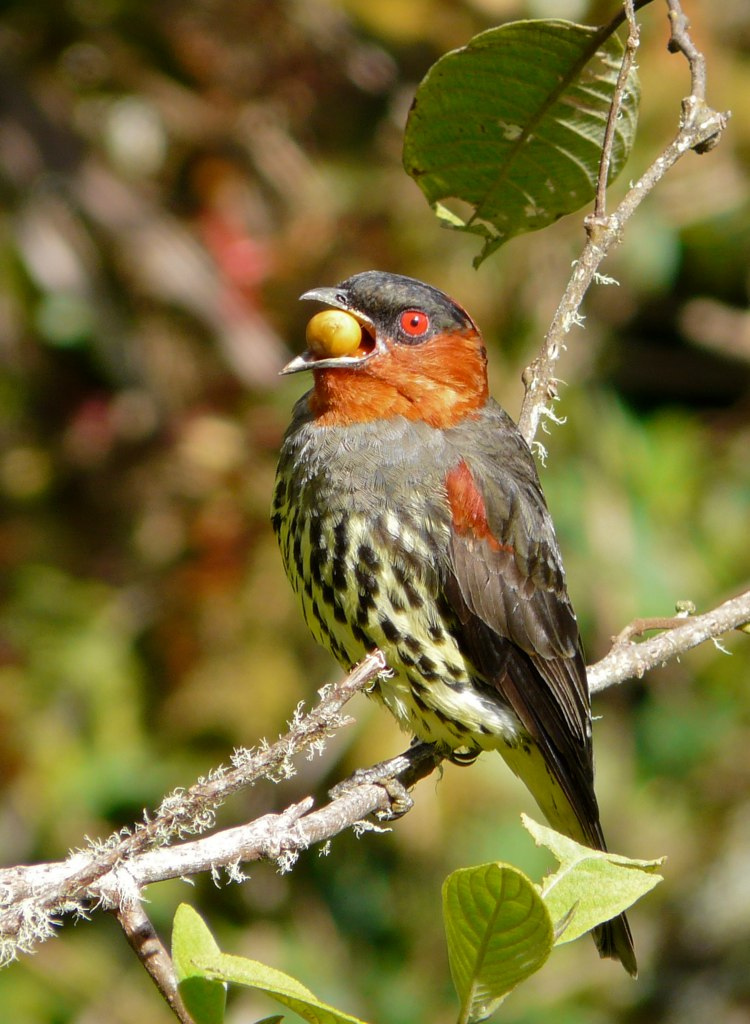
The identification of the Black-tailed Tityra is notably straightforward due to its distinct coloration and markings. Adults exhibit a striking contrast between their pale gray to white bodies and the black tail and mask that give the species its name. The tail is entirely black, a key feature that distinguishes it from other similar-sized birds in its range. The males and females are quite similar in appearance, though males might exhibit slightly more intense coloration around the head and neck. Juveniles resemble adults but tend to have more subdued tones and less defined masks.
In terms of shape, the Black-tailed Tityra has a robust, slightly stocky build with a fairly large head and short neck. Its wings are broad and rounded, well-suited for short bursts of flight through dense foliage. When perched, the bird often adopts an upright posture, which coupled with its distinct plumage, makes it relatively easy to identify even from a distance.
The most likely species for confusion is the Masked Tityra (Tityra semifasciata), which also has a black mask but lacks the completely black tail. Observers should note the bird's overall body coloration and tail pattern to accurately distinguish between these similar species. The Black-tailed Tityra's flight silhouette is characterized by its broad wings and short tail, often seen gliding between trees in search of food.
Having trouble telling birds apart? Upload a photo to our bird identification tool for an instant species match.
Black-tailed Tityra Habitat and Range
Preferred Habitat
The Black-tailed Tityra predominantly inhabits tropical and subtropical forests, thriving in both primary and secondary growth. It is most commonly found in lowland forests but occurs up to elevations of about 1,500 meters in foothill regions. These birds are often seen at forest edges, benefiting from the diversity of fruits and insects available in these transitional zones. While primarily a forest dweller, the Black-tailed Tityra also ventures into adjacent open areas, such as plantations and gardens, particularly where fruit trees are present.
In terms of seasonal habitat shifts, the Black-tailed Tityra demonstrates some flexibility, moving locally in response to food availability. It prefers humid environments and is less frequently seen in arid regions. The bird's adaptability to secondary growth and human-altered landscapes offers some resilience against habitat loss, although it remains dependent on forested environments for breeding and roosting.
Geographic Range
The Black-tailed Tityra has a wide range across northern and central South America. It is resident throughout much of the Amazon Basin, stretching from eastern Panama and Colombia through Venezuela, the Guianas, Brazil, Ecuador, Peru, Bolivia, and into northern Argentina. Within these regions, the bird is generally non-migratory, although it may exhibit local movements in response to changes in fruiting patterns and other ecological factors.
The species is most densely populated in the Amazon rainforest, where the abundance of fruiting trees provides ample feeding opportunities. However, the Black-tailed Tityra also inhabits the Atlantic Forests in Brazil and can be found in the foothills of the Andes. Its range does not extend into the cooler, higher altitudes of the Andean range or into the southern extremes of the continent.
The Black-tailed Tityra is a common sight across its range, though its density may vary depending on habitat quality and food availability. The bird's presence in both primary and secondary forests allows it to occupy a broad geographical area, though it remains largely absent from heavily urbanized areas.
Want to know which birds visit your area? Browse our backyard birds by location guides for region-specific species lists.
What Does the Black-tailed Tityra Eat?
The Black-tailed Tityra primarily consumes fruit, making it an important frugivore in its ecosystem. Figs, berries, and other soft fruits constitute the bulk of its diet. The bird plays a critical role in seed dispersal, as it often swallows fruits whole and later excretes the seeds at a distance from the parent plant, facilitating forest regeneration.
In addition to fruits, the Black-tailed Tityra supplements its diet with insects and other arthropods, providing a protein-rich food source, especially during breeding seasons when energy demands are higher. It employs a sit-and-wait foraging strategy, often perching at mid-canopy levels to spot prey before making quick sallies to capture insects in flight or glean them from foliage.
Dietary habits can vary seasonally, with the bird exploiting different fruiting trees as their availability changes. This adaptability in diet helps the Black-tailed Tityra maintain its population across various forest habitats, especially during the leaner months when fruit is scarce and insects become a more vital food source.
Black-tailed Tityra Behavior and Social Structure
The Black-tailed Tityra exhibits a range of interesting behaviors, particularly in its social structure and interactions. Typically seen in pairs or small family groups, this bird is not highly territorial, allowing multiple groups to inhabit overlapping areas. During the breeding season, however, pairs may become more assertive in defending their nesting sites.
Courtship displays involve a series of calls and visual signals, with the male often adopting a more conspicuous posture and presenting food to the female as part of the bonding process. Once paired, Black-tailed Tityras exhibit strong parental cooperation, with both male and female sharing responsibilities related to nesting and rearing.
The bird's daily activity pattern includes periods of foraging interspersed with rest in shaded canopy areas during the hottest parts of the day. The Black-tailed Tityra remains alert to predators, using its keen eyesight to detect threats from the air and on the ground. When threatened, adults will emit alarm calls and may dive into dense foliage for cover.
Though generally not forming large flocks, the Black-tailed Tityra may join mixed-species feeding groups, particularly outside of the breeding season, benefiting from the collective vigilance and increased foraging efficiency these gatherings provide.
Black-tailed Tityra Nesting and Reproduction
The Black-tailed Tityra typically nests in tree cavities, often taking advantage of abandoned woodpecker holes or natural crevices. These sites offer protection from predators and harsh weather conditions. The bird does not build elaborate nests but rather lines the cavity with a minimal layer of plant materials to cushion the eggs.
Clutch size usually ranges from 2 to 4 eggs, which are incubated by both parents for approximately 18 to 20 days. During this period, the pair remains highly attentive, taking turns to forage and keep the eggs warm. After hatching, the chicks are altricial and require constant care and feeding from both parents.
Fledging occurs about 24 to 30 days after hatching, with the young birds leaving the nest but remaining under parental supervision for several weeks as they learn to forage independently. The Black-tailed Tityra typically produces one brood per year, though in areas with abundant resources, a second brood may be attempted.
Black-tailed Tityra Sounds and Vocalizations
The Black-tailed Tityra's vocalizations are characterized by a series of loud, rolling calls that carry through the forest. The primary song consists of a series of short, harsh notes delivered in rapid succession, often described as "churr-churr-churr." These calls serve both to mark territory and to communicate with mates.
In addition to its song, the bird emits various call notes that include softer whistles and clicks used in close-range communication between paired birds and family groups. Alarm calls are sharper and higher-pitched, serving as warnings of nearby threats. During the dawn chorus, the Black-tailed Tityra's calls blend with those of other forest inhabitants, contributing to the rich morning soundscape.
Interesting Facts About the Black-tailed Tityra
- 1The Black-tailed Tityra can often be seen joining mixed-species flocks, benefiting from increased foraging success.
- 2Unlike many birds, the Black-tailed Tityra does not construct elaborate nests, preferring simple cavities lined with minimal materials.
- 3The species' diet is so diverse that it can adapt to seasonal changes, switching from fruits to insects as required.
- 4A Black-tailed Tityra's call can be heard up to a kilometer away, making it a prominent voice in the forest soundscape.
- 5Despite their striking appearance, Black-tailed Tityras are sometimes overlooked due to their quiet, deliberate movements in the canopy.
- 6The bird's role as a seed disperser is pivotal in maintaining the biodiversity of tropical forests.
- 7The Black-tailed Tityra's ability to thrive in both primary and secondary forests highlights its adaptability in changing environments.
Black-tailed Tityra Conservation Status
The Black-tailed Tityra is currently classified as Least Concern by the IUCN, with its population considered stable across much of its range. However, ongoing habitat destruction, particularly in the Amazon Basin, poses potential threats to its long-term survival. Deforestation for agriculture and logging reduces available habitat, potentially leading to localized declines. Conservation efforts focus on preserving large tracts of continuous forest, which are crucial for the species' foraging and nesting needs. Protected areas and national parks within its range offer some refuge from habitat loss. Historically, the Black-tailed Tityra has shown resilience to moderate habitat changes, but continuous monitoring of population trends is essential to ensure its continued stability.
Other Cotingidae Species



Birds Similar to the Black-tailed Tityra
These species are often confused with the Black-tailed Tityra due to similar appearance or overlapping range.

