
Black-throated Parrotbill
Suthora nipalensis
Order: Passeriformes / Family: Sylviidae

Wikimedia Commons
About the Black-throated Parrotbill
The Black-throated Parrotbill, scientifically known as Suthora nipalensis, is a captivating member of the Sylviidae family. This small avian species holds a notable place in the rich tapestry of Asian birdlife due to its distinctive appearance and intriguing behaviors. The bird is primarily distributed across the dense montane forests of the Himalayas, extending through countries such as Nepal, Bhutan, and parts of India, including Arunachal Pradesh and Sikkim. The Black-throated Parrotbill thrives in subtropical and temperate forests, usually at elevations ranging from 1,200 to 3,000 meters.
This species plays an essential role in its ecosystem as both a consumer of insects and a disperser of seeds, contributing to forest health and regeneration. During the breeding season, which generally occurs from April to July, the Black-throated Parrotbill becomes an active participant in the forest's acoustic landscape. Its vocalizations are a common backdrop to the rich biodiversity of its habitat.
Ecologically, the Black-throated Parrotbill is significant for its adaptability to various forest environments, from lowland areas to higher elevations. This adaptability ensures it remains a consistent presence in its native regions, despite the seasonal climatic changes that characterize its habitat. While primarily a resident bird, some populations may exhibit slight altitudinal movements in response to seasonal changes, ensuring access to food sources throughout the year.
The Black-throated Parrotbill belongs to the family Sylviidae, within the order Passeriformes. These birds typically live typical lifespan is 3-5 years; max recorded 7 years..
How to Identify a Black-throated Parrotbill
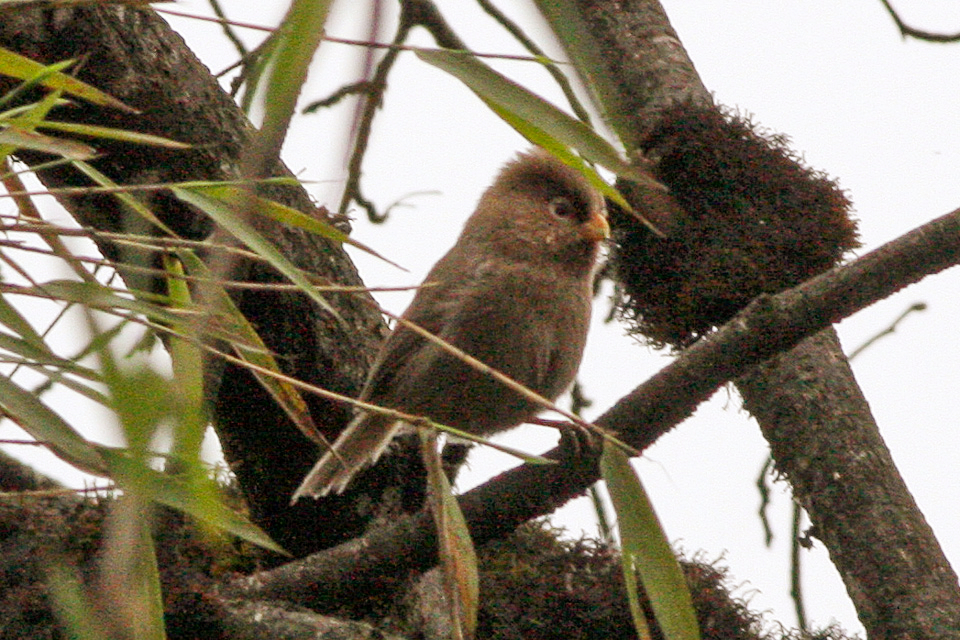
The Black-throated Parrotbill is easily identified by its small size and distinctive plumage. Adults measure approximately 14 cm in length. The bird's most striking feature is its black throat patch, contrasting sharply with the warm brown and orange hues of the rest of its body. Its back is a rich chestnut color, while the underparts are paler with a more buffy tone. The wings and tail exhibit a darker brown, contributing to its overall subdued yet distinctive palette.
Juveniles resemble adults but with less defined color contrasts, particularly lacking the pronounced black throat that characterizes mature individuals. Males and females are similar in appearance, although subtle variations in size may occur, with males being slightly larger on average.
The Black-throated Parrotbill can be confused with other parrotbills, yet its unique throat patch and size help distinguish it from similar species. In flight, it displays a compact silhouette with rapid, direct wingbeats, often moving in flocks. When perched, it often adopts an upright posture, making it easier to spot against the foliage.
Having trouble telling birds apart? Upload a photo to our bird identification tool for an instant species match.
Black-throated Parrotbill Habitat and Range
Preferred Habitat
The Black-throated Parrotbill inhabits a variety of forest types across its range, primarily favoring subtropical and temperate montane forests. These birds are most commonly found at elevations between 1,200 to 3,000 meters, where the dense undergrowth provides ample foraging opportunities and nesting sites.
During different seasons, the Black-throated Parrotbill may shift its habitat slightly, often moving to lower elevations during the colder months to avoid harsh weather conditions. This altitudinal migration ensures a consistent supply of food resources. While predominantly a forest dweller, it can occasionally be observed in secondary growth areas and scrublands, especially when searching for food.
The bird shows a marked preference for thick, tangled vegetation, which offers both protection from predators and a rich supply of insects and plant matter. It is less commonly found in urban areas, as it tends to avoid open and heavily human-modified landscapes.
Geographic Range
The Black-throated Parrotbill has a breeding range that spans the eastern Himalayas, covering parts of Nepal, Bhutan, and northeastern India. Its presence is particularly notable in regions such as Arunachal Pradesh and Sikkim, where the bird is common in suitable habitats. It is also found in parts of Myanmar and southwestern China, including Yunnan and Sichuan provinces.
This species is primarily sedentary, with most populations remaining in their breeding range year-round. However, some individuals may undertake short-distance altitudinal migrations, moving to lower elevations during the winter months to escape cold temperatures and snow.
Population density is highest in areas with extensive forest cover and minimal human disturbance. The bird's adaptability to different forest types allows it to inhabit a relatively wide range, although it remains largely absent from heavily urbanized regions.
Want to know which birds visit your area? Browse our backyard birds by location guides for region-specific species lists.
What Does the Black-throated Parrotbill Eat?
The diet of the Black-throated Parrotbill consists mainly of insects, which it forages among the dense undergrowth and foliage of its forest habitat. The bird employs a variety of foraging techniques, including gleaning insects from leaves and branches, as well as occasionally catching prey in mid-air.
In addition to insects, the Black-throated Parrotbill consumes plant matter, such as seeds and berries, particularly during the winter months when insect availability decreases. This dietary flexibility allows it to sustain itself year-round, even in varying environmental conditions.
The bird typically forages in small groups or mixed-species flocks, moving through the forest in a methodical manner. Its feeding activities are most intense during the early morning and late afternoon, aligning with the peak activity times of many insect species. Prey items are generally small, allowing the bird to consume them efficiently without the need for extensive handling.
Black-throated Parrotbill Behavior and Social Structure
The Black-throated Parrotbill exhibits a range of fascinating behaviors that reflect its social and ecological roles within its habitat. This species is highly social, often found in small groups or forming part of mixed-species flocks. Such flocking behavior enhances foraging efficiency and offers protection against predators by increasing vigilance and confusing potential threats.
During the breeding season, the bird's territorial instincts become more pronounced. Pairs establish and defend small territories within the dense forest undergrowth, where they build nests and rear their young. Courtship displays include a combination of vocalizations and physical displays, such as wing quivering and tail fanning, aimed at attracting mates and strengthening pair bonds.
The Black-throated Parrotbill is diurnal, with most of its activities occurring during daylight hours. It engages in regular preening and bathing behaviors, which help maintain the condition of its plumage. When faced with predators, the bird relies on cryptic coloration and the dense vegetation of its habitat to evade detection, often freezing in place until the threat passes.
Black-throated Parrotbill Nesting and Reproduction
The nesting habits of the Black-throated Parrotbill are as intricate as they are effective. This species typically constructs its nest in dense shrubbery or low trees, utilizing materials such as grasses, moss, and spider webs to create a compact and well-camouflaged structure. The nest is usually cup-shaped and placed at a height that provides both concealment and access to food sources.
A typical clutch consists of two to four eggs, which are incubated mainly by the female. The incubation period lasts approximately 14 days, after which the altricial chicks hatch. Both parents participate in feeding the young, bringing a steady supply of insects and other small invertebrates to the nest.
Fledging occurs about two weeks after hatching, with the young remaining dependent on their parents for an additional few weeks as they learn to forage independently. The Black-throated Parrotbill may raise up to two broods in a single breeding season, depending on food availability and environmental conditions.
Black-throated Parrotbill Sounds and Vocalizations
The Black-throated Parrotbill is known for its distinctive vocalizations, which play a crucial role in communication and territory defense. Its primary song consists of a series of melodious notes delivered in a rhythmic sequence, often described as a 'chirring' or 'trilling' sound. This song serves both to attract mates and delineate territory boundaries.
In addition to its primary song, the bird produces a variety of call notes that facilitate communication within flocks. These calls range from short, sharp 'chip' sounds to more complex sequences used to coordinate movements with other flock members.
Alarm calls are sharper and more urgent, designed to alert conspecifics to potential threats. During the dawn chorus, the Black-throated Parrotbill's song contributes to the rich tapestry of sounds characteristic of its forest habitat, often blending seamlessly with the calls of sympatric species.
Interesting Facts About the Black-throated Parrotbill
- 1The Black-throated Parrotbill is part of a group of birds often called 'parrotbills' due to their stout, parrot-like bills.
- 2Despite its small size, the Black-throated Parrotbill can be quite vocal, with a repertoire of calls used for communication.
- 3This species can form mixed-species flocks, enhancing foraging efficiency and offering protection against predators.
- 4The Black-throated Parrotbill is known for its striking plumage, with a black throat patch that contrasts with its warm brown body.
- 5Unlike many birds, the Black-throated Parrotbill may adjust its elevation range slightly in response to seasonal changes.
- 6The species' preference for dense undergrowth makes it an elusive bird, often heard before it is seen in its natural habitat.
- 7Black-throated Parrotbills play a crucial ecological role by controlling insect populations and aiding in seed dispersal.
Black-throated Parrotbill Conservation Status
The Black-throated Parrotbill currently holds a status of Least Concern on the IUCN Red List, indicating a stable population trend. Despite being relatively widespread, the species faces threats from habitat loss due to deforestation and land conversion for agriculture. Efforts to conserve forest habitats in its range are crucial to ensuring the long-term survival of this species. Conservation initiatives often focus on preserving the integrity of montane forest ecosystems, which provide essential resources for the Black-throated Parrotbill and countless other species. Monitoring population trends and habitat conditions can help identify emerging threats and inform conservation strategies. Historically, the bird's population has remained stable, owing in part to its adaptability to different forest environments. However, ongoing habitat fragmentation and human encroachment necessitate continued vigilance to prevent future declines.
Other Sylviidae Species



Birds Similar to the Black-throated Parrotbill
These species are often confused with the Black-throated Parrotbill due to similar appearance or overlapping range.

