
Blyth's Pipit
Anthus godlewskii
Order: Passeriformes / Family: Motacillidae
Wikimedia Commons
About the Blyth's Pipit
Blyth's Pipit (Anthus godlewskii) is a passerine bird that belongs to the family Motacillidae. This species is widely distributed across the grasslands and steppes of Asia, particularly thriving in regions like Mongolia, northern China, and parts of Siberia. Blyth's Pipit plays an essential ecological role as an insectivore, helping to control populations of grassland insects. The bird's subtle plumage, characterized by earthy tones, allows it to blend seamlessly into its surroundings, providing protection against predators. During the breeding season, typically from May to July, Blyth's Pipit becomes a more prominent feature of its habitat as it engages in complex aerial displays and vocalizations to attract mates. These behaviors not only facilitate reproduction but also contribute to the biodiversity of the regions it inhabits by supporting a variety of plant and insect life through its dietary habits. The seasonal movements of Blyth's Pipit reflect its adaptability. In winter, the bird migrates to warmer areas, often reaching as far south as the Indian subcontinent. This migration is crucial for the survival of the species, as it provides access to food sources that are unavailable in its breeding range during the colder months. The bird's migratory patterns also reflect broader ecological interactions, as it becomes part of diverse avian communities in its wintering grounds, often seen in mixed-species flocks. Blyth's Pipit is not only significant in terms of its ecological role but also holds cultural importance in some regions, where its presence marks seasonal changes and is often celebrated in local folklore. As such, the conservation of this species is vital for maintaining both ecological balance and cultural heritage. Blyth's Pipit serves as an indicator species for the health of grassland ecosystems, and its presence can signify a well-functioning habitat rich in biodiversity.
The Blyth's Pipit belongs to the family Motacillidae, within the order Passeriformes. These birds typically live average 3-5 years, with a maximum recorded lifespan of 8 years..
How to Identify a Blyth's Pipit
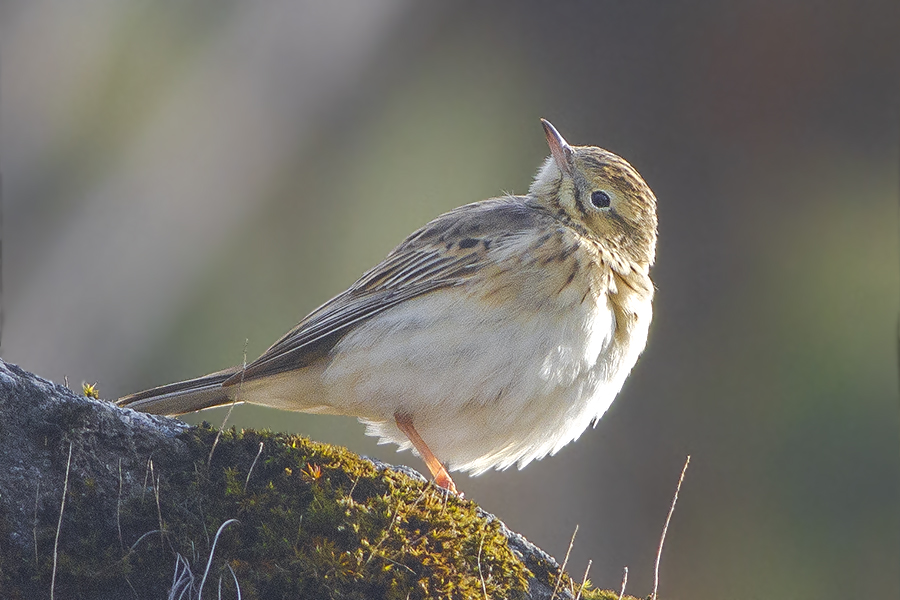
Blyth's Pipit exhibits distinct plumage that aids in identification. Adult Blyth's Pipits possess a brown upper body with streaks that provide excellent camouflage against the grassland terrain. Their underparts are paler with fine streaking on the breast, which becomes less pronounced in juveniles. Both males and females appear similar in plumage, though males are slightly larger. Juveniles can be distinguished by their more uniform and less streaked plumage. In flight, Blyth's Pipit displays a characteristic bounding motion, with its wings and tail showing a contrasting pattern of darker flight feathers against paler edges. This flight silhouette is a useful field mark when observing the bird from a distance. Perched, the bird maintains a horizontal posture, often seen flicking its tail. Despite its subtle appearance, Blyth's Pipit is at times confused with Richard's Pipit (Anthus richardi), which shares similar habitats. However, careful attention to size and vocalizations aids in differentiation. Blyth's Pipit is generally smaller and more finely built, with a shorter bill in comparison. Observers can also identify the bird by its distinctive call, which differs in tone and pattern from that of Richard's Pipit, providing an auditory clue to its identity.
Having trouble telling birds apart? Upload a photo to our bird identification tool for an instant species match.
Blyth's Pipit Habitat and Range
Preferred Habitat
Blyth's Pipit primarily inhabits open grasslands and steppes, favoring areas with sparse vegetation that offer both foraging opportunities and visibility for potential predators. These habitats are typically found at elevations ranging from 300 to 2000 meters, depending on the region. In its breeding range, the bird prefers undisturbed grasslands in Mongolia and northern China, where it nests on the ground among tufts of grass. During migration and in winter, Blyth's Pipit exhibits some habitat flexibility, adapting to agricultural fields, fallow land, and open country in the Indian subcontinent. In urban areas, the bird is less common, though it occasionally frequents parks and gardens that mimic its natural habitat. The seasonal habitat shifts underscore the bird's adaptability, allowing it to exploit a range of environments across its broad geographic range.
Geographic Range
Blyth's Pipit breeds across a wide expanse of Central Asia, primarily in Mongolia, northern China, and parts of southern Siberia. During the breeding season, it establishes territories in open grasslands and steppes. As autumn approaches, the species undertakes a significant migration southward, with many individuals wintering in the Indian subcontinent, particularly in northern and central India. The migration corridors cover vast distances, with birds often passing through regions such as the Himalayas and the Tibetan Plateau. Within its breeding range, Blyth's Pipit is relatively widespread, though population densities can vary depending on habitat quality and climatic conditions. In winter, it becomes more concentrated in suitable agricultural and open habitats, where food resources are abundant. The bird's presence during these times is often noted in regions like Rajasthan and Uttar Pradesh, where it forms part of mixed-species flocks.
Want to know which birds visit your area? Browse our backyard birds by location guides for region-specific species lists.
What Does the Blyth's Pipit Eat?
The diet of Blyth's Pipit primarily consists of insects, making it an important insectivore within its ecosystem. Its primary food sources include beetles, grasshoppers, and various insect larvae. The bird employs a foraging technique known as 'ground gleaning,' where it walks or runs quickly across the ground, picking insects from the soil and vegetation. Blyth's Pipit adapts its diet seasonally, taking advantage of the most abundant prey types available. During the breeding season, the bird's diet shifts slightly to include more protein-rich insects, which are crucial for feeding developing chicks. In winter, when insects are less abundant, Blyth's Pipit may consume seeds and grains, although these form a minor component of its diet. The bird typically feeds throughout the day, with peak activity observed during the cooler morning and late afternoon hours when insects are most active. This feeding schedule allows it to maximize energy intake while minimizing exposure to predators.
Blyth's Pipit Behavior and Social Structure
Blyth's Pipit exhibits a range of behaviors that highlight its adaptability and ecological interactions. The bird is generally solitary or found in pairs during the breeding season, with males establishing and defending territories through song and display flights. Courtship involves aerial displays, where the male ascends to a height before descending with fluttering wingbeats and singing. Outside the breeding season, Blyth's Pipit becomes more social, often forming loose flocks during migration and winter. These flocks may consist of other pipit species, creating a diverse assemblage of birds that forage together. In response to predators, Blyth's Pipit relies on its cryptic plumage and ground-hugging flight to evade detection. The bird's daily activity pattern involves alternating periods of feeding and resting, with increased vocal activity during the early morning and evening. Blyth's Pipit is a ground-nesting species, and its behavior reflects the need to remain vigilant against ground-based threats.
Blyth's Pipit Nesting and Reproduction
The nesting behavior of Blyth's Pipit involves constructing a ground nest, often concealed among grass tussocks or low vegetation. The nest is a simple structure, made from grasses and lined with finer materials for insulation. Typically, the female lays a clutch of 3 to 5 eggs, which are incubated primarily by the female for about 13 to 15 days. During this period, the male may assist by providing food and maintaining a lookout for predators. Once hatched, the chicks remain in the nest for approximately 14 to 16 days before fledging. Both parents participate in feeding the young, ensuring a steady supply of insects. Blyth's Pipit generally raises one brood per year, although in favorable conditions, a second brood may be attempted. The success of the nesting effort is closely tied to habitat quality and predator presence, with higher success rates observed in undisturbed grasslands.
Blyth's Pipit Sounds and Vocalizations
The vocalizations of Blyth's Pipit are distinctive, featuring a clear, melodious song that consists of repeated phrases and trills. The song is often delivered during display flights, providing an auditory cue to the bird's presence. In addition to its song, Blyth's Pipit produces a series of call notes that serve various functions, including communication with mates and signaling alarm. The alarm call is a sharp 'tsip' sound, used to warn of approaching predators. During the dawn chorus, the bird's song is most prominent, often heard resonating across the grasslands. Compared to familiar bird songs, Blyth's Pipit's song is more fluid and less mechanical, with a gentle rhythm that makes it a pleasant addition to the natural soundscape.
Interesting Facts About the Blyth's Pipit
- 1Blyth's Pipit is named after Edward Blyth, a 19th-century British zoologist who made significant contributions to ornithology.
- 2During migration, Blyth's Pipit can cover distances exceeding 1,500 kilometers, showcasing its remarkable endurance.
- 3The species was first described scientifically in the 19th century and has since become a subject of interest for birdwatchers across Asia.
- 4Blyth's Pipit exhibits a unique behavior known as 'wagging,' where it alternates raising and lowering its tail while foraging.
- 5In some cultures, Blyth's Pipit's arrival marks the onset of the monsoon season, highlighting its role as a seasonal indicator.
- 6Despite its subtle plumage, Blyth's Pipit is a skilled mimic, often incorporating the calls of other birds into its own song.
- 7The bird's cryptic coloration provides effective camouflage, making it difficult to spot in its grassland habitat.
Blyth's Pipit Conservation Status
Blyth's Pipit currently holds a status of Least Concern according to the IUCN Red List, reflecting a stable population trend across much of its range. However, localized declines have been noted in areas where habitat loss and degradation occur, particularly due to agricultural expansion and overgrazing. Conservation efforts aimed at preserving grassland habitats are crucial for maintaining healthy populations of Blyth's Pipit. Initiatives such as the establishment of protected areas and sustainable land management practices can mitigate the impact of human activities. Historically, the species has shown resilience to environmental changes, but continued monitoring is necessary to ensure its long-term survival. Conservationists emphasize the importance of maintaining habitat connectivity to support the bird's migratory movements and breeding success.
Other Motacillidae Species



Birds Similar to the Blyth's Pipit
These species are often confused with the Blyth's Pipit due to similar appearance or overlapping range.
