
Bugun Liocichla
Liocichla bugunorum
Order: Passeriformes / Family: Leiothrichidae

Wikimedia Commons
About the Bugun Liocichla
The Bugun Liocichla (Liocichla bugunorum) is a strikingly beautiful bird, notable for its vibrant plumage and rarity. Discovered relatively recently, in 2006, this bird has quickly captured the attention of ornithologists and birdwatchers alike. It resides primarily in the subtropical and temperate forests of Arunachal Pradesh in northeast India, specifically within the Eaglenest Wildlife Sanctuary. The sanctuary's rich biodiversity and varied elevation provide an ideal habitat for this species. Given its restricted range and small known population, the Bugun Liocichla is often considered a flagship species for conservation efforts in the region.
The Bugun Liocichla's ecological role is vital within its forest habitat. As an insectivorous bird, it helps control insect populations, contributing to the ecological balance. Its presence indicates the health of the forest ecosystem, as it thrives in undisturbed, mature forests. The bird's discovery and subsequent monitoring have highlighted the importance of preserving these habitats, which face threats from logging and land conversion.
Seasonally, the Bugun Liocichla displays intriguing behaviors. During the breeding season, its activity increases, and it becomes more vocal, allowing researchers and bird enthusiasts rare glimpses of its courtship rituals. Outside the breeding season, the bird may become more elusive, blending with the dense foliage. The Bugun Liocichla is primarily sedentary, although it may move vertically within its range in response to seasonal changes in food availability. As a result, the protection of its habitat is crucial year-round to ensure its survival and continued presence in the region.
The Bugun Liocichla belongs to the family Leiothrichidae, within the order Passeriformes. These birds typically live unknown, but estimated to be around 5-8 years.
How to Identify a Bugun Liocichla
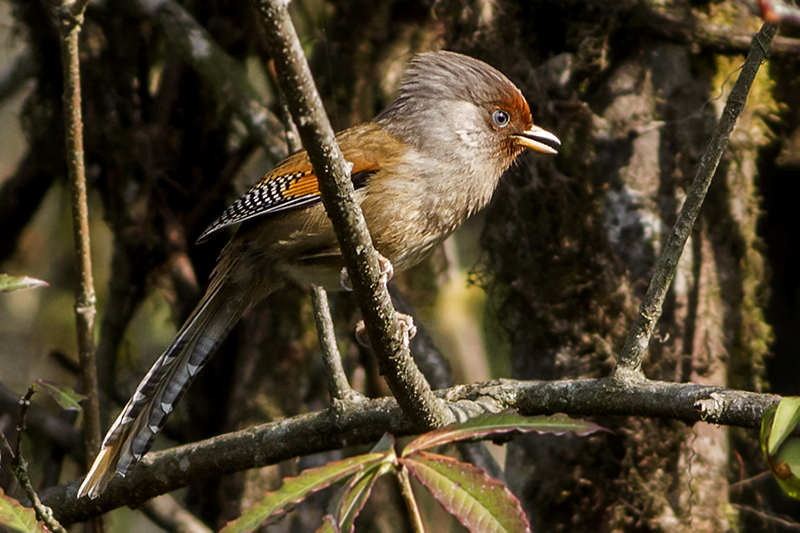
To identify the Bugun Liocichla, observers should note its distinct plumage and size. The adult bird boasts a striking combination of olive and gray, with bright red patches on the wings and a vivid yellow-orange patch on the face. These colors contrast sharply with its olive-green back and gray underparts, making it unmistakable among its peers. The eyes are surrounded by a fine white eye-ring that adds to its distinctive appearance.
Juvenile Bugun Liocichlas are slightly duller than adults, with less pronounced facial markings and wing patches. Males and females appear similar, making sexing individuals in the field challenging without close observation of their behavior. Both sexes share comparable plumage, though the male may exhibit slightly brighter tones during the breeding season.
When observing the Bugun Liocichla, note its slender, medium-sized body and relatively long tail. Its flight is undulating, typical of many forest-dwelling songbirds, and it often perches in an upright posture, frequently in dense thickets where it forages for insects.
Having trouble telling birds apart? Upload a photo to our bird identification tool for an instant species match.
Bugun Liocichla Habitat and Range
Preferred Habitat
The Bugun Liocichla inhabits the lush, biodiverse forests of Arunachal Pradesh, specifically the Eaglenest Wildlife Sanctuary. This region's subtropical and temperate forests provide an ideal environment for the bird, offering dense undergrowth and abundant insect prey. The bird typically resides at elevations ranging from 2000 to 2500 meters, although it may move to different altitudes seasonally in search of food.
Within these forests, the Bugun Liocichla prefers areas with dense foliage, such as thickets and understory vegetation, where it can forage and remain concealed from predators. The sanctuary's varied topography, including hills and valleys, offers numerous microhabitats that support the species' needs. The Bugun Liocichla is not found in urban areas, as it relies heavily on undisturbed natural habitats.
As a non-migratory bird, the Bugun Liocichla remains in its forest home year-round, although it may exhibit some altitudinal movement depending on seasonal food availability. Conservation of its habitat is essential, as deforestation and habitat fragmentation pose significant threats to its survival.
Geographic Range
The Bugun Liocichla's range is remarkably restricted, confined to the Eaglenest Wildlife Sanctuary in Arunachal Pradesh, northeast India. This sanctuary is a biodiversity hotspot, providing a haven for numerous rare and endemic species. The Bugun Liocichla is a resident breeder within this limited range, highlighting its vulnerability to habitat changes.
Unlike many bird species, the Bugun Liocichla does not migrate over long distances. Instead, it remains within the sanctuary's confines, occasionally undertaking short altitudinal movements in response to environmental factors such as temperature and food availability. This sedentary lifestyle emphasizes the importance of protecting its specific habitat, as it cannot easily relocate to new areas if its current environment is degraded.
Population densities of the Bugun Liocichla are not well documented due to its elusive nature and the difficult terrain of its habitat. However, estimates suggest that there are fewer than 250 mature individuals remaining, making it one of the most critically endangered bird species in the world. Conservation efforts are focused on protecting its limited habitat and mitigating threats from deforestation and human encroachment.
Want to know which birds visit your area? Browse our backyard birds by location guides for region-specific species lists.
What Does the Bugun Liocichla Eat?
The Bugun Liocichla primarily feeds on insects, playing a crucial role in controlling insect populations within its forest habitat. Its diet consists of various arthropods, including beetles, caterpillars, and spiders. During the breeding season, it may increase its intake of protein-rich prey to support the nutritional needs of its young.
Seasonal changes in food availability can influence the Bugun Liocichla's foraging behavior. In the dry season, when insect populations may decline, the bird might expand its diet to include some fruits and berries found within the forest. This dietary flexibility helps the species survive in its limited range, where food resources can vary.
Foraging typically occurs in the dense understory foliage, where the Bugun Liocichla uses its sharp beak to probe leaves and branches for hidden insects. Its agile movements and keen eyesight allow it to efficiently locate and capture prey. Feeding usually takes place during daylight hours, with the bird being most active in the early morning and late afternoon when temperatures are cooler and insect activity is higher.
Bugun Liocichla Behavior and Social Structure
The Bugun Liocichla exhibits a range of intriguing behaviors, reflective of its adaptation to the forest environment. It is typically a solitary or pair-living bird, although it may join mixed-species foraging flocks during certain times of the year. This social flexibility can enhance foraging success and reduce the risk of predation.
Territorial behavior is evident in the Bugun Liocichla, particularly during the breeding season when pairs become more vocal and active in defending their nesting area. Courtship displays involve a series of calls and visual signals, with the male often displaying his vibrant wing patches to attract a mate. The Bugun Liocichla's response to predators includes remaining motionless or retreating into thick vegetation to avoid detection.
Daily activity patterns are dictated by the need to forage for food and maintain territory boundaries. The Bugun Liocichla is most active during the early morning and late afternoon, coinciding with peak insect activity. During the midday heat, it may rest in the shade, resuming activity as temperatures cool. The bird's elusive nature and quiet demeanor make it a challenging species to observe in its natural habitat, further underscoring the importance of preserving its environment for continued study and appreciation.
Bugun Liocichla Nesting and Reproduction
The Bugun Liocichla constructs its nest in dense shrubbery or low trees, often choosing sites that offer concealment from predators. The nest is cup-shaped, made from twigs, grass, and leaves, and lined with softer materials like moss and feathers to provide a comfortable environment for the eggs and chicks.
A typical clutch consists of 2 to 3 eggs, which are incubated primarily by the female. The incubation period lasts about 14 days, during which the male assists by providing food and guarding the nest. Once hatched, the chicks remain in the nest for approximately 12 to 14 days before fledging. Both parents participate in feeding and caring for the young, ensuring their survival during these critical early stages.
The Bugun Liocichla generally raises one brood per year, although favorable conditions might allow for a second. The timing of breeding coincides with the onset of the monsoon season, which brings an abundance of food resources. This synchronization ensures that the chicks have ample food for rapid growth and development. The nesting success of the Bugun Liocichla heavily depends on the preservation of its habitat, as disturbances can lead to nest failure and population decline.
Bugun Liocichla Sounds and Vocalizations
The Bugun Liocichla produces a melodious song characterized by a series of clear, sweet notes that rise and fall in pitch. This song serves as a primary means of communication between mates and a tool for establishing territory boundaries. The rhythm of the song is steady, with a gentle cadence that echoes through its forest habitat.
In addition to its song, the Bugun Liocichla has a variety of call notes, including sharp, metallic clicks used to alert others of potential threats. Alarm calls are more rapid and urgent, signaling the presence of predators or intruders. During the dawn chorus, the Bugun Liocichla's song is particularly prominent, as it joins other forest birds in greeting the new day. Comparatively, its song is reminiscent of a thrush, but with a distinct tonal quality that sets it apart.
The Bugun Liocichla's vocalizations are an essential aspect of its behavior, helping maintain social bonds and territorial integrity. These sounds also offer valuable cues for researchers and birdwatchers attempting to locate this elusive species in its dense habitat.
Interesting Facts About the Bugun Liocichla
- 1The Bugun Liocichla was only discovered in 2006, making it one of the newest bird species identified in recent years.
- 2This bird is named after the Bugun tribe of Arunachal Pradesh, highlighting the connection between local communities and wildlife.
- 3Unlike many passerines, the Bugun Liocichla exhibits little sexual dimorphism, with males and females sharing similar plumage.
- 4The Bugun Liocichla's song is often compared to that of a thrush, but its distinct tonal quality sets it apart.
- 5Its restricted range makes the Bugun Liocichla one of the most critically endangered bird species, highlighting the urgent need for conservation.
Bugun Liocichla Conservation Status
The Bugun Liocichla is classified as Critically Endangered by the IUCN, with a population estimated at fewer than 250 mature individuals. Its restricted range in the Eaglenest Wildlife Sanctuary makes it highly vulnerable to habitat loss and degradation from logging and agricultural expansion. Conservation efforts focus on habitat protection and the regulation of human activities within the sanctuary. Local communities are engaged in conservation initiatives, emphasizing sustainable practices and the importance of preserving biodiversity. These efforts include monitoring populations and promoting awareness of the Bugun Liocichla's ecological significance. Historically, the discovery of the Bugun Liocichla spurred increased interest in conserving the area's unique flora and fauna. Despite ongoing threats, these conservation measures have helped stabilize the population, but continued vigilance is necessary to ensure the species' long-term survival.
Other Leiothrichidae Species


Birds Similar to the Bugun Liocichla
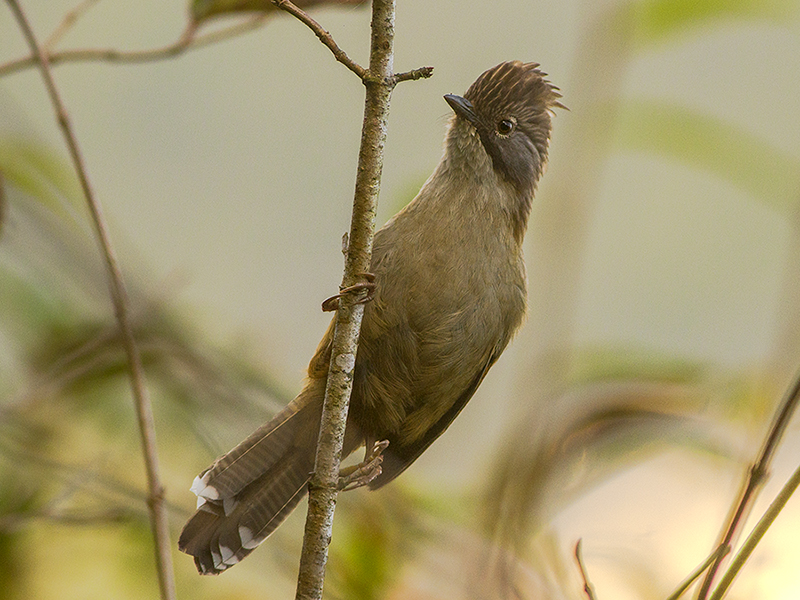
These species are often confused with the Bugun Liocichla due to similar appearance or overlapping range.

