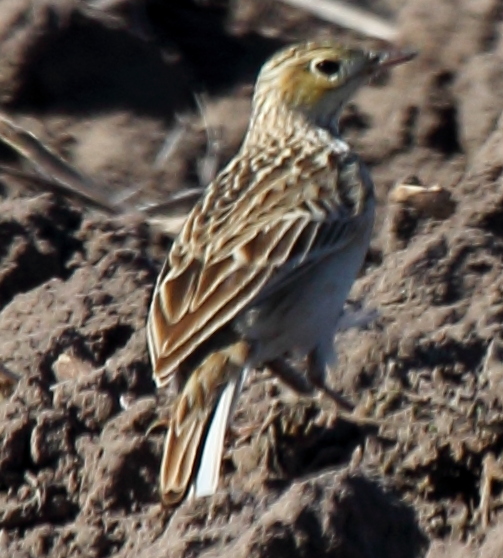
Bush Pipit
Anthus caffer
Order: Passeriformes / Family: Motacillidae

Wikimedia Commons
About the Bush Pipit
The Bush Pipit, scientifically referred to as Anthus caffer, is a small passerine bird belonging to the family Motacillidae. This species is predominantly found in sub-Saharan Africa, extending its range across several countries including South Africa, Namibia, Botswana, and Zimbabwe. The Bush Pipit thrives in open grasslands and savannas, where its unobtrusive plumage allows it to blend seamlessly with its surroundings. Characterized by its slender build and elongated tail, the Bush Pipit is an adept forager, gleaning insects from the ground with remarkable agility.
As a member of the diverse pipit genus, the Bush Pipit plays a significant ecological role in its native habitats. It assists in controlling insect populations, thus maintaining ecological balance in the grasslands. The bird's presence indicates a healthy ecosystem, as it requires undisturbed habitats with ample food supply. During the breeding season, which varies geographically, the Bush Pipit engages in elaborate courtship displays, often involving aerial acrobatics and melodious song to attract a mate.
The Bush Pipit exhibits interesting seasonal behaviors, adapting to varying climatic conditions across its range. In regions with distinct wet and dry seasons, the Bush Pipit may alter its feeding and breeding behaviors to coincide with the availability of resources. During wet seasons, when insects are abundant, it takes full advantage of the rich food supply to rear its young. Conversely, during dry spells, it may shift to more shaded and moist areas, demonstrating its remarkable adaptability.
The Bush Pipit belongs to the family Motacillidae, within the order Passeriformes. These birds typically live average 3-5 years with a max recorded of 6 years..
How to Identify a Bush Pipit
The Bush Pipit is a small, inconspicuous bird with a length of approximately 15 cm and a wingspan that ranges around 20 cm. Adults exhibit a predominantly brown upper body with subtle streaking that aids in camouflage within grassland habitats. The underparts are a pale buff color with fine streaking on the breast, contributing to its cryptic appearance. Notably, the tail is long and features white outer feathers visible in flight, a key identification marker.
Juvenile Bush Pipits resemble adults but often show more pronounced streaking on the back and head. There are no significant differences in plumage between males and females, which can complicate gender identification in the field. The Bush Pipit may be confused with similar species such as the Plain-backed Pipit (Anthus leucophrys), but the latter lacks the distinct tail pattern and has a more robust build.
In flight, the Bush Pipit displays a characteristic undulating pattern, common among pipits, and its long tail is an unmistakable feature. When perched, it often adopts an upright posture, which, combined with its tail movements, can aid in distinguishing it from other grassland birds.
Having trouble telling birds apart? Upload a photo to our bird identification tool for an instant species match.
Bush Pipit Habitat and Range
Preferred Habitat
The Bush Pipit predominantly inhabits open grasslands, savannas, and lightly wooded areas throughout its range in sub-Saharan Africa. It favors regions with low to moderate vegetation cover, where it can forage effectively for insects. This species is often found at elevations ranging from sea level to around 2,000 meters, though it is more common in lower-altitude areas.
Seasonal habitat shifts are not typically pronounced in the Bush Pipit, though individuals may move to denser vegetation during dry periods to seek moisture and cover. While primarily a bird of rural landscapes, the Bush Pipit can occasionally be observed on the fringes of agricultural lands, where it benefits from the insect-rich environments.
Though not commonly found in urban centers, the Bush Pipit may venture into suburban areas with suitable green spaces. Its presence in such areas is usually transient, as it primarily relies on expansive grassland habitats for breeding and foraging.
Geographic Range
The range of the Bush Pipit includes a broad expanse of sub-Saharan Africa, with populations residing in countries such as South Africa, Namibia, Botswana, Zimbabwe, and parts of Mozambique. This species exhibits a resident breeding range, with local movements dictated by environmental conditions rather than long-distance migration.
In some regions, particularly in the southern parts of its range, the Bush Pipit may undertake short-distance movements in response to seasonal changes in food availability. However, it does not exhibit the extensive migratory behavior seen in some other pipit species.
Population density hotspots for the Bush Pipit are often found in well-preserved grasslands and savannas, where human disturbance remains minimal. These areas provide the necessary resources for breeding and foraging, supporting stable populations.
Want to know which birds visit your area? Browse our backyard birds by location guides for region-specific species lists.
What Does the Bush Pipit Eat?
The diet of the Bush Pipit primarily consists of insects, which it actively forages for on the ground. Beetles, ants, grasshoppers, and caterpillars form the bulk of its diet, with occasional consumption of seeds and plant material, particularly in dry seasons when insect availability decreases.
Foraging behavior involves a characteristic walk-and-pause technique, where the Bush Pipit scans the ground intently before darting forward to capture prey. This methodical approach allows it to exploit a variety of microhabitats within grasslands and savannas effectively.
Seasonal diet changes occur, with the Bush Pipit taking advantage of the abundance of insects during the wet season to support breeding and rearing young. As an opportunistic feeder, it adjusts its diet based on availability, ensuring a consistent food supply throughout the year.
Bush Pipit Behavior and Social Structure
The Bush Pipit is generally a solitary or loosely gregarious bird, often observed singly or in small groups. During the breeding season, it becomes more territorial, with males frequently engaging in song displays from elevated perches to establish territories and attract mates. These displays often include a distinctive flight pattern interspersed with bursts of song.
Courtship involves aerial displays where the male ascends rapidly before descending in a series of fluttering dives, accompanied by melodious calls. This behavior is crucial in mate selection and territory establishment. Outside the breeding season, the Bush Pipit may form small flocks, particularly in areas with abundant food resources.
Despite its small size, the Bush Pipit exhibits alertness and agility in response to predators, quickly taking flight with its characteristic undulating motion. Its daily activities primarily revolve around foraging, interspersed with periods of rest and grooming. The Bush Pipit is diurnal, with peak activity occurring in the early morning and late afternoon.
Bush Pipit Nesting and Reproduction
The Bush Pipit constructs a simple yet effective nest on the ground, typically nestled among grass tufts or under small shrubs for added concealment. The nest is an open cup made of grass, stems, and rootlets, providing a secure environment for eggs and chicks.
Clutch size generally ranges from 2 to 4 eggs, with incubation lasting approximately 12 to 14 days. Both parents share incubation duties, ensuring continuous warmth and protection for the developing embryos.
Once hatched, the chicks remain in the nest for about 14 to 16 days, during which both parents actively feed and care for them. The Bush Pipit usually raises one to two broods per year, depending on environmental conditions and food availability. The fledglings become independent several weeks after leaving the nest, though they may stay within the parental territory for a short period before dispersing.
Bush Pipit Sounds and Vocalizations
The Bush Pipit's primary song is a series of high-pitched, melodious notes that rise and fall in a rhythmic sequence. The song often carries a sweet, tinkling quality, reminiscent of tiny bells, and is most commonly heard during the breeding season when males establish territories.
Call notes are softer and include short, sharp 'tsip' sounds used in communication between individuals. Alarm calls, on the other hand, are more strident and serve as a warning to potential threats. During the dawn chorus, the Bush Pipit's song blends harmoniously with those of other songbirds, creating a vibrant soundscape.
Compared to similar species, the Bush Pipit's vocalizations are less complex but are delivered with clarity and precision, making them a distinctive feature for identification.
Interesting Facts About the Bush Pipit
- 1The Bush Pipit is adept at mimicking the songs of other pipit species, adding complexity to its vocal repertoire.
- 2Its scientific name, Anthus caffer, refers to the bird's presence in regions historically known as Kaffraria in South Africa.
- 3Bush Pipits are known to perform 'anting,' a behavior where they allow ants to crawl over their feathers to reduce parasites.
- 4Despite their small size, Bush Pipits can cover large distances while foraging, maximizing their food intake.
- 5During courtship, male Bush Pipits may engage in 'parade flights,' flying in loops above their territory while singing.
- 6The Bush Pipit's camouflage is so effective that it can remain undetected even when observers are in close proximity.
- 7Young Bush Pipits practice their songs in a process called 'subsong,' gradually refining their vocal skills.
Bush Pipit Conservation Status
The International Union for Conservation of Nature (IUCN) currently lists the Bush Pipit as a species of Least Concern, reflecting its stable population across a wide range. However, habitat loss due to agricultural expansion and urbanization poses potential threats to certain populations. Conservation efforts focus on preserving grassland habitats and mitigating the impacts of land use changes. Historical data suggests that while some local populations have experienced declines, the overall trend remains stable. Continued monitoring and habitat protection are essential to ensure the long-term survival of the Bush Pipit, particularly in areas facing increased human encroachment.