
European Storm-Petrel
Hydrobates pelagicus
Order: Procellariiformes / Family: Hydrobatidae

Wikimedia Commons
About the European Storm-Petrel
The European Storm-Petrel (Hydrobates pelagicus) is an intriguing seabird belonging to the family Hydrobatidae and order Procellariiformes. This diminutive bird, typically measuring around 15-16 centimeters in length, plays a crucial role in marine ecosystems as both predator and prey. Its significance in marine food webs is heightened by its foraging behavior, which involves skimming the ocean surface for plankton and small fish. Found primarily in the North Atlantic Ocean, the European Storm-Petrel breeds along the coasts of northwestern Europe, including the British Isles, Norway, and down to France and Spain. During the breeding season, these birds form large colonies on coastal cliffs and islands, favoring secluded areas that provide protection from terrestrial predators. As a pelagic species, the European Storm-Petrel spends most of its life at sea, only returning to land for breeding purposes. Their role in the ecosystem extends beyond simple predation; they serve as indicators of ocean health due to their reliance on specific marine conditions for foraging. Seasonal behaviors of the European Storm-Petrel include migratory patterns that lead them to wintering grounds off the coasts of South Africa and the southwestern Atlantic. This migratory journey underscores their adaptability and resilience in the face of changing oceanic conditions. The European Storm-Petrel's ecological role is further emphasized by their interaction with other marine species. They often follow cetaceans or associate with other seabirds, taking advantage of feeding opportunities stirred up by larger animals. By understanding the habits and habitats of the European Storm-Petrel, researchers gain insights into broader oceanic processes and the impacts of climate change on marine biodiversity.
The European Storm-Petrel belongs to the family Hydrobatidae, within the order Procellariiformes. These birds typically live average 14 years with a maximum recorded age of 30 years..
How to Identify a European Storm-Petrel
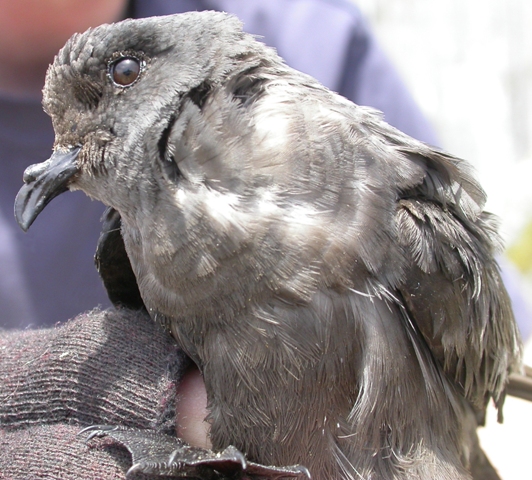
The European Storm-Petrel exhibits distinctive field marks that make it recognizable to experienced birders. Adults are characterized by their sooty black plumage with a contrasting white rump patch, a feature that is particularly visible during flight. The wings are long and pointed, aiding in their agile, fluttering flight pattern. Both males and females share similar plumage, making gender differentiation in the field challenging. Juveniles, however, may show a slightly duller appearance but retain the characteristic white rump. In flight, the European Storm-Petrel can be confused with the Leach's Storm-Petrel, but key differences exist. The European Storm-Petrel has a more fluttering and erratic flight, often compared to that of a bat, whereas the Leach's has a more direct and bounding flight style. Additionally, the white rump of the European Storm-Petrel forms a band across the lower back, unlike the forked tail of the Leach's. When perched, the European Storm-Petrel maintains a horizontal posture with wings folded neatly along the body, a stance that reduces its visibility on rocky breeding grounds. Observers must be vigilant, as the bird's small size and dark coloration can make it less conspicuous against the dark backdrop of sea and sky.
Having trouble telling birds apart? Upload a photo to our bird identification tool for an instant species match.
European Storm-Petrel Habitat and Range
Preferred Habitat
The European Storm-Petrel thrives in marine environments, primarily over the open ocean. Its preferred habitats include the pelagic zones of the North Atlantic, particularly in areas rich in upwellings that bring nutrients to the surface, supporting an abundance of plankton. These birds breed on remote coastal islands with steep cliffs and rocky outcrops, such as those found in the United Kingdom, Ireland, and parts of Scandinavia. At these breeding sites, the European Storm-Petrel seeks out crevices and burrows that offer protection from predators like gulls and skuas. Elevation ranges for these habitats are generally low, close to sea level, though the cliffs themselves can be quite steep. During the winter months, the European Storm-Petrel migrates to warmer waters, with a seasonally shifting habitat to the southern Atlantic regions. Unlike many bird species, they are rarely found in urban or densely populated areas, given their reliance on expansive marine environments. Their presence in rural coastal areas, often far from human habitation, underscores their status as true seabirds, adapted to life on the wing over open waters.
Geographic Range
The European Storm-Petrel has a breeding range that encompasses the northeastern Atlantic Ocean, notably along the coasts of the British Isles and Norway down to France and parts of Spain and Portugal. The highest concentrations occur on islands and secluded coastal cliffs where they form dense breeding colonies. During the non-breeding season, they migrate to the southern Atlantic Ocean, with documented wintering ranges extending to the waters off South Africa's coast and occasionally as far west as the South American coast. This long-distance migration highlights their adaptability and the vastness of their oceanic range. Migration corridors typically follow the western coasts of Europe and Africa, where birds can take advantage of prevailing winds and ocean currents. Population density hotspots during breeding can be observed in places such as the Faroe Islands and St. Kilda, Scotland, where colonies number in the thousands. Outside the breeding season, population concentrations are more dispersed across oceanic waters, reflecting their pelagic lifestyle.
Want to know which birds visit your area? Browse our backyard birds by location guides for region-specific species lists.
What Does the European Storm-Petrel Eat?
The European Storm-Petrel primarily feeds on small marine organisms, with a diet consisting mainly of planktonic crustaceans, small fish, and squid. Their feeding technique, known as 'pattering,' involves hovering above the water's surface and picking up prey with their beaks, often giving the appearance of walking on water. This behavior allows them to exploit the abundant food resources found in nutrient-rich upwellings. Seasonal diet changes occur as they migrate, with a shift towards different prey types depending on availability in their wintering ranges. Prey size is typically small, averaging a few centimeters, suitable for their diminutive size and feeding style. The European Storm-Petrel often feeds in mixed-species flocks, taking advantage of the foraging activities of other seabirds and marine animals that drive prey to the surface. Feeding usually occurs during daylight hours, although they are also known to feed at night, using their keen sense of smell to locate prey in the dark.
European Storm-Petrel Behavior and Social Structure
European Storm-Petrels exhibit fascinating social and territorial behaviors, especially during the breeding season. They are colonial nesters, often forming large colonies on remote islands where they breed in burrows or crevices. These colonies are a flurry of activity, with birds engaging in elaborate courtship displays that include synchronized flight patterns and vocalizations to attract mates. Their social structure is complex, with birds often returning to the same nesting sites and partners year after year, a testament to their monogamous nature. Outside the breeding season, European Storm-Petrels are more solitary, spending the majority of their time over open ocean waters. They display a unique response to predators; when threatened on land, they rely on their cryptic plumage and nesting burrows for protection. In flight, their erratic and fast-paced movements make them difficult targets for aerial predators. Daily activity patterns vary, but during the breeding season, they are most active at dawn and dusk, times when they are less visible to predators. Their nocturnal visits to nesting colonies further minimize predation risks. Despite their small size, European Storm-Petrels exhibit remarkable endurance and navigational abilities, traveling vast distances between breeding and feeding grounds.
European Storm-Petrel Nesting and Reproduction
The nesting habits of the European Storm-Petrel are closely tied to their choice of remote and inaccessible breeding sites. They typically nest in burrows or small crevices found on steep coastal cliffs or rocky islands, locations that provide protection from predators and harsh weather conditions. Nesting materials include pebbles, bits of vegetation, and feathers, which they arrange to form a simple nest lining. The clutch size is usually one egg, reflecting their investment in high parental care. Both parents share incubation duties, with an incubation period lasting around 38-42 days. After hatching, the chick remains in the nest for several weeks, receiving regurgitated food from both parents, who alternate between feeding trips and brooding. The fledging process takes approximately 50-60 days, during which the chick develops the necessary flight skills and waterproofing. European Storm-Petrels typically have one brood per year, a strategy that ensures enough resources for the successful rearing of their young. Parental roles are well-defined, with both sexes contributing equally to nesting and feeding duties.
European Storm-Petrel Sounds and Vocalizations
The vocalizations of the European Storm-Petrel are a distinctive feature of their nocturnal breeding colonies. Their primary song, often described as a series of rapid, chattering notes, is used to communicate between mates and signal territory. The rhythm is consistent, with a repetitive pattern that echoes across breeding sites, especially during calm nights. Call notes are typically softer and used for close-range communication, while alarm calls are sharper and more abrupt, serving as warnings to others in the colony. During the dawn chorus, their calls blend into a cacophony that can be heard from a distance, a mesmerizing soundscape that defines their coastal habitats. Compared to more familiar bird sounds, the European Storm-Petrel’s calls might be likened to the quick tapping of a typewriter, both in speed and repetition.
Interesting Facts About the European Storm-Petrel
- 1The European Storm-Petrel is one of the smallest seabirds in the world, weighing only 20-30 grams.
- 2Despite their size, European Storm-Petrels can live up to 30 years, showing remarkable longevity for such a small bird.
- 3These birds have a keen sense of smell, which they use to locate food over vast ocean distances.
- 4European Storm-Petrels are known to follow ships, sometimes for days, taking advantage of food waste and stirred-up prey.
- 5Their name 'storm-petrel' is derived from their association with storms; sailors once believed they were harbingers of bad weather.
- 6The European Storm-Petrel's fluttering flight is often described as 'bat-like,' setting it apart from other seabirds.
- 7They exhibit strong site fidelity, often returning to the same burrow and mate every year.
European Storm-Petrel Conservation Status
The European Storm-Petrel is currently listed as 'Least Concern' by the IUCN, indicating a stable global population. However, certain local populations have faced declines due to habitat disturbance, introduced predators such as rats and cats, and pollution, particularly oil spills that contaminate their feeding areas. Conservation efforts focus on protecting breeding sites, eradicating invasive species, and monitoring population trends through banding and tracking studies. Historical population changes have been influenced by human activities, but protective measures in key breeding areas have led to notable recoveries. Ensuring the continued health of their marine habitats, particularly in the face of climate change, remains a priority for conservationists.
Other Hydrobatidae Species



Birds Similar to the European Storm-Petrel
These species are often confused with the European Storm-Petrel due to similar appearance or overlapping range.
