Golden Pipit
Tmetothylacus tenellus
Order: Passeriformes / Family: Motacillidae
Wikimedia Commons
About the Golden Pipit
The Golden Pipit (Tmetothylacus tenellus) is a distinctive member of the family Motacillidae, renowned for its vibrant plumage and captivating behaviors. This species inhabits arid and semi-arid regions across Eastern Africa, particularly in countries such as Kenya, Somalia, Ethiopia, and Tanzania. The bird thrives in savanna and open woodland environments, where it can be observed engaging in its characteristic displays. The Golden Pipit plays an essential role in its ecosystem as both a consumer of insects and a prey species for larger predators. Its presence indicates a healthy balance in these ecosystems, as it relies on the abundance of invertebrates and appropriate nesting sites.
The Golden Pipit is particularly significant for bird watchers due to its striking appearance and behavioral displays. During the breeding season, male Golden Pipits perform an elaborate aerial display to attract females, showcasing their agility and the brilliance of their plumage. These displays are not only crucial for mating success but also serve as a territorial declaration. Outside the breeding season, these pipits can be found in small flocks, wandering the savannas in search of food, which primarily consists of insects and other small invertebrates.
Ecologically, the Golden Pipit serves as an important control for insect populations, consuming a variety of prey that might otherwise reach pest status. The bird's foraging activity benefits the plant community by reducing herbivore pressures. In turn, the pipits contribute to the nutrient cycle through their droppings, enriching the soil and promoting plant growth. Seasonal movements of the Golden Pipit are largely influenced by rainfall patterns, which dictate the availability of food resources. As such, the bird's presence is often a reliable indicator of the onset of the rainy season in its habitat.
Observing the Golden Pipit in its natural habitat offers insights into the complex interplay between species and their environments. Its adaptive behaviors, such as timing breeding with peak insect abundance, highlight the intricate strategies birds in arid regions employ to survive. The Golden Pipit remains a subject of interest not only for ornithologists but also for conservationists, as understanding its habits and requirements helps inform broader efforts to protect Africa's avian biodiversity.
The Golden Pipit belongs to the family Motacillidae, within the order Passeriformes. These birds typically live average 4-5 years, with max recorded up to 8 years..
How to Identify a Golden Pipit
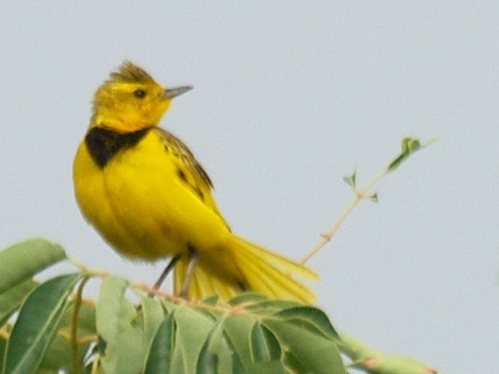
The Golden Pipit stands out with its vivid yellow plumage, a feature that aids in easy identification among its peers. Adult males display a bright golden-yellow body contrasted by a striking black throat and upper chest. The wings and tail are primarily brown, offering a subtle backdrop to the bird's vibrant upperparts. Females and juveniles, while similar in structure, exhibit more subdued coloration, with a paler yellow hue and less pronounced black markings. This sexual dimorphism is typical, allowing quick differentiation in the field.
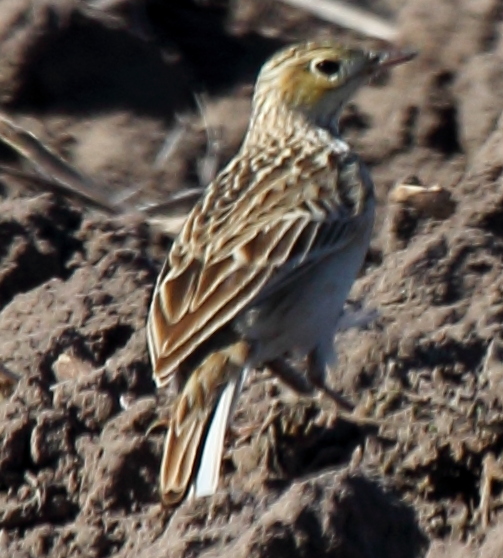
One might confuse the Golden Pipit with other pipit species; however, its unique coloration and behavior set it apart. The African Pipit, for example, lacks the bright yellow of the Golden Pipit and has a more streaked appearance. In flight, the Golden Pipit shows a distinctive silhouette, with long wings and a slender body, often accompanied by a bounding flight pattern that is characteristic of pipits.
Perched, the Golden Pipit maintains an upright posture, often seen on low branches or the ground. Its movements are deliberate, with a tendency to flick its tail repeatedly, a behavior common among pipits. Observers should note the bird's preference for open areas, where its bright plumage serves as both a lure for mates and a signal to rivals.
Having trouble telling birds apart? Upload a photo to our bird identification tool for an instant species match.
Golden Pipit Habitat and Range
Preferred Habitat
The Golden Pipit primarily inhabits arid and semi-arid regions of Eastern Africa, with a preference for open savannas and sparse woodlands. These habitats are characterized by scattered trees and shrubs, providing ample foraging grounds and perching spots. The bird can be found at elevations ranging from sea level up to approximately 1,500 meters, depending on the specific geography of the region.
During the breeding season, the Golden Pipit often seeks out areas with a higher density of vegetation that offer suitable nesting sites and increased insect activity. Conversely, in non-breeding periods, it may venture into more open plains where food sources are more readily accessible.
Although primarily a bird of rural landscapes, the Golden Pipit occasionally appears in semi-urban environments, particularly where these overlap with natural habitats. However, it tends to avoid densely populated human areas, maintaining a preference for the relative tranquility of open spaces.
Geographic Range
The Golden Pipit ranges across several East African countries, with a core distribution in Kenya, Somalia, Ethiopia, and Tanzania. Within these nations, it is most frequently observed in regions that provide the open savanna habitats it favors. This bird does not follow long migration patterns, instead displaying more localized movements in response to seasonal changes in food availability and habitat conditions.
During breeding periods, the Golden Pipit tends to concentrate in areas where favorable conditions for nesting and feeding coincide. In Kenya, for instance, the bird is most often found in the southern and eastern parts, where the landscape offers ideal breeding sites.
In the non-breeding season, the Golden Pipit may expand its range slightly, moving into areas that provide abundant foraging opportunities. This species does not typically form dense populations, but it can be locally common in areas where conditions are optimal. Bird watchers are more likely to spot the Golden Pipit in specific hotspots such as the Tsavo National Park in Kenya, a region known for its bird diversity.
Want to know which birds visit your area? Browse our backyard birds by location guides for region-specific species lists.
What Does the Golden Pipit Eat?
The diet of the Golden Pipit primarily consists of insects and other small invertebrates, with a particular preference for beetles, grasshoppers, and ants. During the wet season, when insect populations peak, the Golden Pipit capitalizes on the abundance, often seen foraging in open areas where prey is easily accessed.
In addition to insects, the Golden Pipit may consume small seeds, especially during periods when insect prey is less available. This dietary flexibility allows the bird to maintain its energy needs throughout varying seasonal conditions.
The Golden Pipit employs a ground-foraging technique, moving swiftly across the terrain with keen eyes scanning for movement. Once prey is detected, the bird captures it with rapid, precise strikes. Feeding activity primarily occurs during the cooler parts of the day, such as early morning and late afternoon, aligning with peak insect activity and avoiding midday heat.
Golden Pipit Behavior and Social Structure
The social structure of the Golden Pipit is primarily solitary or in small groups, especially outside the breeding season. During the breeding period, males become particularly territorial, engaging in aerial displays that involve dramatic flights and calls to establish dominance and attract mates. These displays include rapid ascents, followed by spiraling descents, showcasing the bird's agility and stamina.
Courtship involves a series of displays and vocalizations, with males presenting food items to females as part of the bonding process. Once paired, the male and female Golden Pipit work together to defend their territory from intruders, although the male remains the primary defender.
The bird's response to predators includes alarm calls and evasive maneuvers. When approached by ground predators, the Golden Pipit often takes flight, utilizing its agile movements to escape. Its daily activity pattern follows a diurnal cycle, with peak activity in the early morning and late afternoon when foraging conditions are optimal.
Golden Pipit Nesting and Reproduction
The Golden Pipit constructs its nest on the ground, typically in well-hidden locations under shrubs or tall grasses to minimize exposure to predators. The nest is a cup-shaped structure made from grasses, leaves, and other plant materials, lined with softer items to provide comfort for the eggs and chicks.
A typical clutch consists of 2 to 4 eggs, with incubation performed by the female over a period of approximately two weeks. During this time, the male provides food for the incubating female, ensuring that she can remain on the nest as much as possible.
After hatching, the chicks are altricial, requiring extensive parental care. Both parents participate in feeding the young, bringing insects and other small prey to the nest. The fledging period lasts about two weeks, after which the young birds gradually become more independent, though they may continue to receive some parental support. The Golden Pipit usually raises one brood per year, though favorable conditions might allow for a second.
Golden Pipit Sounds and Vocalizations
The primary song of the Golden Pipit is a series of melodious whistles, characterized by a clear, rising and falling pattern. Often heard during the breeding season, this song serves to establish territory and attract mates. The rhythm is steady, with a musical quality that distinguishes it from the harsher calls of some other pipit species.
In addition to its song, the Golden Pipit emits various call notes, especially during flight or when disturbed. These calls are sharp and high-pitched, serving as communication between individuals. Alarm calls are more abrupt and urgent, alerting nearby birds to potential threats.
During the dawn chorus, the Golden Pipit's song contributes to the symphony of sounds in its habitat, adding a bright, lively tone to the early morning ambiance.
Interesting Facts About the Golden Pipit
- 1The Golden Pipit is one of the few bird species where males are more brightly colored than females, a trait linked to sexual selection.
- 2During courtship, male Golden Pipits perform aerial displays reminiscent of acrobatic shows, climbing high and executing spirals.
- 3The species was first described in 1884 by the ornithologist Anton Reichenow, known for his extensive work on African birds.
- 4Golden Pipits are known to time their breeding season with the onset of rains, ensuring maximum food availability for their chicks.
- 5Despite their vibrant color, Golden Pipits are adept at blending into their surroundings when on the ground, thanks to their brown wings and tail.
Golden Pipit Conservation Status
The Golden Pipit is currently classified as Least Concern by the IUCN, reflecting its relatively stable population trend. While not considered threatened, the Golden Pipit faces challenges from habitat loss due to agricultural expansion and land degradation in parts of its range. Conservation efforts focus on preserving the open savanna and woodland habitats that are crucial for the species' survival. Initiatives include habitat restoration projects and protected area management to ensure that these environments remain viable for wildlife. Historically, the population of the Golden Pipit has remained stable, with no significant declines reported. However, ongoing monitoring is essential to detect any early signs of population stress that might arise from environmental changes or human activities.