
Moustached Tinkerbird
Pogoniulus leucomystax
Order: Piciformes / Family: Lybiidae

Wikimedia Commons
About the Moustached Tinkerbird
The Moustached Tinkerbird, scientifically known as Pogoniulus leucomystax, is a small yet captivating member of the Lybiidae family. This bird is native to the montane forests of East Africa, where its presence adds a splash of color and vibrancy to its habitats. Known for its distinctive black and white facial pattern resembling a moustache, this tinkerbird inhabits regions characterized by dense vegetation and abundant insect life, which provide both sustenance and cover.
The significance of the Moustached Tinkerbird extends beyond its aesthetic appeal. As an insectivore, it plays a crucial role in controlling insect populations within its habitat. This ecological contribution helps maintain a balanced ecosystem, supporting both plant life and other animal species. Its role as a seed disperser also aids in the propagation of various plant species, further contributing to the health of its natural environment.
Typically found in the montane forests of countries like Uganda, Kenya, and Tanzania, the Moustached Tinkerbird thrives in areas abundant with fruiting trees and flowering plants. The bird's seasonal behaviors are influenced by food availability, leading it to adjust its foraging patterns and territory size in response to seasonal shifts. During the breeding season, which often coincides with the onset of the rainy season, this bird becomes more vocal and active, establishing territories and engaging in courtship displays. Its presence is an indicator of a healthy forest ecosystem, and its absence could signal disruptions in habitat quality.
The Moustached Tinkerbird's ecological role and its adaptation to specific montane environments highlight its importance in the biodiversity of East Africa. Its interactions within its ecosystem, both as a predator of insects and a consumer of fruits, underscore the interconnectedness of species within these lush habitats. As such, the conservation of this species and its habitat is vital not only for its survival but also for the overall health of the ecosystems it inhabits.
The Moustached Tinkerbird belongs to the family Lybiidae, within the order Piciformes. These birds typically live approximately 5-7 years, with some individuals living longer in optimal conditions..
How to Identify a Moustached Tinkerbird
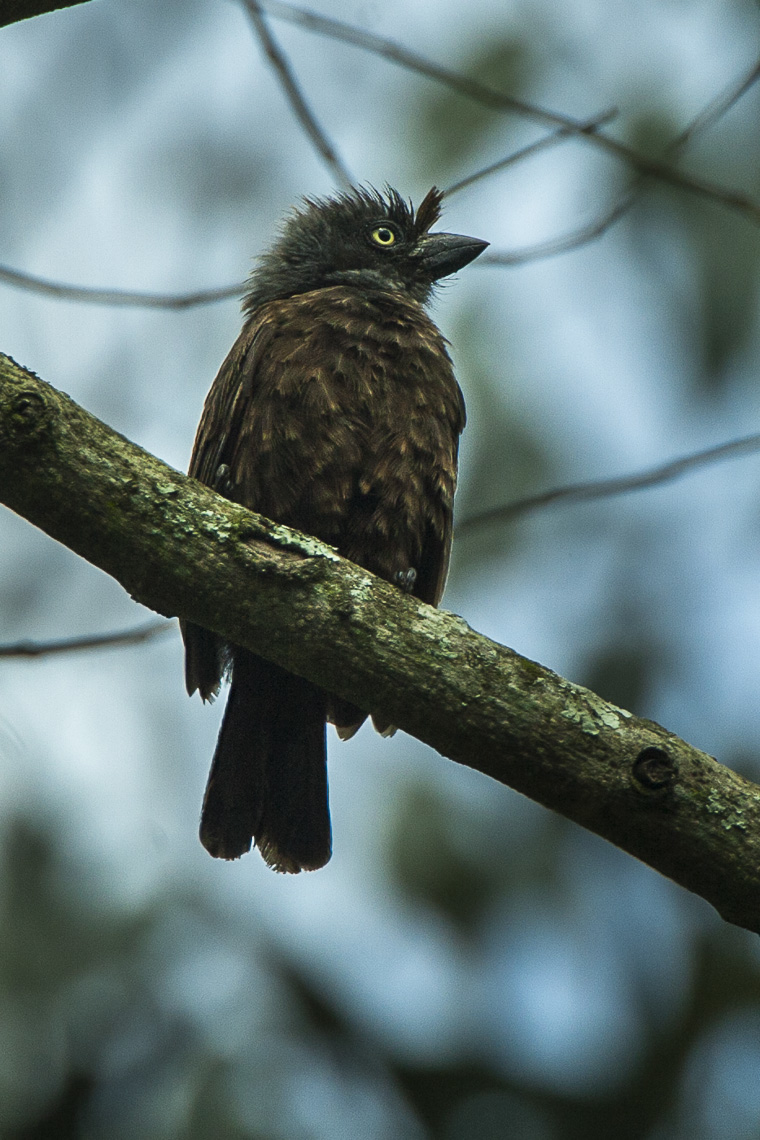
The Moustached Tinkerbird is easily recognized by its small size, measuring about 10 centimeters in length, and its vibrant plumage. Adults display a striking combination of colors with a mostly green back, yellow underparts, and a distinctive black and white 'moustache' pattern on the face. The crown is often a darker shade of green, providing a stark contrast to the bright yellow of the underparts.
Juvenile Moustached Tinkerbirds resemble adults but with slightly duller colors and less defined facial markings. As they mature, their plumage becomes more vivid, and the characteristic facial pattern sharpens. There is little sexual dimorphism in this species, meaning males and females look quite similar, which can make field identification challenging without close observation.
In flight, the Moustached Tinkerbird's silhouette is compact, with short, rounded wings and a relatively short tail. When perched, it often adopts an upright posture, making it easier to spot against the dense foliage it favors. While there are other tinkerbird species within its range, the Moustached Tinkerbird's unique facial pattern and vibrant colors help distinguish it from similar species.
Having trouble telling birds apart? Upload a photo to our bird identification tool for an instant species match.
Moustached Tinkerbird Habitat and Range
Preferred Habitat
The Moustached Tinkerbird primarily inhabits montane forests, thriving in elevations ranging from 1,200 to 3,000 meters. These forests offer a rich tapestry of flora and fauna, providing the bird with ample food sources and nesting opportunities. Key examples of its habitat include the lush forests of Mount Kenya, the Aberdare Range, and the Eastern Arc Mountains.
In terms of habitat specificity, the Moustached Tinkerbird shows a preference for areas with dense understory and a variety of fruiting plants. This bird can occasionally be found in forest edges and secondary growth areas, where it benefits from the abundance of insects and fruit. Seasonal habitat shifts are minimal, as the bird tends to remain in montane regions throughout the year, although it may move to slightly lower elevations during colder months.
While primarily a forest dweller, the Moustached Tinkerbird has been known to adapt to human-modified landscapes, such as agricultural areas, where it finds food and shelter. However, it is less commonly found in urban environments, as these do not meet its specific habitat needs.
Geographic Range
The Moustached Tinkerbird's range is largely confined to the montane regions of East Africa. It breeds and resides year-round in countries such as Uganda, Kenya, Tanzania, and parts of eastern Democratic Republic of the Congo. These regions offer the high-altitude forests that the bird depends on for survival.
During the breeding season, which coincides with the rainy season, the Moustached Tinkerbird is especially abundant in well-vegetated areas where food resources are plentiful. The bird's population density is highest in regions where montane forest cover is extensive, such as the slopes of Mount Elgon and the Virunga Mountains.
Migration is not a prominent feature in the life of the Moustached Tinkerbird. Unlike many other avian species, it does not undertake long-distance migrations. Instead, it exhibits a more localized movement pattern, primarily shifting elevations in response to seasonal variations in temperature and food availability.
Want to know which birds visit your area? Browse our backyard birds by location guides for region-specific species lists.
What Does the Moustached Tinkerbird Eat?
The diet of the Moustached Tinkerbird predominantly comprises insects and fruit, reflecting its role as both an insectivore and frugivore. Insects form the primary component of its diet, with a particular preference for beetles, ants, and caterpillars. These are often gleaned from foliage and bark, demonstrating the bird's adept foraging skills.
Fruit consumption is particularly important during the dry season when insect availability declines. The Moustached Tinkerbird favors figs and other small, soft fruits that are abundant in its montane forest habitat. This dietary flexibility allows the bird to thrive even in periods of scarcity, ensuring its survival through fluctuating environmental conditions.
Foraging typically occurs throughout the day, with peak activity in the early morning and late afternoon. The bird employs a methodical approach to foraging, often moving systematically through vegetation to maximize its food intake. This efficiency in feeding supports its energetic lifestyle and active territorial behavior.
Moustached Tinkerbird Behavior and Social Structure
The Moustached Tinkerbird exhibits fascinating behavior patterns that reflect its adaptive strategies for survival. It is generally a solitary bird, often seen alone or in pairs, particularly during the breeding season. This species maintains a well-defined territory, which it defends vigorously against intruders, including other tinkerbirds and potential predators.
Courtship displays are a notable aspect of its behavior, with males engaging in vocal and visual displays to attract females. These displays often involve repeated singing, accompanied by wing-fluttering and hopping movements. Once paired, the birds engage in mutual preening, which strengthens the bond between mates.
Despite its solitary nature, the Moustached Tinkerbird may join mixed-species feeding flocks, especially outside the breeding season. This social behavior increases foraging efficiency and enhances predator detection. Daily activities include periods of rest interspersed with active feeding and territorial defense, making the bird a dynamic participant in its ecosystem.
Moustached Tinkerbird Nesting and Reproduction
The nesting habits of the Moustached Tinkerbird reflect its adaptation to forest environments. The bird typically excavates a nest cavity in a dead tree or branch, a task undertaken by both members of a breeding pair. The excavation process can take several days, during which the birds use their beaks to chip away at the wood.
The nest is lined with soft plant material, providing a comfortable environment for the eggs. A typical clutch consists of 2-4 eggs, which both parents incubate over a period of approximately 12-15 days. This shared responsibility extends to feeding and caring for the chicks once they hatch.
Fledging occurs about 18-21 days after hatching, although young birds may remain with their parents for several weeks as they learn essential survival skills. The Moustached Tinkerbird usually raises one brood per year, although favorable conditions may enable a second brood in some instances. Parental roles are well-defined, with both parents contributing equally to the nurturing of their young.
Moustached Tinkerbird Sounds and Vocalizations
The Moustached Tinkerbird's vocalizations are distinctive and serve as key identification markers. Its primary song is a series of repetitive, metallic 'tink' notes that resemble the sound of a distant hammer striking an anvil. These notes are delivered in a consistent rhythm, often persisting for extended periods, particularly during the breeding season.
Apart from its song, the bird emits various call notes used in communication with mates and offspring. Alarm calls are sharper and more urgent, designed to alert others to potential threats. The dawn chorus sees the Moustached Tinkerbird joining other forest birds in a vocal display that establishes territory and attracts mates. Its vocalizations are not only a tool for communication but also a characteristic feature of its presence in the forest.
Interesting Facts About the Moustached Tinkerbird
- 1The Moustached Tinkerbird's distinctive song can be heard up to half a kilometer away, making it a prominent sound in its habitat.
- 2Despite its small size, the Moustached Tinkerbird plays a crucial role in seed dispersal, aiding in forest regeneration.
- 3The bird's name 'tinkerbird' derives from its metallic-sounding call, reminiscent of a blacksmith's hammer at work.
- 4Moustached Tinkerbirds are known to join mixed-species flocks, benefiting from increased foraging success and predator vigilance.
- 5Their nesting cavities, often excavated in dead wood, provide crucial habitats for other species once abandoned.
- 6The Moustached Tinkerbird is one of the few bird species that can move its upper mandible independently of its lower one.
- 7This species is a year-round resident of montane forests, showing little to no migratory behavior, unlike many other birds.
Moustached Tinkerbird Conservation Status
The Moustached Tinkerbird is currently classified as Least Concern by the IUCN, with a stable population trend. However, like many forest-dependent species, it faces potential threats from habitat loss due to deforestation and land conversion for agriculture. Conservation efforts focus on preserving montane forest habitats, which are critical for the survival of this species. In recent years, increased awareness of the importance of montane ecosystems has led to the establishment of protected areas and conservation initiatives. These efforts aim to mitigate the impact of human activities and ensure the long-term viability of habitats crucial for the Moustached Tinkerbird. Continued monitoring of population trends and habitat conditions will be essential to address any emerging threats to this species' survival.
Other Lybiidae Species


Birds Similar to the Moustached Tinkerbird
These species are often confused with the Moustached Tinkerbird due to similar appearance or overlapping range.

