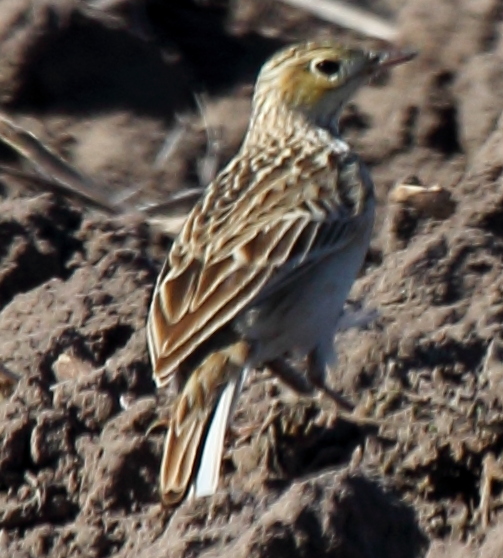
Plain-backed Pipit
Anthus leucophrys
Order: Passeriformes / Family: Motacillidae

Wikimedia Commons
About the Plain-backed Pipit
The Plain-backed Pipit (Anthus leucophrys) is a sparrow-sized passerine bird known for its unremarkable yet subtly elegant plumage. It thrives in the open grasslands and savannas of sub-Saharan Africa, making it a familiar sight across a diverse range of ecosystems. This species plays a significant role in its ecosystem by acting as both a predator and prey. As insectivores, Plain-backed Pipits help control insect populations, consuming a variety of grasshoppers, beetles, and other arthropods. In turn, they serve as prey for larger birds of prey and small mammals. The presence of the Plain-backed Pipit is often an indicator of healthy grassland ecosystems. This bird is resilient, adapting to changes in land use and seasonal shifts in climate. During the breeding season, which generally aligns with the wet season, males establish territories with conspicuous display flights and vocalizations. Outside of the breeding season, these pipits may form loose flocks, particularly when food resources become concentrated in specific areas. Their adaptability allows them to exploit both natural and altered landscapes, including agricultural fields and pastures. The ecological role of the Plain-backed Pipit underscores the interconnectedness of species within an ecosystem. By participating in the food web, they help maintain ecological balance. Additionally, their presence in agricultural areas can be beneficial for pest control, offering a natural solution to managing insect populations. The Plain-backed Pipit’s widespread distribution across Africa, from South Africa to Ethiopia, makes it a species of interest to ornithologists and birdwatchers alike. Observing their behavior provides insights into the dynamics of grassland bird communities. As grasslands face threats from overgrazing, agriculture, and urbanization, the conservation of the Plain-backed Pipit and its habitat becomes increasingly important. Ensuring the preservation of grassland ecosystems not only supports this species but also the myriad of other organisms that depend on these landscapes.
The Plain-backed Pipit belongs to the family Motacillidae, within the order Passeriformes. These birds typically live typically 3-5 years, with a maximum recorded of 8 years..
How to Identify a Plain-backed Pipit
Identifying the Plain-backed Pipit requires careful observation of its subtle field marks. Adults exhibit a plain, olive-brown back with no streaking, distinguishing them from other pipits that often have more marked plumage. Their underparts are a pale buff with light streaking on the breast, providing camouflage against the grassland backdrop. The face features a distinct but understated supercilium, or eyebrow stripe, which is whitish in color. The legs are characteristically pinkish, and the bill is slender and dark, adapted for insectivory. Juveniles resemble adults but often display a more pronounced streaking on the back and wings, which fades as they mature. Sexual dimorphism is minimal, with males and females appearing similar, though males may be slightly larger. In flight, the Plain-backed Pipit shows a typical pipit silhouette with pointed wings and a long tail. Its flight pattern is undulating, with bursts of rapid wingbeats followed by short glides. When perched, this bird often adopts an upright posture, which aids in scanning for predators and prey alike. The Plain-backed Pipit can be confused with other pipit species such as the African Pipit, but careful attention to the lack of back streaks and the overall less marked appearance helps differentiate it.
Having trouble telling birds apart? Upload a photo to our bird identification tool for an instant species match.
Plain-backed Pipit Habitat and Range
Preferred Habitat
The habitat preference of the Plain-backed Pipit includes open grasslands, savannas, and agricultural fields. These environments provide the ideal conditions for foraging and nesting. Typically found at elevations ranging from sea level to about 2,500 meters, the bird adjusts to varying altitudes throughout its range. Seasonal habitat shifts occur as the Plain-backed Pipit moves in response to changes in food availability, often favoring wetter areas during the dry season. While primarily associated with rural landscapes, this species occasionally ventures into urban fringes where suitable grassland patches exist. In regions like the Serengeti in Tanzania and the Highveld grasslands of South Africa, the Plain-backed Pipit is commonly observed. Understanding its habitat requirements helps in conservation efforts, particularly in areas facing land-use changes.
Geographic Range
The range of the Plain-backed Pipit spans the vast grasslands of sub-Saharan Africa. It breeds in regions extending from South Africa northwards to Zambia, Zimbabwe, and Tanzania. During the non-breeding season, populations may disperse more widely, reaching countries like Kenya, Uganda, and Ethiopia. Migration corridors are not distinctly defined, as this species is largely resident, with some local movements driven by seasonal rains and food availability. Population density is highest in grassland regions, such as the savannas of Botswana and the open fields of the Eastern Cape in South Africa. The bird's adaptability allows it to flourish across these varied landscapes, maintaining a stable presence throughout its range.
Want to know which birds visit your area? Browse our backyard birds by location guides for region-specific species lists.
What Does the Plain-backed Pipit Eat?
The diet of the Plain-backed Pipit primarily consists of insects, making it an effective insectivore. Grasshoppers, beetles, and ants form the bulk of its diet, with variations occurring seasonally based on availability. During periods of abundance, such as after rains, the pipit will consume a wide range of arthropods, taking advantage of the increased prey availability. Its foraging technique involves walking or running along the ground with quick, deliberate movements, often pausing to scan for prey. This method allows the pipit to detect and capture insects efficiently. The size of prey typically ranges from small ants to larger grasshoppers, which the bird handles adeptly with its slender bill. Feeding occurs primarily during daylight hours, with peak activity in the early morning and late afternoon when insects are most active.
Plain-backed Pipit Behavior and Social Structure
The social structure of the Plain-backed Pipit is relatively solitary outside of the breeding season, although loose associations may form in areas with abundant food. During the breeding season, males establish territories and engage in conspicuous display flights, characterized by ascending in a steep, fluttering flight, singing, then parachuting down. This display asserts territorial dominance and attracts potential mates. Territorial disputes are common, often involving aerial chases and vocal duels. Courtship involves males performing aerial displays and presenting food to females. In response to predators, the pipit relies on its cryptic coloration and swift flight to evade capture. It often remains motionless on the ground, blending with its surroundings when threatened. Daily activity patterns include foraging in the early morning and late afternoon to avoid the midday heat, with rest periods during the hottest part of the day. The Plain-backed Pipit’s behaviors reflect its adaptation to the grassland environment, balancing solitary and social tendencies.
Plain-backed Pipit Nesting and Reproduction
Plain-backed Pipits nest on the ground, often choosing sites well-hidden among grasses to avoid detection by predators. The nest is a simple cup structure, constructed from dry grasses and lined with finer materials for insulation and comfort. Preferred nest locations include slight depressions or natural hollows that provide additional concealment. A typical clutch comprises 2 to 4 eggs, which are pale with speckled markings. Both parents participate in incubation, which lasts approximately 12 to 14 days. Once hatched, the nestlings are altricial, requiring significant parental care. Fledging occurs around two weeks after hatching, with parents continuing to feed and protect the young for an additional period. The species generally raises one to two broods per year, depending on environmental conditions and food availability.
Plain-backed Pipit Sounds and Vocalizations
The Plain-backed Pipit's primary song is a series of melodious, high-pitched notes that rise and fall in a rhythmic pattern, often delivered during display flights. These vocalizations serve both territorial and courtship purposes, echoing across the grasslands. Call notes are shorter and more subdued, consisting of a sharp 'tsip' used for communication between individuals. Alarm calls are more insistent, alerting others to potential threats. During the dawn chorus, the Plain-backed Pipit adds its voice to the symphony of grassland birds, with its song being one of the more prominent and recognizable elements.
Interesting Facts About the Plain-backed Pipit
- 1Plain-backed Pipits are capable of walking or running over 100 meters in search of food.
- 2Despite their plain appearance, the display flight of the Plain-backed Pipit is a striking aerial performance.
- 3This species is known to mimic the songs of other grassland birds, adding complexity to its own vocal repertoire.
- 4Plain-backed Pipits can be found in altitudes reaching up to 2,500 meters, showing remarkable adaptability.
- 5The species' preference for open habitats makes it less common in densely forested areas.
- 6In some regions, Plain-backed Pipits are considered beneficial for controlling agricultural pests.
- 7Their nests are often so well-hidden that they are more often heard than seen by potential predators.
Plain-backed Pipit Conservation Status
The conservation status of the Plain-backed Pipit is currently classified as Least Concern by the IUCN, with a stable population trend. However, habitat degradation due to overgrazing, agriculture, and urbanization poses potential long-term threats. Conservation efforts focus on preserving grassland habitats and promoting sustainable land-use practices. While not currently endangered, monitoring population trends remains important to ensure that this widespread and adaptable species continues to thrive in its natural habitats.