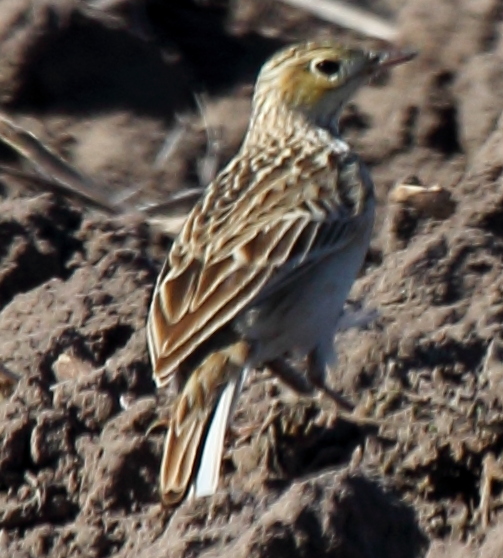
Sokoke Pipit
Anthus sokokensis
Order: Passeriformes / Family: Motacillidae

Wikimedia Commons
About the Sokoke Pipit
The Sokoke Pipit (Anthus sokokensis) is a small passerine bird native to the dense, lowland forests of East Africa, specifically the coastal regions of Kenya and northeastern Tanzania. Its presence is particularly noted in the Arabuko-Sokoke Forest in Kenya, the bird's namesake, as well as in the Usambara Mountains of Tanzania. This bird is a vital part of its ecosystem, contributing to insect population control and serving as an indicator of forest health. The Sokoke Pipit primarily inhabits undisturbed forest areas with dense undergrowth, where it forages on the forest floor. This species' significance extends beyond its ecological role; it is a subject of interest for conservationists due to its restricted range and vulnerability to habitat destruction. Given its reliance on forest habitats, the Sokoke Pipit is sensitive to deforestation and habitat fragmentation, making preservation efforts crucial for its survival.
The Sokoke Pipit's ecological role is underscored by its feeding habits, which help maintain the balance of invertebrate populations within its habitat. As an insectivore, it plays a part in controlling insect populations that could otherwise grow unchecked. This bird's presence also signifies a healthy and undisturbed forest environment, making it a key species for conservation monitoring. The Sokoke Pipit is not migratory, but it does exhibit some seasonal movements within its range, likely linked to food availability and breeding requirements. During the dry season, these birds may move to moister areas with richer insect abundance.
The Sokoke Pipit is a species of concern for conservationists. Its restricted distribution and specialized habitat needs render it susceptible to environmental changes and human activities. Conservation efforts focus on protecting its forest habitat from logging, agriculture, and infrastructure development. The Sokoke Pipit serves as a flagship species for conservation initiatives, highlighting the importance of maintaining the integrity of East African coastal forests. In addition to its ecological importance, the bird's rarity and unique behaviors make it a subject of interest for birdwatchers and researchers alike, further emphasizing the need for continued study and conservation of this remarkable species.
The Sokoke Pipit belongs to the family Motacillidae, within the order Passeriformes. These birds typically live average 4 years, with a maximum recorded of 6 years..
How to Identify a Sokoke Pipit
The Sokoke Pipit is a small, unobtrusive bird with a length of approximately 15 cm and a weight of around 25 grams. Adult plumage is predominantly brown, providing excellent camouflage against the forest floor. The bird exhibits a streaked pattern on its upperparts, with fine, dark streaks running across the brown back and wings. Underparts are paler, often displaying a slight buffy wash with faint streaking. This plumage aids in its cryptic behavior, making it challenging to spot in its natural habitat.
Juveniles resemble adults but possess slightly duller plumage with more pronounced streaking. There is little sexual dimorphism in this species, meaning males and females look similar, which can complicate field identification. However, subtle differences may be noted during the breeding season when males may exhibit more vibrant plumage.
When comparing the Sokoke Pipit to similar species, one might consider the African Pipit or the Woodland Pipit, both of which share overlapping ranges. However, the Sokoke Pipit can be distinguished by its preference for dense forest habitats and its more subdued coloration. The bird's flight silhouette is characterized by a relatively short tail and rounded wings, and it often perches low on branches or directly on the forest floor, where it exhibits a distinctive tail-bobbing behavior.
Having trouble telling birds apart? Upload a photo to our bird identification tool for an instant species match.
Sokoke Pipit Habitat and Range
Preferred Habitat
The Sokoke Pipit is primarily found in lowland coastal forests, with a strong preference for dense, undisturbed woodland areas. The bird's range is tightly linked to the remaining patches of indigenous forest along the East African coast. This includes the Arabuko-Sokoke Forest in Kenya, the largest remaining fragment of coastal forest in East Africa, and the Usambara Mountains in Tanzania.
These forests are typically situated at elevations ranging from sea level to about 300 meters. The Sokoke Pipit relies heavily on dense undergrowth and leaf litter, which provide both foraging grounds and protection from predators. Seasonal habitat shifts are minimal as the bird is non-migratory, but it may move to slightly different forest areas during dry spells in search of food.
Human encroachment poses a significant threat to the Sokoke Pipit's habitat. Logging, agriculture, and development have reduced the extent of these forests, highlighting the importance of protected areas and sustainable land-use practices in preserving these critical environments.
Geographic Range
The Sokoke Pipit's range is highly restricted, primarily confined to the coastal forests of eastern Kenya and northeastern Tanzania. Key locations include the Arabuko-Sokoke Forest in Kenya, which is considered one of the most important sites for the species, and the Usambara Mountains in Tanzania. This limited range means that the Sokoke Pipit is considered endemic to this specific region of East Africa.
Unlike many other pipits, the Sokoke Pipit is non-migratory, residing year-round within its forest home. However, it may exhibit minor local movements within its range, particularly in response to changes in food availability or environmental conditions. Although the bird’s range is small, population density can be relatively high in suitable habitats where undergrowth is dense and insect prey abundant.
Conservation efforts are critical in these areas, as habitat loss due to deforestation and human encroachment threatens the already limited range of this species. Protecting the remaining forest fragments within its range is crucial for the Sokoke Pipit's survival and for maintaining the biodiversity of these unique ecosystems.
Want to know which birds visit your area? Browse our backyard birds by location guides for region-specific species lists.
What Does the Sokoke Pipit Eat?
The Sokoke Pipit's diet primarily consists of insects and other small invertebrates, which it forages from the forest floor. Its diet includes ants, beetles, spiders, and small caterpillars. This bird employs a methodical foraging technique, walking slowly along the ground, flicking aside leaf litter with its bill to uncover hidden prey. This behavior not only aids in prey detection but also minimizes energy expenditure in the dense forest environment.
Seasonal changes in diet are not well-documented, but it is likely that the Sokoke Pipit adjusts its prey selection based on availability. During the wet season, when insect populations are at their peak, the bird may have a more varied diet, while in drier times, it may rely on more abundant insect species.
Feeding occurs primarily during the day, with peak activity in the early morning and late afternoon when temperatures are cooler and insect activity is high. The Sokoke Pipit's specialized diet and foraging strategy highlight its adaptation to the specific ecological niche within the East African coastal forests.
Sokoke Pipit Behavior and Social Structure
The Sokoke Pipit exhibits a range of behaviors suited to its forested environment. It is generally solitary or seen in pairs, particularly during the breeding season. Territorial behavior is pronounced, with individuals defending their feeding and nesting areas from intruders. The bird's territorial calls are an essential part of maintaining boundaries and attracting mates.
Courtship displays are subtle and primarily involve vocalizations and low-intensity chases through the undergrowth. The Sokoke Pipit is not known to form large flocks, but small family groups may be observed outside the breeding season.
In response to predators, the Sokoke Pipit relies on its cryptic plumage and behavior, often freezing or retreating into dense vegetation to avoid detection. Daily activity patterns revolve around foraging, with the bird spending much of its time on the ground, moving deliberately and using its bill to probe the leaf litter.
The Sokoke Pipit's shy nature and preference for dense cover make it a challenging species to observe in the wild, adding to its allure among birdwatchers and naturalists.
Sokoke Pipit Nesting and Reproduction
The Sokoke Pipit typically constructs its nest on or near the ground, hidden within dense undergrowth or among the roots of trees. The nest is a small cup made of grass, leaves, and other plant materials, often lined with finer grasses for added comfort.
Clutch size generally ranges from two to four eggs, which are pale with fine speckling to aid in camouflage. Both parents share the responsibility of incubating the eggs, which lasts approximately 12 to 14 days. After hatching, the chicks remain in the nest for about 14 to 16 days before fledging.
Parental care continues post-fledging, with adults feeding and protecting the young until they are independent. The Sokoke Pipit typically raises one or two broods per year, depending on environmental conditions and food availability. Nest predation by mammals and birds poses a threat to breeding success, emphasizing the importance of well-concealed nesting sites.
Sokoke Pipit Sounds and Vocalizations
The primary song of the Sokoke Pipit is a soft, melodious series of notes, often described as a sequence of trills and whistles. The song serves multiple purposes, including territory defense and mate attraction. It has a rhythmic quality, with a mixture of high-pitched notes that can carry through the dense forest.
Call notes are more subdued, consisting of short, sharp 'chip' sounds used for communication between mates and during foraging. Alarm calls are more urgent and harsh, signaling the presence of potential threats to conspecifics.
The Sokoke Pipit participates in the dawn chorus, with males singing vigorously at first light to establish their presence and territorial claims. Its song, while not as loud or complex as some other forest birds, is nevertheless an integral part of the forest soundscape.
Interesting Facts About the Sokoke Pipit
- 1The Sokoke Pipit was first described in 1920, highlighting its relatively recent recognition in ornithology.
- 2This elusive bird is one of the few species endemic to the East African coastal forests, emphasizing its unique habitat preference.
- 3The Sokoke Pipit's song is often compared to a gentle stream of water, reflecting its serene and subtle nature.
- 4Despite its small size, the Sokoke Pipit plays a significant role in controlling insect populations in its forest habitat.
- 5The bird's cryptic plumage and behavior make it a challenging find for even experienced birdwatchers.
- 6Conservation of the Sokoke Pipit also benefits other endangered species sharing its forest habitat, promoting biodiversity.
- 7The dense forests of the Arabuko-Sokoke are home to several other rare bird species, making it a hotspot for biodiversity.
Sokoke Pipit Conservation Status
The Sokoke Pipit is currently classified as Vulnerable by the IUCN, with its population trend showing a decline. The primary threats to this species include habitat destruction due to logging, agricultural expansion, and human settlement. These activities have significantly reduced the extent of the coastal forests where the Sokoke Pipit resides. Conservation efforts focus on habitat protection, with several initiatives aimed at preserving the Arabuko-Sokoke Forest and other key sites within its range. Establishing protected areas and promoting sustainable land-use practices are critical components of these efforts. Historical records indicate that the Sokoke Pipit was once more widespread, but habitat fragmentation has led to isolated populations. Continued research and monitoring are essential to understand the full extent of the bird's range and population dynamics. Engaging local communities in conservation activities and raising awareness about the importance of preserving East Africa's unique forest ecosystems are also vital for the Sokoke Pipit's future.