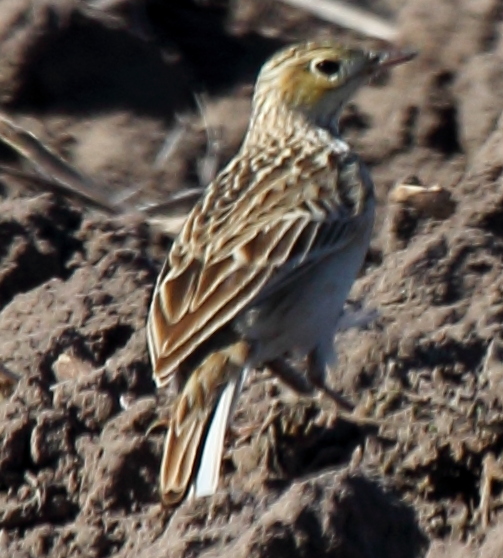
Yellow-throated Longclaw
Macronyx croceus
Order: Passeriformes / Family: Motacillidae

Wikimedia Commons
About the Yellow-throated Longclaw
The Yellow-throated Longclaw (Macronyx croceus) is a charismatic member of the family Motacillidae, known for its vibrant yellow throat and underparts contrasted with its mottled brown upperparts. It inhabits the open grasslands and savannas of sub-Saharan Africa, where it plays a vital role in the ecosystem as both predator and prey. The bird's presence across this vast region underscores its adaptability and significance in these environments. Found from Senegal and Gambia in the west, across to Ethiopia and down to South Africa, the Yellow-throated Longclaw thrives in areas where grassland management practices support its habitat preferences. Its ecological role includes controlling insect populations, as it primarily feeds on insects and other small invertebrates. The bird is often found in open areas, including pastures and meadows, where its vivid plumage provides a striking contrast against the green grass. During the breeding season, which typically coincides with the rainy season, these birds become more territorial and vocal, using their song to establish and defend their territories. They adapt well to modified landscapes as long as sufficient grass cover remains, demonstrating a remarkable resilience to certain human impacts. While not currently considered threatened, the Yellow-throated Longclaw faces potential risks from habitat loss due to agricultural expansion and overgrazing. Conservation efforts focus on sustainable land management practices that preserve the grassland ecosystems crucial to its survival. This bird's success in diverse grassland habitats highlights the importance of these ecosystems for avian biodiversity in Africa.
The Yellow-throated Longclaw belongs to the family Motacillidae, within the order Passeriformes. These birds typically live average 4-6 years with a max recorded of 8 years..
How to Identify a Yellow-throated Longclaw
The Yellow-throated Longclaw is easily recognized by its bright yellow throat and breast, which stand out against its olive-brown back and wings. Adults exhibit a black necklace-like band separating the yellow throat from their white belly, a feature not present in juveniles, which have a more subdued yellow and lack the black band. The males and females look similar, though, during the breeding season, males may appear slightly more vibrant. Its slender legs and elongated toes are adapted for walking on the ground, typical of the Motacillidae family. In flight, the Yellow-throated Longclaw displays a distinctive silhouette with its long tail and pointed wings. When perched, it often adopts an upright posture, frequently observed on low shrubs or tall grasses. This bird could be confused with the African Pipit due to similar coloring, but the pipit lacks the striking yellow throat and black necklace. Observing these distinct field marks can aid in accurate identification, especially in mixed-species flocks.
Having trouble telling birds apart? Upload a photo to our bird identification tool for an instant species match.
Yellow-throated Longclaw Habitat and Range
Preferred Habitat
The Yellow-throated Longclaw inhabits open grasslands, savannas, and sometimes marshy areas, typically below 2000 meters elevation. Its presence is notable in regions with dense grass cover interspersed with scattered shrubs. This bird thrives in areas that maintain natural grassland dynamics, such as seasonal flooding plains and lightly grazed pastures. While primarily a rural species, it can also be found in peri-urban settings where these conditions exist. The bird shows some flexibility in habitat use, occasionally venturing into agricultural lands, especially where traditional practices allow for natural vegetation buffers. Seasonal shifts in habitat preference are minimal, although breeding activities may drive them towards areas with taller grasses that provide better concealment for nests.
Geographic Range
The Yellow-throated Longclaw's range extends across sub-Saharan Africa, from Senegal and Gambia in the west to Ethiopia in the east, and downwards through eastern and southern Africa to South Africa. It is a resident species in much of its range, with some local movements occurring in response to rainfall patterns. These movements are generally short, aligning with the availability of food resources and suitable breeding sites. In regions such as Kenya and Tanzania, the bird is particularly abundant, favoring the expansive savannas of the Serengeti and Masai Mara. Population densities are higher in areas with optimal grassland conditions, and while it is not considered migratory, its local movements ensure it remains widespread throughout its range.
Want to know which birds visit your area? Browse our backyard birds by location guides for region-specific species lists.
What Does the Yellow-throated Longclaw Eat?
The Yellow-throated Longclaw primarily feeds on insects, including grasshoppers, beetles, and caterpillars, playing a crucial role in controlling these populations. It also consumes small invertebrates and occasionally seeds, especially during the dry season when insect abundance decreases. The bird employs a foraging technique characterized by walking along the ground, pausing intermittently to pick prey from the grass or soil surface. This method allows it to cover considerable ground efficiently, maximizing its food intake. Prey size is typically small, with the bird adept at handling and consuming insects that are proportionate to its size. Feeding occurs throughout the day, with peak activity in the early morning and late afternoon when temperatures are cooler.
Yellow-throated Longclaw Behavior and Social Structure
The Yellow-throated Longclaw exhibits a solitary or paired lifestyle outside the breeding season, although it may join mixed-species flocks in non-breeding periods to forage. It is territorial during breeding, with males performing aerial displays and singing to assert dominance and attract mates. Courtship involves both vocalizations and display flights, where males showcase their bright plumage and agility. The bird is primarily diurnal, engaging in feeding and social interactions during daylight hours. Its response to predators includes alarm calls and rapid flight into dense grass to evade detection. Despite its bold coloration, the bird relies on its cryptic upperparts to blend into the grassland when threatened.
Yellow-throated Longclaw Nesting and Reproduction
The Yellow-throated Longclaw constructs an open cup nest made from grass and other plant materials, usually positioned on the ground well-hidden within tall grass. Nests are often lined with softer materials to provide comfort and insulation for the eggs. The typical clutch size ranges from two to four eggs, which are incubated for about 12 to 14 days by the female. Both parents participate in feeding and caring for the chicks after hatching. The young fledge approximately two weeks post-hatching, though they remain dependent on the parents for several more weeks. The species typically raises one or two broods per year, influenced by environmental conditions and food availability.
Yellow-throated Longclaw Sounds and Vocalizations
The primary song of the Yellow-throated Longclaw is a melodious series of whistles, often described as clear and penetrating, with a rhythmic pattern that rises and falls in pitch. These vocalizations serve both territorial and mate attraction purposes. In addition to its song, the bird emits sharp, repetitive calls as alarm notes, used to alert conspecifics of potential danger. During the dawn chorus, its song is particularly prominent, echoing across the grasslands as males compete acoustically to establish territories. Compared to other grassland birds, the Yellow-throated Longclaw's vocalizations are more musical, adding a distinctive soundscape to its habitat.
Interesting Facts About the Yellow-throated Longclaw
- 1The Yellow-throated Longclaw's song can be heard over a kilometer away, making it one of the more prominent vocalists in African grasslands.
- 2Despite its bright plumage, the Yellow-throated Longclaw uses its cryptic back feathers to blend seamlessly into its grassy surroundings.
- 3This bird is named for its long, curved claws, which assist in navigating the dense grassland terrain.
- 4The Yellow-throated Longclaw is often misidentified as a Meadowlark due to its similar appearance and habitat preference.
- 5During courtship, males engage in display flights that showcase their vibrant yellow throats to potential mates.
- 6Unlike many grassland birds, the Yellow-throated Longclaw can adapt to some agricultural landscapes, provided sufficient grass cover remains.
- 7The bird's diet shifts seasonally, with increased seed consumption during periods of low insect availability.
Yellow-throated Longclaw Conservation Status
The Yellow-throated Longclaw is currently listed as Least Concern by the IUCN, with stable population trends across most of its range. However, habitat degradation due to intensified agriculture and overgrazing poses future threats. Conservation efforts focus on promoting sustainable land use practices that maintain the grassland ecosystems vital for its survival. Monitoring programs are in place in key regions to track population changes and habitat quality. Historically, the species has shown resilience to habitat modifications, but ongoing conservation is necessary to ensure long-term stability.