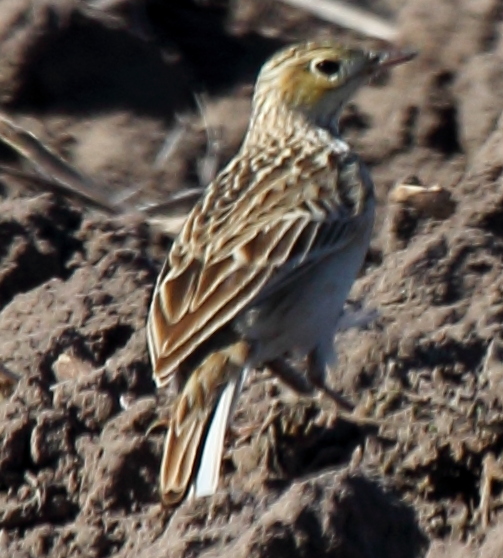
Yellowish Pipit
Anthus lutescens
Order: Passeriformes / Family: Motacillidae

Wikimedia Commons
About the Yellowish Pipit
The Yellowish Pipit, scientifically known as Anthus lutescens, is a member of the Motacillidae family and is widely recognized for its vibrant yellow underparts. This small passerine bird is predominantly found across the open grasslands and savannas of South America. Its presence is significant in countries such as Brazil, Uruguay, and Argentina, where it plays a crucial role in the ecosystem as an insect predator. The Yellowish Pipit thrives in areas with short grass, often near water bodies, where it benefits from a rich supply of insects and seeds. During the breeding season, which typically occurs in the Southern Hemisphere's spring and summer, the Yellowish Pipit's population becomes more concentrated in these regions, as the birds engage in territorial displays and nesting activities. The ecological role of the Yellowish Pipit extends beyond its immediate environment. As an insectivorous bird, it helps control insect populations, which could otherwise become pests to agriculture. The presence of the Yellowish Pipit is also an indicator of healthy grassland ecosystems. Its behavior during the winter months is marked by partial migratory movements, where some populations move northward to escape harsher weather conditions. In these months, the bird can be found in a variety of habitats, including open fields, pastures, and even on the fringes of urban environments. The Yellowish Pipit contributes to the avian diversity in these areas and shares the ecosystem with other grassland and wetland species. Furthermore, the Yellowish Pipit is an important subject for birdwatchers and ornithologists due to its distinct plumage and song, which make it a unique species to study and observe in its natural habitat.
The Yellowish Pipit belongs to the family Motacillidae, within the order Passeriformes. These birds typically live typically 2-4 years, with some individuals living up to 6 years..
How to Identify a Yellowish Pipit
The Yellowish Pipit is a small bird, measuring approximately 15 cm in length, with a wingspan of around 25 cm. Adult plumage is characterized by its olive-brown upperparts and striking yellow underparts, particularly prominent on the belly and flanks. The face is marked with a subtle supercilium above the eye, which is more pronounced in males. Juvenile Yellowish Pipits display more subdued coloration, with buff underparts and streaked backs, providing them with camouflage in grassland habitats. Males and females are similar in appearance, although males may exhibit slightly brighter yellow underparts during the breeding season. To distinguish the Yellowish Pipit from similar species, observers should note its distinct yellowish hue and the lack of extensive streaking on the breast, which differentiates it from the closely related Hellmayr's Pipit. In flight, the Yellowish Pipit displays a characteristic undulating pattern, often accompanied by a series of soft, melodious calls. When perched, it maintains a slightly upright posture, often on a low shrub or rock, providing a clear view of its plumage.
Having trouble telling birds apart? Upload a photo to our bird identification tool for an instant species match.
Yellowish Pipit Habitat and Range
Preferred Habitat
The Yellowish Pipit primarily inhabits open grasslands and savannas, with a preference for areas with short, sparse vegetation. These habitats often include pastures, agricultural fields, and the edges of wetlands, where the bird can forage for insects and seeds. In regions such as the Pampas of Argentina and the Cerrado of Brazil, the Yellowish Pipit is a common sight. This species typically resides at low to mid-elevations, though it can be found up to 1500 meters in areas like the Brazilian highlands. Seasonal habitat shifts occur as some populations move to more temperate areas during winter, occasionally venturing into suburban and urban fringes. Despite these shifts, the Yellowish Pipit remains closely tied to open landscapes, avoiding dense forests and heavily urbanized zones.
Geographic Range
The Yellowish Pipit is native to South America, with a breeding range extending across Brazil, Uruguay, Paraguay, and northern Argentina. During the breeding season, these birds are predominantly found in grassland and savanna regions, where they establish territories and build nests. In winter, some populations migrate northward, reaching central Brazil and occasionally as far as Bolivia and northern Argentina. Migration corridors mainly follow the open landscapes of the continent, avoiding dense rainforests and mountainous regions. Population density hotspots include the expansive Pampas and Cerrado regions, where the birds benefit from suitable nesting and feeding conditions.
Want to know which birds visit your area? Browse our backyard birds by location guides for region-specific species lists.
What Does the Yellowish Pipit Eat?
The Yellowish Pipit's diet primarily consists of insects, including beetles, grasshoppers, and caterpillars, which it captures using a technique known as 'ground gleaning.' This involves walking or running across open ground before darting forward to snatch insects from the surface or just beneath the soil. During the breeding season, the pipit's diet becomes more varied, incorporating small seeds and occasionally berries. Seasonal variations in food availability may prompt slight dietary shifts, with the bird consuming more seeds during the winter months when insects are less abundant. The pipit tends to feed throughout daylight hours, with peak activity occurring in the early morning and late afternoon.
Yellowish Pipit Behavior and Social Structure
The Yellowish Pipit exhibits a range of interesting behaviors, particularly during the breeding season. Males are highly territorial, engaging in aerial displays and singing to establish and defend territories. These displays often involve fluttering flights and melodious songs that can be heard across the grasslands. Socially, the Yellowish Pipit is generally solitary or found in pairs during breeding, though small flocks may form outside the breeding season. The species shows a strong response to predators, with adults performing distraction displays to draw potential threats away from nests. Daily activity patterns include foraging in open areas during the cooler parts of the day, while resting in shaded spots during the midday heat.
Yellowish Pipit Nesting and Reproduction
The Yellowish Pipit constructs a simple cup-shaped nest on the ground, often concealed within tufts of grass or low shrubs to protect it from predators. Nest materials include grass, leaves, and small twigs, which the female primarily gathers and arranges. Clutch size typically ranges from 2 to 4 eggs, with incubation lasting approximately 12 to 14 days. Both parents share incubation duties, though the female takes a more active role. After hatching, the young remain in the nest for about 14 days before fledging. The parents continue to care for the fledglings for several weeks post-fledging, ensuring their survival as they learn to forage independently. The Yellowish Pipit usually raises one or two broods per year, depending on environmental conditions.
Yellowish Pipit Sounds and Vocalizations
The Yellowish Pipit's primary song is a series of melodious, high-pitched notes delivered in a rhythmic sequence. These songs serve both to attract mates and to establish territory. Call notes are softer and more subdued, often used for communication between mates. Alarm calls, however, are sharp and abrupt, alerting others to potential danger. During the dawn chorus, the Yellowish Pipit's song can be heard resonating across the grasslands, contributing to the vibrant acoustic landscape of its habitat. The song's quality and rhythm bear some resemblance to those of other pipit species but can be distinguished by its unique phrasing and tone.
Interesting Facts About the Yellowish Pipit
- 1The Yellowish Pipit's undulating flight pattern is a unique adaptation for energy-efficient travel across open landscapes.
- 2Despite its small size, the Yellowish Pipit can cover significant distances during its migratory journeys across South America.
- 3The Yellowish Pipit's song, often heard during the breeding season, plays a crucial role in mate attraction and territorial defense.
- 4Grassland management practices, such as controlled grazing, can positively impact Yellowish Pipit populations by maintaining suitable habitats.
- 5The Yellowish Pipit shares its habitat with various other grassland species, including the Rufous-collared Sparrow and the Southern Lapwing.
- 6In regions like the Pampas, the Yellowish Pipit is considered an indicator species for the health of grassland ecosystems.
- 7The Yellowish Pipit's nest, often hidden in dense grass, provides effective camouflage against predators.
Yellowish Pipit Conservation Status
The Yellowish Pipit is currently listed as Least Concern by the IUCN, with stable population trends across its range. However, habitat loss due to agricultural expansion and urban development poses a potential threat to some populations. Conservation efforts focus on preserving grassland habitats and promoting sustainable land-use practices. Historically, the Yellowish Pipit has maintained a stable presence in its native regions, although localized declines may occur where habitat degradation is significant. Continued monitoring and habitat conservation are essential to ensure the species' long-term survival and ecological contributions.