
Long-billed Pipit
Anthus similis
Order: Passeriformes / Family: Motacillidae

Wikimedia Commons
About the Long-billed Pipit
The Long-billed Pipit, Anthus similis, is a versatile songbird that thrives in a variety of open habitats across its range. This species belongs to the Motacillidae family and exhibits remarkable adaptability to its environment. Found primarily in sub-Saharan Africa and extending into parts of the Middle East and South Asia, the Long-billed Pipit occupies territories from grasslands and savannas to rocky hillsides and scrublands. It is particularly prevalent in regions like southern Africa, including countries such as South Africa, Botswana, and Namibia, as well as parts of India, Nepal, and Sri Lanka.
Ecologically, the Long-billed Pipit plays a significant role as an insect predator, contributing to the control of insect populations in its habitats. Its diet consists predominantly of insects, which it forages for efficiently due to its specialized bill. The bird's presence in various ecosystems underlines its importance in maintaining ecological balance. The Long-billed Pipit is often observed foraging on the ground, where its cryptic plumage provides excellent camouflage against predators.
Seasonally, the Long-billed Pipit demonstrates behavioral adaptations, altering its foraging patterns to align with insect availability. During the breeding season, which varies by region but generally coincides with warmer months, the bird becomes particularly territorial. Males perform elaborate courtship displays, often involving song flights that showcase their vocal prowess. These displays serve both to attract mates and to defend territories from rival males.
The Long-billed Pipit's resilience to environmental changes and its broad geographic distribution highlight its ecological adaptability. While not currently considered at risk, ongoing habitat alteration poses potential challenges. Conservation efforts aimed at protecting its diverse habitats ensure that the Long-billed Pipit continues to thrive across its range, maintaining its vital role in the ecosystems it inhabits.
The Long-billed Pipit belongs to the family Motacillidae, within the order Passeriformes. These birds typically live average 6 years, with a maximum recorded of 9 years..
How to Identify a Long-billed Pipit
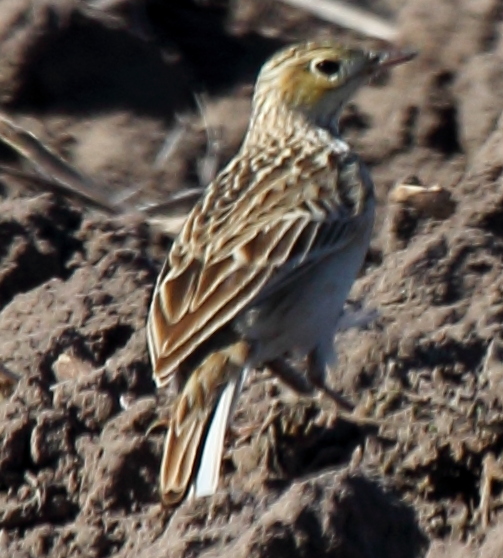
The Long-billed Pipit is a medium-sized passerine, measuring approximately 16-18 cm in length, with a wingspan of about 25 cm. Its most distinctive feature is its elongated, slender bill, which sets it apart from other pipits. Adult plumage is primarily brown with streaks of darker brown, providing effective camouflage in its natural habitats. The underparts are pale with slight streaking on the breast, making it somewhat difficult to spot when perched.
Juvenile Long-billed Pipits resemble adults but tend to have more pronounced streaking and a slightly duller coloration overall. Males and females appear similar, with no significant sexual dimorphism in plumage. However, males are often slightly larger and more vocal during the breeding season.
In flight, the Long-billed Pipit displays a characteristic undulating pattern, typical of pipits. Its tail is relatively long and exhibits white outer feathers, which can be a useful identification marker. When perched, the bird often adopts an upright posture, allowing for better visibility and communication through its song. While similar in appearance to other pipit species, the Long-billed Pipit's longer bill and distinctive song help differentiate it from look-alikes like the African Pipit or the Tawny Pipit.
Having trouble telling birds apart? Upload a photo to our bird identification tool for an instant species match.
Long-billed Pipit Habitat and Range
Preferred Habitat
The Long-billed Pipit occupies a wide range of open habitats, preferring regions with sparse vegetation that allow for easy ground foraging. Grasslands, savannas, and open scrublands serve as its primary habitats, though it can also be found in rocky outcrops and dry riverbeds. This adaptability to various landscapes makes it a common sight across its range.
The species is typically found at elevations ranging from sea level to about 2500 meters. In higher altitudes, particularly in the mountainous regions of the Himalayas, it adapts to cooler conditions by seeking out sunny, exposed areas where it can forage efficiently.
While the Long-billed Pipit generally avoids densely forested areas, it can occasionally be seen in more open sections of woodland. Urban presence is limited, as the bird prefers more rural settings where human activity is minimal. Seasonal habitat shifts are influenced by food availability, with the bird sometimes moving to lower altitudes or more open areas during wetter months when insects are abundant.
Geographic Range
The Long-billed Pipit exhibits a broad geographical range, stretching across several continents. In Africa, it is primarily found in southern and eastern regions, extending from South Africa and Namibia through Mozambique and Tanzania. In the Middle East, it inhabits countries like Saudi Arabia and Yemen.
In South Asia, the Long-billed Pipit is prevalent in India, particularly in the western and southern parts, and extends into Nepal, Pakistan, and Sri Lanka. This widespread distribution is supported by its ability to adapt to various open habitats, avoiding only the densest forests and arid deserts.
The Long-billed Pipit is largely resident in most of its range, with some populations exhibiting partial migratory behavior. In regions like the Indian subcontinent, it may undertake altitudinal migrations, moving to lower elevations during winter months to escape harsher weather conditions. Population density tends to be highest in areas with optimal foraging conditions, such as extensive grasslands and lightly grazed pastures.
Want to know which birds visit your area? Browse our backyard birds by location guides for region-specific species lists.
What Does the Long-billed Pipit Eat?
The Long-billed Pipit primarily consumes a diet rich in insects, which it efficiently captures using its elongated bill. Ground-dwelling insects such as ants, beetles, and grasshoppers constitute the bulk of its diet. The bird employs a methodical foraging technique, walking steadily while scanning the ground for prey.
During the breeding season, the Long-billed Pipit increases its intake of protein-rich insects to support the energy demands of raising young. It may also consume small quantities of seeds and other plant material, particularly when insect prey is less abundant.
Foraging occurs mainly during the early morning and late afternoon when insect activity peaks. In open habitats, this bird often follows a routine, exploiting areas with high insect concentrations. The Long-billed Pipit's keen eyesight and ability to detect subtle movement aid in locating prey, even against complex backgrounds.
Long-billed Pipit Behavior and Social Structure
The Long-billed Pipit exhibits a range of interesting behaviors, most notably its territorial and courtship displays during the breeding season. Males establish territories by singing from prominent perches and performing aerial song flights, during which they ascend on fluttering wings before parachuting down while delivering melodious calls. This behavior serves to attract females and deter rival males.
Socially, the Long-billed Pipit tends to be solitary or found in pairs, especially during the breeding season. Outside of this period, it may form loose flocks, particularly when foraging in areas with abundant food resources. The bird exhibits a degree of site fidelity, returning to the same breeding territories each year if conditions remain favorable.
In terms of predator response, the Long-billed Pipit relies on its camouflage and vigilance. When threatened, it often crouches low to blend into its surroundings, only taking flight as a last resort. Daily activity peaks around dawn and dusk, when it engages in most of its foraging and social interactions.
Long-billed Pipit Nesting and Reproduction
The Long-billed Pipit constructs cup-shaped nests on the ground, often hidden among tufts of grass or under small shrubs. The nest is composed of grasses, roots, and other plant materials, lined with finer materials to provide a soft base for the eggs.
Clutch size typically ranges from 3 to 5 eggs, which are incubated primarily by the female for about 12 to 14 days. Both parents share in feeding the young, which fledge approximately 14 to 16 days after hatching. During this period, they remain in the vicinity of the nest, relying on the parents for food and protection.
The Long-billed Pipit may raise more than one brood per year, depending on environmental conditions and food availability. Parental roles are well defined, with the male often taking on the responsibility of territory defense while the female focuses on incubation and nurturing the young.
Long-billed Pipit Sounds and Vocalizations
The Long-billed Pipit's primary song is a series of melodious, repetitive notes delivered in a rapid sequence. The rhythm is lively, with a pitch that rises and falls, creating a distinctive warbling quality. Its calls include short, sharp 'chip' notes used for communication between individuals.
During the breeding season, males frequently perform song flights, singing continuously to establish and defend their territories. Alarm calls are more abrupt, serving as a warning to nearby birds of potential threats. The Long-billed Pipit often contributes to the dawn chorus, its clear notes ringing out across its open habitat.
The bird's song is reminiscent of other pipit species but can be distinguished by its unique tempo and the context in which it is delivered, particularly when accompanied by its characteristic flight display.
Interesting Facts About the Long-billed Pipit
- 1The Long-billed Pipit can consume up to 50 small insects in a single hour, showcasing its efficiency as an insectivore.
- 2Despite its name, the Long-billed Pipit's bill length varies regionally, adapting to different prey types.
- 3Long-billed Pipits sometimes take dust baths to maintain feather condition and control parasites.
- 4This pipit species can be found at elevations up to 2,500 meters in the Himalayas, adapting to cooler climates.
- 5In courtship, males perform an impressive aerial display, singing while fluttering high above their territory.
- 6The species' versatility in habitat choice allows it to thrive in regions from arid savannas to lush grasslands.
- 7Long-billed Pipits often forage in recently burned areas, taking advantage of exposed insects and seeds.
Long-billed Pipit Conservation Status
The Long-billed Pipit is currently listed as Least Concern by the IUCN, reflecting its widespread distribution and stable population trends. However, habitat loss due to agricultural expansion and land development poses potential threats to its natural environments. Conservation efforts focus on preserving open habitats and grasslands, which are crucial for the species' survival. Monitoring population trends and habitat conditions helps ensure that any declines can be addressed promptly. Historically, the Long-billed Pipit has shown resilience to moderate changes in land use, adapting to altered landscapes where natural foraging opportunities remain. Continued habitat conservation and management will be essential to maintaining its status and ecological role.
Other Motacillidae Species



Birds Similar to the Long-billed Pipit
These species are often confused with the Long-billed Pipit due to similar appearance or overlapping range.
