
Mangrove Vireo
Vireo pallens
Order: Passeriformes / Family: Vireonidae

Wikimedia Commons
About the Mangrove Vireo
The Mangrove Vireo (Vireo pallens) is a small passerine bird primarily found in the tropical and subtropical mangrove forests of Central America. This bird's presence is significant as it plays a vital role in the mangrove ecosystems, contributing to insect population control and serving as an indicator of environmental health due to its sensitivity to habitat changes. Predominantly residing in the coastal regions of Mexico, Belize, and Honduras, the Mangrove Vireo is well-adapted to the saline and brackish conditions of mangrove swamps. During the breeding season, which peaks from March to June, these birds become particularly active, with males singing persistently to defend their territory and attract mates. While they are non-migratory, they may exhibit some local movements influenced by food availability and environmental conditions. They are often found in the company of other Vireo species, thriving in the dense, tangled vegetation of the mangroves where they forage for insects and spiders. The ecological role of the Mangrove Vireo extends beyond mere insectivory. By engaging in mutualistic relationships with other species, such as spreading seeds from the fruits they consume, they indirectly support plant diversity. Seasonal behaviors include increased vocal activity during the early morning and late afternoon, coinciding with peak insect activity. As an insectivore, the Mangrove Vireo contributes to controlling pest populations, maintaining the balance within the mangrove environment. Furthermore, their preference for specific microhabitats within the mangrove forests, such as the mid-canopy levels where they find abundant food and nesting sites, highlights their role as specialized inhabitants of these coastal ecosystems.
The Mangrove Vireo belongs to the family Vireonidae, within the order Passeriformes. These birds typically live average 3 years, with a maximum recorded of 5 years..
How to Identify a Mangrove Vireo
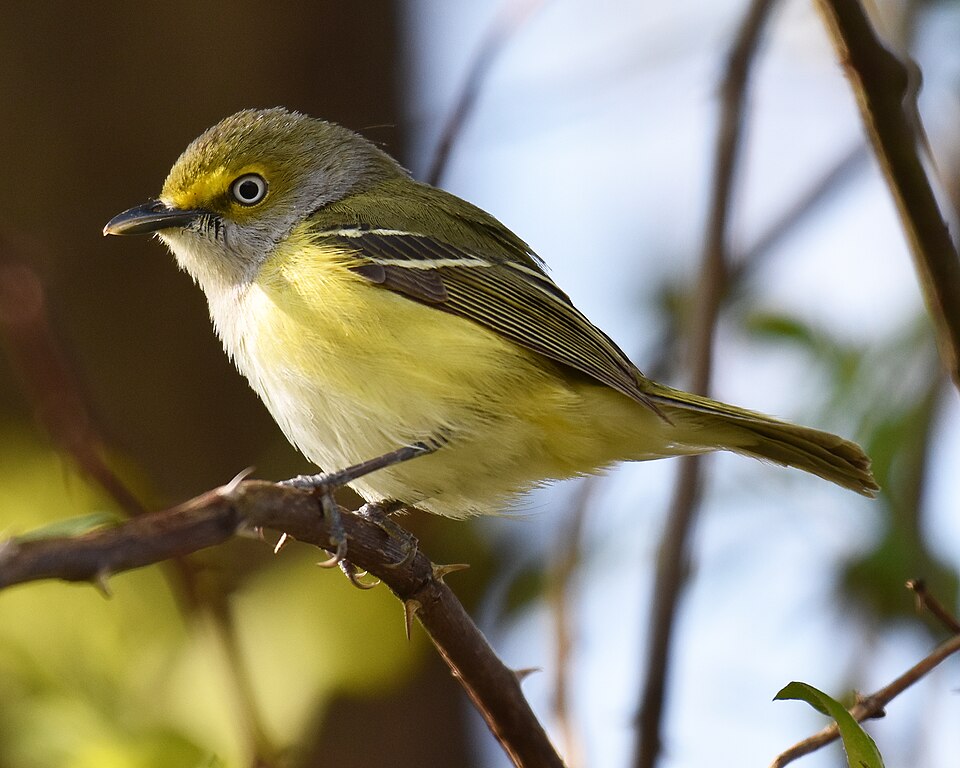
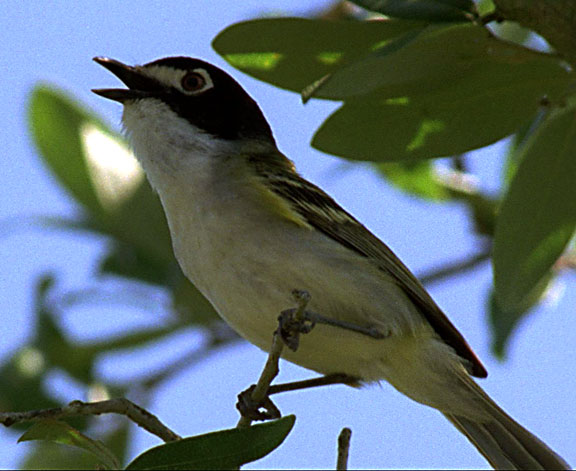
The adult Mangrove Vireo exhibits a distinctive olive-green plumage on its back, contrasting with a paler, almost grayish belly. Its wings are adorned with faint wing bars, and its eyes are highlighted by a white eye ring, creating a spectacled appearance. Juveniles resemble adults but have a duller coloration and less distinct wing bars. Both males and females share similar plumage, making it challenging to differentiate them visually. However, males may be slightly more vibrant during the breeding season. In flight, the Mangrove Vireo displays a compact silhouette with rapid, direct wing beats. When perched, it often adopts an upright posture, frequently moving its tail and wings in short, jerky motions. The Mangrove Vireo can be confused with the similar-looking White-eyed Vireo (Vireo griseus), but the latter has a more pronounced white eye ring and yellow flanks. Another species that closely resembles the Mangrove Vireo is the Thick-billed Vireo (Vireo crassirostris), found in the Bahamas and parts of the Caribbean, distinguishable by its heavier bill and more robust build. Observers should note these subtle differences to accurately identify the Mangrove Vireo in its natural habitat.
Having trouble telling birds apart? Upload a photo to our bird identification tool for an instant species match.
Mangrove Vireo Habitat and Range
Preferred Habitat
The Mangrove Vireo primarily inhabits mangrove forests along the coastal regions of Central America, including the Yucatan Peninsula, Belize, and the Gulf of Honduras. These birds prefer the mid-canopy levels of mangrove trees, where they find shelter and ample food supplies. They thrive in saline environments where red, black, and white mangroves dominate, often avoiding areas with significant human disturbance. While their primary habitat is mangrove swamps, they can occasionally be found in adjacent coastal scrub and secondary growth forests, especially when searching for food. Unlike many passerines, they do not migrate but may exhibit small local movements between habitats based on seasonal food availability. The Mangrove Vireo's habitat range is generally limited to elevations below 100 meters, as they are closely tied to coastal ecosystems. Although less common in urban areas, they may sometimes inhabit suburban gardens close to mangrove habitats if suitable conditions exist.
Geographic Range
The Mangrove Vireo's range is concentrated along the Atlantic Coast of Central America. Breeding occurs predominantly in regions such as the Yucatan Peninsula, Belize, and the northern coast of Honduras. This species is primarily resident, with populations remaining year-round within their breeding territories. They are not considered migratory, though individuals may move short distances locally in response to environmental conditions or food availability. While their range is not extensive, they are relatively common within suitable mangrove habitats. Population density hotspots include the coastal lowlands of Belize and the northern Yucatan, where dense mangrove forests provide ideal nesting and foraging conditions. Occasional reports from nearby regions in Guatemala and Nicaragua suggest some range overlap with other closely related Vireo species, although these are less common.
Want to know which birds visit your area? Browse our backyard birds by location guides for region-specific species lists.
What Does the Mangrove Vireo Eat?
The diet of the Mangrove Vireo primarily consists of insects and other arthropods, making them proficient insectivores within their mangrove habitats. They forage actively among the mid-canopy foliage, employing a gleaning technique to pick insects from leaves and branches. Their prey includes caterpillars, beetles, spiders, and other small invertebrates. During the breeding season, the demand for protein-rich food increases, prompting parents to forage more intensively. In addition to their insect-based diet, they occasionally consume small fruits and berries, particularly during periods when insect availability declines. This opportunistic feeding habit allows them to adapt to seasonal changes in food resources. The size of prey typically ranges from small caterpillars to medium-sized beetles, which they capture with quick, precise movements. Mangrove Vireos usually feed throughout the day, with peak activity occurring during the early morning and late afternoon when their prey is most active.
Mangrove Vireo Behavior and Social Structure
The Mangrove Vireo exhibits a solitary or pair-based social structure, particularly during the breeding season when pairs establish and fiercely defend their territories. Territorial males engage in frequent singing to assert dominance and deter rivals. Their courtship displays involve a combination of vocalizations and physical displays, such as wing flicking and tail spreading, to attract females. While they are not gregarious, Mangrove Vireos may join mixed-species foraging flocks outside the breeding season to increase foraging efficiency and reduce predation risk. Their response to predators includes alarm calls and evasive flying, utilizing the dense mangrove vegetation for cover. Daily activity patterns are diurnal, with peak foraging and vocalization occurring in the cooler hours of the morning and late afternoon. Although primarily solitary, they exhibit cooperative behaviors during breeding, with both parents participating in nest building, incubation, and feeding of the young.
Mangrove Vireo Nesting and Reproduction
Nest construction by the Mangrove Vireo involves both sexes, who weave small cup-shaped nests using twigs, grasses, and spider silk. These nests are strategically placed in the fork of a mangrove tree branch, usually 1 to 3 meters above the ground, to provide protection from predators and high tides. The clutch size typically ranges from 2 to 4 eggs, which are incubated mainly by the female for about 12 to 14 days. The male contributes by feeding the female during incubation. After hatching, both parents participate in feeding the chicks, which fledge approximately 10 to 12 days after hatching. The fledglings remain dependent on parental care for several weeks, gradually learning to forage on their own. The Mangrove Vireo may raise two broods per year, especially in regions with abundant food supply and favorable climatic conditions.
Mangrove Vireo Sounds and Vocalizations
The Mangrove Vireo's primary song consists of a series of short, melodious phrases delivered in a rapid succession. Each phrase typically consists of two to three notes, with a clear and whistling quality. Their song can be described as a repetitive 'chew-chew-chew' or 'whip-whip-whip', often used by males to establish territory and attract mates. In addition to their song, they emit call notes that are sharp and abrupt, serving as contact calls between mates or to signal alarm. These calls can be likened to a sharp 'chip' or 'cheek'. During the breeding season, the Mangrove Vireo participates in a dawn chorus, where singing is more intense and continuous at daybreak. Their alarm calls and vocalizations resemble those of other Vireo species but are distinct in their rhythmic delivery and tonal quality.
Interesting Facts About the Mangrove Vireo
- 1The Mangrove Vireo is part of a small group of Vireo species that have adapted to the unique conditions of mangrove ecosystems.
- 2Despite their small size, Mangrove Vireos are known for their loud and persistent singing, which can be heard over considerable distances.
- 3These birds are non-migratory, allowing them to establish and maintain territories in the same area year-round.
- 4Mangrove Vireos participate in mixed-species flocks outside the breeding season, enhancing their foraging success.
- 5The species' preference for mangrove habitats makes it an important indicator of the health of these crucial coastal ecosystems.
Mangrove Vireo Conservation Status
The Mangrove Vireo is currently classified as Least Concern by the IUCN, with stable population trends across its range. The primary threats to this species include habitat loss due to coastal development and mangrove deforestation. Conservation efforts focus on preserving and restoring mangrove habitats through reforestation projects and protective legislation. Historically, the Mangrove Vireo has maintained stable populations due to their specialized habitat preference, although local declines have been observed in areas with significant environmental degradation. Continued efforts to monitor population trends and implement habitat conservation strategies are crucial for ensuring the long-term survival of this species.
Other Vireonidae Species


Birds Similar to the Mangrove Vireo
These species are often confused with the Mangrove Vireo due to similar appearance or overlapping range.