
Pechora Pipit
Anthus gustavi
Order: Passeriformes / Family: Motacillidae

Wikimedia Commons
About the Pechora Pipit
The Pechora Pipit, scientifically known as Anthus gustavi, belongs to the family Motacillidae, a group of passerines acclaimed for their ground-dwelling habits and intricate song structures. This elusive bird is native primarily to the taiga biome, favoring dense, wet grasslands and marshes in regions of northern Eurasia. Its presence is tightly linked to specific environmental conditions, making it a precise indicator of ecosystem health. Within these habitats, the Pechora Pipit plays a crucial role in the food web, acting both as a predator of invertebrates and as prey for larger avian species.
In terms of geography, its breeding territories predominantly span the vast expanses of Siberia, extending from the Pechora River basin eastward towards the Sea of Okhotsk. These regions offer the varied microhabitats ideal for nesting and feeding, supported by the seasonal abundance of insects. During the breeding season, the Pechora Pipit becomes particularly territorial, establishing and defending its area with melodious songs and visual displays. The bird’s migratory nature sees it travel significant distances to winter in Southeast Asia, reaching as far south as Indonesia and the Philippines. These migrations, synchronized with climatic patterns, highlight its dependence on a range of seasonal habitats.
Beyond its ecological contributions, the Pechora Pipit serves as a subject of interest for ornithologists and birdwatchers alike, given its elusive nature and the challenges it presents in field identification. Understanding its role in the ecosystem and migration patterns adds valuable insights into the broader impacts of climate change and habitat loss. Conservation efforts are increasingly focusing on protecting its breeding and wintering grounds, ensuring this small yet significant bird continues to thrive.
The Pechora Pipit belongs to the family Motacillidae, within the order Passeriformes. These birds typically live average 3-5 years with a max recorded of 7 years..
How to Identify a Pechora Pipit
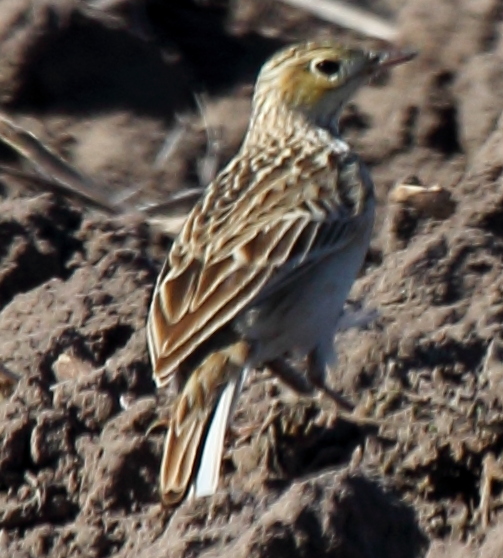
The Pechora Pipit can be identified by its streaky brown upperparts and pale, buff underparts with distinct dark streaks. Adult plumage features a prominent supercilium, or eyebrow stripe, which is white, contrasting with the darker crown and eye line. This bird's wings are brown with two pale wing bars, aiding in identification during flight. Juveniles resemble adults but often appear more buffy overall, with less defined streaking. There is little sexual dimorphism, meaning males and females are similar in appearance.
In the field, the Pechora Pipit might be confused with other pipits such as the Red-throated Pipit, but can be distinguished by its more pronounced streaking and different song. Its flight silhouette is typical of pipits, showing a slender build with a long tail and pointed wings. When perched, it often adopts an upright posture, enabling better scanning of its surroundings for predators or foraging opportunities.
Spotting the Pechora Pipit demands keen observation, especially since it blends well into its grassy environment. During migration, its call notes-sharp and metallic-can also assist in identification, often heard before the bird is sighted.
Having trouble telling birds apart? Upload a photo to our bird identification tool for an instant species match.
Pechora Pipit Habitat and Range
Preferred Habitat
The Pechora Pipit thrives in wetland and marshy habitats, particularly within the boreal forest regions of Russia. These areas provide ample cover and feeding opportunities during the breeding season. It prefers low-lying areas near water bodies, where sedge and grass dominate, offering protection and nesting materials.
During migration and winter, it can be found in a variety of habitats including rice paddies, grassy fields, and even coastal dunes in Southeast Asia. Its altitude range is relatively low, generally remaining below 1,000 meters. In urban settings, it is rare, as its preferred environments are more rural and natural.
Seasonal shifts see the Pechora Pipit adjusting its habitat use, taking advantage of temporary wetland features during migration. These shifts reflect its adaptability to changing conditions, although it remains dependent on specific habitat types, making it vulnerable to habitat modification.
Geographic Range
The breeding range of the Pechora Pipit spans the northern latitudes of Russia, particularly within the taiga zone. It extends from the Pechora River in the west across to the Sea of Okhotsk in the east. This range encompasses vast areas of boreal forest and wetland habitats, crucial for its breeding activities.
During winter, the Pechora Pipit migrates to Southeast Asia, including countries such as Thailand, Vietnam, and Indonesia. The bird favors lowland areas, often seen in rice fields and moist grasslands. Its migration corridors are primarily east-west, utilizing flyways that traverse the Eastern Palearctic.
Population densities vary, with breeding concentrations noted in specific locales where conditions are optimal. In wintering grounds, it is more dispersed, depending on local habitat availability. Despite being widespread in its range, the Pechora Pipit is often elusive, making population assessments challenging.
Want to know which birds visit your area? Browse our backyard birds by location guides for region-specific species lists.
What Does the Pechora Pipit Eat?
The Pechora Pipit's diet primarily consists of insects and other small invertebrates, which it forages from the ground in its marshy habitats. During the breeding season, when insect availability is high, it consumes a diverse array of beetles, caterpillars, and spiders. This high-protein diet supports the energy demands of breeding and raising young.
Outside the breeding season, its diet may expand to include seeds and small berries, particularly during migration when it encounters different environments. Foraging techniques include walking and hopping on the ground, occasionally sallying from perches to catch airborne prey.
Prey size varies, but the Pechora Pipit typically targets small to medium-sized insects, easily handled with its slender bill. Feeding occurs throughout the day, with peak activity during the cooler morning and late afternoon hours, aligning with insect activity patterns.
Pechora Pipit Behavior and Social Structure
The Pechora Pipit exhibits solitary behavior during the breeding season, with males establishing and defending territories through song and display. Territorial disputes are common, often resolved through vocalizations and non-contact displays.
Courtship involves males performing flight displays, characterized by ascents followed by parachuting descents, accompanied by singing. These displays serve to attract females and establish pair bonds. Once paired, both sexes participate in nest building and rearing offspring.
Outside the breeding season, the Pechora Pipit may join mixed-species flocks, especially during migration. These flocks provide safety in numbers and enhance foraging efficiency. In response to predators, the Pechora Pipit relies on its cryptic plumage and sudden, low flights to escape danger. Activity patterns are diurnal, with peak periods of activity in the early morning and late afternoon.
Pechora Pipit Nesting and Reproduction
The Pechora Pipit constructs a nest on the ground, often well-hidden among dense grasses or sedges. The nest is a simple cup made of grass, lined with finer materials such as hair and feathers. This hidden placement offers protection from predators and environmental elements.
Clutch size ranges from 4 to 6 eggs, which are pale with speckled markings. Both parents share incubation duties, which last approximately 12 to 14 days. After hatching, chicks remain in the nest for about 10 to 12 days, during which both parents feed them a diet rich in insects.
The Pechora Pipit typically raises one brood per season, although conditions may allow for a second. Parental investment is significant, with both sexes involved in feeding and protecting the young until they are independent.
Pechora Pipit Sounds and Vocalizations
The Pechora Pipit's primary song is a series of high-pitched, rhythmic notes that rise and fall in a musical sequence, often delivered from a perch or during flight displays. This song functions in both mate attraction and territory defense.
Its call notes are sharp and metallic, often described as 'tsip' or 'prr'. These calls serve as contact notes between individuals, particularly during migration. Alarm calls are more urgent and harsh, used to warn of approaching threats.
During the dawn chorus, the Pechora Pipit's song integrates with those of other passerines, creating a rich tapestry of sound in its breeding habitat. Its vocalizations, though not as elaborate as some songbirds, play a crucial role in its social interactions.
Interesting Facts About the Pechora Pipit
- 1The Pechora Pipit's migratory journey can cover over 5,000 kilometers, showcasing remarkable endurance.
- 2This bird's name derives from the Pechora River in Russia, highlighting its breeding range origins.
- 3Pechora Pipits often travel in mixed-species flocks during migration, illustrating their social adaptability.
- 4The species was first described in 1845 by the German naturalist Cabanis, emphasizing its long-standing scientific interest.
- 5Its cryptic plumage serves as an excellent camouflage, making it difficult to spot in its natural habitat.
- 6During courtship, males perform aerial displays, adding a dynamic element to their breeding behavior.
- 7Despite its extensive range, the Pechora Pipit remains a prized sighting for birdwatchers due to its elusive nature.
Pechora Pipit Conservation Status
The Pechora Pipit is currently classified as Least Concern by the IUCN, with a stable population trend. However, threats such as habitat destruction and climate change pose potential risks. Breeding and wintering habitats face pressures from agriculture and development. Conservation efforts focus on habitat protection and monitoring population trends. International cooperation is essential, given its extensive migratory routes. Historically, the Pechora Pipit has maintained stable numbers, but ongoing environmental changes necessitate vigilant management to ensure its continued survival.
Other Motacillidae Species



Birds Similar to the Pechora Pipit
These species are often confused with the Pechora Pipit due to similar appearance or overlapping range.

