
Tree Pipit
Anthus trivialis
Order: Passeriformes / Family: Motacillidae

Wikimedia Commons
About the Tree Pipit
The Tree Pipit, Anthus trivialis, is a small passerine bird that belongs to the family Motacillidae. This species is a quintessential songbird of open woodlands, heaths, and clearings across Europe and parts of Asia. Notably, the Tree Pipit plays a significant ecological role as both a predator of small invertebrates and a prey item for larger birds and mammals. It acts as an indicator species for the health of its habitat. The Tree Pipit thrives in diverse habitats but prefers areas with scattered trees and shrubs, providing ample perches and observation points. In Europe, its range extends from the British Isles and the Iberian Peninsula eastwards to the Ural Mountains and south into the northern parts of the Mediterranean. In Asia, it is found in temperate regions up to the western Himalayas.
The Tree Pipit's seasonal behaviors are closely tied to its migratory nature. It breeds across Europe, Scandinavia, and parts of Asia during the warmer months, typically from April to September. During this period, males perform elaborate flight displays, characterized by a song delivered while ascending and then parachuting down with wings and tail spread wide. These displays serve both territorial and courtship purposes. In the autumn, populations embark on a migration to sub-Saharan Africa, traveling in flocks that follow well-established routes. This long-distance journey ensures their survival through the winter months, as they seek out regions with abundant food resources.
Ecologically, the Tree Pipit contributes to the control of insect populations, consuming beetles, caterpillars, and other small invertebrates. Its presence in mixed and coniferous forests, as well as in heathlands and grasslands, can indicate a healthy, biodiverse environment. Due to its reliance on both terrestrial and arboreal habitats, the Tree Pipit often falls victim to habitat changes, such as deforestation and agricultural intensification, making it a species of conservation interest. Its adaptability, however, allows it to colonize new areas when traditional habitats become unsuitable, demonstrating its resilience and ecological importance.
The Tree Pipit belongs to the family Motacillidae, within the order Passeriformes. These birds typically live average 3-5 years, with a maximum recorded of 8 years..
How to Identify a Tree Pipit
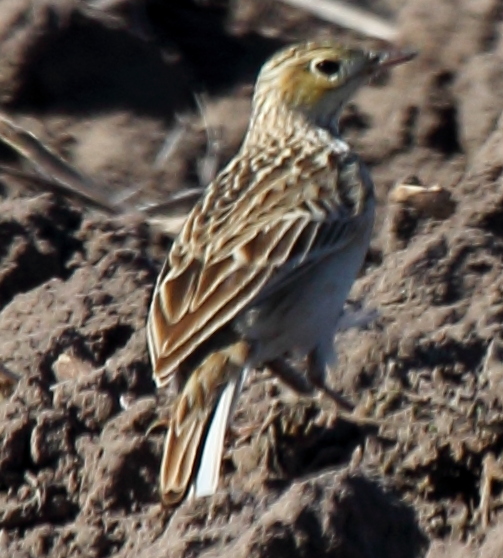
The Tree Pipit is a small bird, measuring approximately 14-15 cm in length with a wingspan of 22-25 cm. Adult plumage is characterized by buff-brown upperparts with dark streaks, while the underparts are pale with fine streaking on the breast and flanks. This streaking helps differentiate it from similar species. The Tree Pipit exhibits characteristic white outer tail feathers, visible in flight. Its legs are pinkish, contrasting with the generally darker tones of its plumage.
Juvenile Tree Pipits resemble adults but often show more pronounced streaking on the upperparts, providing additional camouflage. Sexual dimorphism is not pronounced, as males and females appear similar in plumage. However, males are typically more vocal and are observed performing flight displays during the breeding season.
The Tree Pipit can be confused with the Meadow Pipit (Anthus pratensis), but can be distinguished by its stronger face pattern, more pronounced supercilium, and the characteristic flight display. In flight, the Tree Pipit displays a more undulating pattern compared to the more direct flight of the Meadow Pipit, and its posture when perched is slightly upright, aiding in identification.
Having trouble telling birds apart? Upload a photo to our bird identification tool for an instant species match.
Tree Pipit Habitat and Range
Preferred Habitat
Tree Pipits occupy a range of habitats that include open woodlands, heathlands, and forest clearings. They favor areas with scattered trees, such as birch and oak, interspersed with open ground. These habitats provide crucial perches for their song displays. In mountainous regions, such as the Alps and the Carpathians, they are found at elevations up to 2000 meters, demonstrating their adaptability to various altitudes.
During the breeding season, Tree Pipits prefer areas with a mixture of trees and open spaces, while in the winter, they inhabit savannas and lightly wooded areas in sub-Saharan Africa. The species does not typically occupy urban environments, instead favoring rural and semi-natural landscapes where human disturbance is minimal. Seasonal habitat shifts reflect their migratory nature, as they move to different regions to exploit available resources.
Geographic Range
The Tree Pipit breeds across much of Europe and Asia, from the British Isles and Spain eastwards through Scandinavia and Russia to the western Himalayas. Its breeding range includes most of temperate Europe, avoiding only the most densely forested or mountainous regions. During the breeding season, it occupies areas with suitable open woodland or heathland habitat.
In winter, the Tree Pipit migrates to sub-Saharan Africa, where it is found from Senegal and Gambia in the west across to Ethiopia and Kenya in the east. This migration involves crossing vast distances and utilizing established migration corridors. Key stopover sites include the Mediterranean regions of southern Europe and North Africa. Population densities are higher in areas with abundant food supplies and suitable habitat, such as open woodlands and savannas in its wintering range.
Want to know which birds visit your area? Browse our backyard birds by location guides for region-specific species lists.
What Does the Tree Pipit Eat?
The Tree Pipit's diet consists primarily of insects and other small invertebrates. Beetles, caterpillars, ants, and spiders form the bulk of its diet during the breeding season, providing essential nutrients for raising young. Feeding predominantly occurs on the ground, where the Tree Pipit walks briskly, probing the soil and leaf litter with its bill.
In autumn, as insects become less abundant, the Tree Pipit supplements its diet with seeds and berries, adjusting its foraging behavior to exploit available resources. This dietary shift is crucial for building fat reserves needed for its migratory journey to Africa.
During migration and in its wintering grounds, the Tree Pipit continues to feed on invertebrates but may also consume more plant material, depending on availability. The foraging schedule is largely diurnal, aligning with peak insect activity periods, and it often feeds alone or in small groups.
Tree Pipit Behavior and Social Structure
Tree Pipits exhibit a range of fascinating behaviors, particularly during the breeding season. Males establish territories in suitable habitats and perform conspicuous display flights to attract females and deter rivals. These flights involve ascending steeply while singing and then parachuting down with wings and tail fully spread, showcasing both visual and auditory signals.
Socially, the Tree Pipit is generally solitary or found in pairs during the breeding season, though it becomes more gregarious during migration and wintering periods. Small flocks often form, offering safety in numbers while foraging or roosting.
Territorial disputes are common, with males engaging in song duels and aerial chases to assert dominance. In the presence of predators, the Tree Pipit remains vigilant, employing high-pitched alarm calls to warn others. Daily activity patterns involve active foraging during daylight hours, with peaks in the early morning and late afternoon.
Tree Pipit Nesting and Reproduction
Tree Pipits prefer to nest on the ground, typically choosing a concealed location among grasses or low vegetation. The nest, constructed by the female, consists of a shallow cup made of dry grasses, moss, and leaves, lined with finer materials for insulation and comfort.
Clutch size ranges from four to six eggs, which the female incubates for about 11 to 14 days. The eggs are typically pale with brown speckles, providing camouflage against potential predators. After hatching, both parents participate in feeding the chicks, who fledge approximately 12 to 14 days post-hatching.
The Tree Pipit often raises two broods per year, taking advantage of the abundant insect life during the breeding season. Parental roles are well-defined, with males continuing to defend the territory while females focus on nurturing the young.
Tree Pipit Sounds and Vocalizations
The Tree Pipit's song is a melodic series of trills and whistles, often delivered from a perch or during its characteristic display flight. The rhythm is fluid and continuous, with a pleasing, musical quality that can carry over long distances. Its primary call note is a soft, 'seeep,' used in various contexts including contact between mates or signaling alarm.
Alarm calls are sharper and more insistent, often repeated rapidly to convey urgency. During the dawn chorus, the Tree Pipit's song contributes to the symphony of sounds, providing a clear indication of its presence within its habitat.
Interesting Facts About the Tree Pipit
- 1During its display flight, the Tree Pipit can sing for up to 20 seconds while descending in a parachute-like fashion.
- 2Despite its name, the Tree Pipit spends much of its time on the ground, foraging for insects and small invertebrates.
- 3The Tree Pipit's migration can cover distances of over 3,000 kilometers between Europe and sub-Saharan Africa.
- 4Tree Pipits have been observed using the same nesting sites year after year, showing strong site fidelity.
- 5In the UK, the Tree Pipit has seen a decline in numbers, with a 50% reduction noted in some areas since the 1970s.
- 6The Tree Pipit's song is often mistaken for that of the Woodlark, but its display flight helps distinguish the two species.
- 7Tree Pipits are usually solitary during breeding but can form flocks of up to 50 individuals during migration.
Tree Pipit Conservation Status
The Tree Pipit currently holds a conservation status of Least Concern according to the IUCN Red List. However, population trends show a moderate decline in certain regions, primarily due to habitat loss and degradation. Agricultural intensification, changes in land use, and deforestation are significant threats, reducing available breeding and feeding sites. Conservation efforts focus on habitat preservation and restoration, particularly in breeding areas. Monitoring programs track population changes and inform conservation strategies. Historically, the Tree Pipit has shown resilience through adaptability, but ongoing threats necessitate continued vigilance to ensure its populations remain robust.
Other Motacillidae Species



Birds Similar to the Tree Pipit
These species are often confused with the Tree Pipit due to similar appearance or overlapping range.

