
Meadow Pipit
Anthus pratensis
Order: Passeriformes / Family: Motacillidae

Wikimedia Commons
About the Meadow Pipit
The Meadow Pipit (Anthus pratensis) plays a significant role in the ecosystems of grasslands and open fields across Europe and parts of Asia. This small passerine bird thrives in habitats where its camouflaged plumage helps it blend seamlessly with the landscape. Despite its unassuming appearance, the Meadow Pipit is crucial for the health of its environment, serving as both predator and prey. It contributes to insect population control through its diet and provides sustenance for a variety of raptors and other predators. The Meadow Pipit's presence indicates a healthy ecosystem, as it requires a rich insect supply and open grassy spaces.
Regionally, the Meadow Pipit is a common sight in the British Isles, Scandinavia, and across Europe. During the breeding season, it favors upland moors and lowland marshes, while in winter, it descends to valleys and coastal fields. Its ecological niche extends to the edges of the Arctic Circle, demonstrating its adaptability to various climates and terrains. The Meadow Pipit is a partial migrant, with many northern populations moving southwards during the colder months, while others remain year-round in milder regions.
Behaviorally, the Meadow Pipit is known for its ground-nesting habits and its distinctive 'parachuting' display flight during courtship, where the male ascends and then slowly descends while singing. This behavior is not only a mating ritual but also a territorial display. The Meadow Pipit's presence enriches the soundscape of its habitats with its repetitive and melodic song, especially during the breeding season when its vocalizations become more pronounced. Its interactions with other species, including symbiotic relationships with cuckoos, which often lay their eggs in Meadow Pipit nests, highlight its complex role in the avian community.
The Meadow Pipit belongs to the family Motacillidae, within the order Passeriformes. These birds typically live average lifespan is 2 years, with some living up to 5 years..
How to Identify a Meadow Pipit
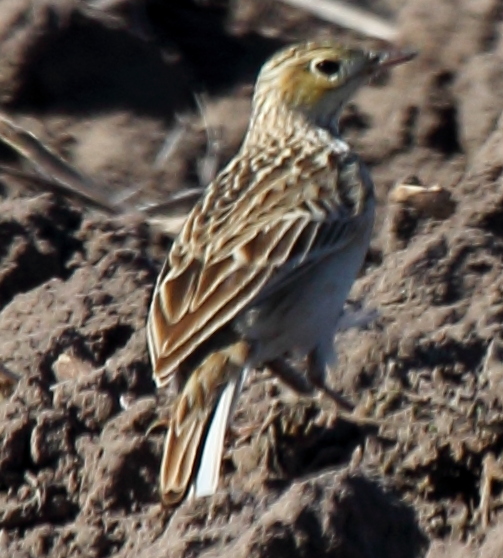
Identifying the Meadow Pipit involves noting its streaked and somewhat nondescript brown plumage, which provides effective camouflage against grassy backgrounds. Adult Meadow Pipits display fine streaking on their breast and flanks, a characteristic that distinguishes them from similar species. Their upperparts are a more uniform brown, with lighter underparts that carry the streaks, providing a subtle contrast. The Meadow Pipit's legs are pinkish, and it possesses a medium-length, slender bill suitable for its insectivorous diet. In terms of size, the Meadow Pipit is a small bird, measuring approximately 14-15 cm in length with a wingspan of about 22-25 cm.
Juveniles resemble adults but often exhibit slightly more pronounced streaking, especially on the head and back, giving them a somewhat mottled appearance. There is little sexual dimorphism, making it challenging to distinguish between males and females in the field based solely on appearances. However, during the breeding season, males are more vocal and display more frequently, aiding identification.
The Meadow Pipit's flight silhouette is characterized by rapid wingbeats followed by short glides, often giving the impression of a bouncing flight pattern. When perched, it often adopts an upright posture, frequently seen atop small shrubs or fence posts, where its streaked plumage blends effectively with the surroundings. It is often confused with the Tree Pipit, but the Meadow Pipit typically lacks the more pronounced facial markings and the stronger bill of its arboreal relative.
Having trouble telling birds apart? Upload a photo to our bird identification tool for an instant species match.
Meadow Pipit Habitat and Range
Preferred Habitat
The Meadow Pipit thrives in open environments such as grasslands, moorlands, and marshes, where its coloration offers excellent camouflage against predators. In the breeding season, it favors upland moors and lowland marshes across Europe and parts of Asia, needing wide open spaces that provide abundant insect food sources. It can be found at elevations ranging from sea level to about 2,000 meters, particularly in mountainous regions where it occupies the lower slopes.
Seasonally, the Meadow Pipit exhibits habitat shifts, often moving to lower altitudes and coastal areas during winter to escape harsher conditions. In these areas, it often frequents salt marshes and estuarine environments. Although predominantly rural, the Meadow Pipit may occasionally venture into urban parks and gardens, especially during migration periods or in milder climates where suitable open spaces are available.
This adaptability to various open habitats underscores the Meadow Pipit's resilience, although it remains more commonly associated with rural landscapes, where human disturbance is minimal, and natural vegetation provides necessary cover and foraging opportunities.
Geographic Range
The Meadow Pipit breeds across a wide range, extending from the British Isles and Scandinavia eastward to Western Siberia. During the breeding season, it occupies territories from Ireland and the United Kingdom through much of continental Europe, including France, Germany, and Poland, reaching into the Russian steppe. Populations in northern regions, such as Scandinavia and parts of Russia, are largely migratory, moving southward as winter approaches.
In winter, the Meadow Pipit migrates to milder climates, primarily in Western Europe and the Mediterranean region. It can be found in southern France, the Iberian Peninsula, Italy, and occasionally North Africa. Migration corridors typically follow coastal and riverine routes, where birds can find suitable stopover habitats rich in food resources.
Population density varies, with significant concentrations in the British Isles, where suitable breeding and wintering habitats are plentiful. Although less common in urban areas, the Meadow Pipit is a widespread presence across its range, with migration offering glimpses of this species even in regions outside its typical breeding or wintering grounds. Birdwatchers often note its presence during migration in areas where it is not known to breed or winter, marking its extensive range and adaptability.
Want to know which birds visit your area? Browse our backyard birds by location guides for region-specific species lists.
What Does the Meadow Pipit Eat?
The Meadow Pipit's diet primarily consists of insects and other arthropods, which it forages for on the ground. Its slender bill is adapted for picking insects from the vegetation and soil surface. During the breeding season, its diet is rich in caterpillars, beetles, and flies, which provide the necessary protein for both adults and their developing chicks.
In autumn and winter, the Meadow Pipit's diet expands to include seeds and small invertebrates, reflecting the seasonal availability of food resources. It forages in flocks outside the breeding season, often seen moving methodically across fields and meadows, probing the ground with quick, deliberate motions.
Insects remain the primary food source, but the Meadow Pipit displays remarkable adaptability in its feeding habits, capable of adjusting its diet according to habitat and seasonal changes. This dietary flexibility not only aids survival across diverse environments but also ensures the Meadow Pipit's role in controlling insect populations remains consistent throughout the year.
Meadow Pipit Behavior and Social Structure
The Meadow Pipit exhibits a range of behaviors that reflect its adaptability and social nature. Typically solitary or in pairs during the breeding season, it becomes more gregarious outside this period, forming loose flocks that can number in the dozens. These flocks provide safety in numbers and facilitate efficient foraging as birds move across open habitats.
Territorial behavior dominates during the breeding season, with males establishing and defending territories through song and display. The Meadow Pipit's courtship involves a distinctive display flight, where the male ascends into the air, singing, before parachuting down with wings and tail spread. This display serves to attract females and to deter rival males.
In response to predators, the Meadow Pipit relies on its cryptic plumage and erratic flight patterns. It will often crouch low to avoid detection or take off in a zigzag flight to elude pursuit. Daily activity is largely diurnal, with foraging taking place from early morning until late afternoon, punctuated by periods of rest and preening.
Meadow Pipit Nesting and Reproduction
The Meadow Pipit constructs its nest on the ground, typically concealed within a tussock of grass or heather. The nest consists of a cup-shaped structure made from grasses, moss, and lined with finer materials such as hair and feathers. This careful construction helps insulate the eggs and chicks from the elements.
Preferred nesting sites are often in open grasslands or moorland, where vegetation provides both cover and proximity to food sources. The female lays a clutch of 4 to 6 eggs, with incubation lasting approximately 11 to 14 days. During this period, the female remains primarily responsible for incubation, while the male assists by bringing food to the nest.
Once hatched, the chicks are altricial, requiring intensive parental care. Both parents participate in feeding the young, who fledge about 14 days after hatching. The Meadow Pipit often raises two broods per year, capitalizing on the abundance of food during the spring and summer months. Parental roles are well-defined, with both sexes contributing to the success of the offspring.
Meadow Pipit Sounds and Vocalizations
The Meadow Pipit's song is a repetitive series of high-pitched, tinkling notes, often delivered during an aerial display flight. Its song carries a rhythm that rises and falls, reminiscent of the bird's undulating flight pattern. This vocalization is a key identifier in its open habitat, where visual detection can be challenging.
In addition to its song, the Meadow Pipit produces a variety of call notes, including a short 'tsip' alarm call used to signal danger. During the dawn chorus, its song is a prominent feature, blending with those of other grassland species. These vocalizations serve multiple functions, from territory establishment to mate attraction, and are an integral part of the Meadow Pipit's behavioral repertoire.
Interesting Facts About the Meadow Pipit
- 1The Meadow Pipit is often parasitized by the Common Cuckoo, which lays its eggs in the pipit's nest, relying on it to raise the cuckoo chick.
- 2During migration, Meadow Pipits can travel distances exceeding 1,000 kilometers to reach their wintering grounds.
- 3The species is known for its distinctive 'parachuting' display flight, a unique behavior among pipits used during courtship.
- 4Meadow Pipits molt twice a year, with a complete molt after the breeding season and a partial molt before migration.
- 5This bird's diet shifts seasonally, from insect-rich in summer to including more seeds and small invertebrates in winter.
- 6The Meadow Pipit's song is often compared to the jingling of small bells, and it can be heard from afar due to its elevated display flight.
- 7In Europe, Meadow Pipits are one of the most common prey items for the Merlin, a small species of falcon.
Meadow Pipit Conservation Status
The Meadow Pipit is categorized as Least Concern by the IUCN, reflecting its widespread distribution and stable populations. However, localized declines have occurred due to habitat loss from agricultural intensification and land-use changes. Conservation efforts focus on preserving and restoring suitable habitats, particularly in areas where grasslands and moorlands have been degraded. Historical population trends show fluctuations tied to climatic conditions and habitat availability, with populations remaining robust in regions where traditional land management practices support biodiversity. Continued monitoring and habitat conservation are essential to ensure the Meadow Pipit's continued abundance and ecological role.
Other Motacillidae Species



Birds Similar to the Meadow Pipit
These species are often confused with the Meadow Pipit due to similar appearance or overlapping range.

