
Turquoise Cotinga
Cotinga ridgwayi
Order: Passeriformes / Family: Cotingidae

Wikimedia Commons
About the Turquoise Cotinga
The Turquoise Cotinga (Cotinga ridgwayi), a member of the Cotingidae family, is a vibrant and striking bird found primarily in the tropical lowland forests of Costa Rica and Panama. Its vivid blue-green plumage and static presence in the canopy make it a prized sighting for birdwatchers. Despite its vibrant colors, the Turquoise Cotinga remains elusive due to its preference for dense foliage and quiet demeanor.
This species plays a significant ecological role as a frugivore, aiding in seed dispersal for a variety of plant species. By consuming fruits and berries and subsequently excreting the seeds, the Turquoise Cotinga contributes to forest regeneration and diversity. This mutualistic relationship underscores the importance of the bird within its ecosystem, fostering plant growth necessary for sustaining other wildlife.
Located primarily in Costa Rica's Pacific slope and extending into western Panama, the Turquoise Cotinga dwells in both primary and secondary forests. It exhibits a notable preference for mature forest areas, though it can also be found in partially degraded forests. While generally considered resident, some local movements occur in response to fruit availability, highlighting the bird's dependence on specific ecological niches.
Seasonal behaviors of the Turquoise Cotinga include increased vocalizations during the breeding season, as the male seeks to attract a mate. This season also sees territorial displays, with males defending their foraging and nesting areas. Outside of the breeding season, the Turquoise Cotinga can be more solitary or found in small mixed-species flocks, particularly when foraging for food.
The Turquoise Cotinga belongs to the family Cotingidae, within the order Passeriformes. These birds typically live averages 7-10 years, with a maximum recorded of 12 years..
How to Identify a Turquoise Cotinga
The Turquoise Cotinga is easily recognizable by its luminous blue-green plumage, with males displaying more intense colors than females. Males possess a vivid turquoise body with a purplish-blue throat and chest, while females are more subdued, with olive-brown tones and speckled underparts, providing better camouflage among dense foliage. Juveniles often resemble females but with duller colors and less distinct patterns.
In flight, the Turquoise Cotinga presents a compact silhouette with broad wings and a relatively short tail. Its flight is typically direct and swift, characterized by rapid wingbeats. When perched, the bird maintains an upright posture, often remaining still for extended periods, which can make spotting it a challenge despite its vibrant colors.
The Turquoise Cotinga may be confused with the Blue Cotinga (Cotinga nattererii), which shares its range. However, the Blue Cotinga generally exhibits a more uniform deep blue plumage, lacking the turquoise hue. Observers should note the distinct coloration and habitat preferences to accurately identify these cotingas.
Having trouble telling birds apart? Upload a photo to our bird identification tool for an instant species match.
Turquoise Cotinga Habitat and Range
Preferred Habitat
The Turquoise Cotinga inhabits tropical lowland forests, primarily on the Pacific slopes of Costa Rica and western Panama. These birds prefer mature rainforests with dense canopies, often found at elevations ranging from sea level to about 1,200 meters. While they primarily reside in primary forests, they also adapt to secondary growth and forest edges, provided fruiting trees are available.
Seasonal habitat shifts are minimal, as these birds are generally non-migratory. However, they may move between different forest areas in search of food, especially during fruit shortages. Urban environments rarely support the Turquoise Cotinga due to its reliance on forest habitats, though small populations may occasionally be found in rural, forested landscapes.
Geographic Range
The Turquoise Cotinga's range is restricted to the Pacific lowlands of Costa Rica and western Panama. It occupies a relatively narrow geographical strip, favoring the humid lowland and foothill forests. Its distribution is not continuous, and the bird is considered uncommon throughout its range. Population density tends to be higher in protected areas like Costa Rica's Carara National Park and Panama's La Amistad International Park, where suitable habitats and food resources are abundant.
The species does not undertake long-distance migrations, but local movements are observed in response to seasonal fruiting patterns. These movements ensure the bird remains within regions that provide adequate food resources year-round.
Want to know which birds visit your area? Browse our backyard birds by location guides for region-specific species lists.
What Does the Turquoise Cotinga Eat?
Turquoise Cotingas primarily feed on a variety of fruits and berries, making them essential seed dispersers within their ecosystems. Their diet includes figs, small drupes, and berries, which they typically consume in the canopy. Seasonal shifts in fruit availability influence their foraging behavior, with these birds taking advantage of seasonal abundance in different forest areas.
Foraging involves short flights from perch to perch, where they pluck fruits using their strong, hooked bills. On occasion, Turquoise Cotingas may also consume small insects, supplementing their diet, especially when fruits are scarce. They are diurnal feeders, most active during the early morning and late afternoon, when they capitalize on peak fruit availability.
Turquoise Cotinga Behavior and Social Structure
The Turquoise Cotinga exhibits solitary to loosely social behaviors, often seen alone or in pairs. During the breeding season, males become more territorial, engaging in displays to attract females and defend their foraging grounds. Courtship displays include vocalizations and physical posturing, showcasing their vibrant plumage.
Outside the breeding season, Turquoise Cotingas may participate in mixed-species flocks, particularly when foraging. These flocks provide increased vigilance against predators and enhance foraging efficiency. Predators include raptors and arboreal snakes, prompting the cotinga to maintain a vigilant presence while in the canopy.
Daily activity patterns are diurnal, with peak activity aligning with feeding times in the morning and late afternoon. The bird spends much of its time perched quietly, scanning its surroundings for food and potential threats.
Turquoise Cotinga Nesting and Reproduction
The Turquoise Cotinga builds a simple, shallow cup nest composed of twigs and leaves, typically located high in the tree canopy. These nests are often positioned on horizontal branches, providing some concealment from predators. The female is primarily responsible for nest construction.
Clutch size generally consists of one or two eggs, with an incubation period lasting approximately 18 to 20 days. Females handle most of the incubation duties, while males may assist by bringing food. After hatching, both parents participate in feeding the young, which fledge around 22 to 25 days post-hatching.
Turquoise Cotingas typically have one brood per year, though favorable conditions may allow for a second. Parental roles are well-defined, with both members sharing the responsibilities of feeding and protecting their young.
Turquoise Cotinga Sounds and Vocalizations
The primary song of the Turquoise Cotinga is a series of melodious whistles, often described as resembling a flute. These notes are delivered in a steady, rhythmic sequence, varying slightly in pitch. The song serves as a territorial call and a courtship display, often heard during the breeding season.
Call notes include a short, sharp 'pip,' which serves as an alarm call or contact call among individuals. The Turquoise Cotinga does not participate in a dawn chorus like many other passerines, but it vocalizes sporadically throughout the day, particularly during peak activity periods.
Interesting Facts About the Turquoise Cotinga
- 1Despite its bright colors, the Turquoise Cotinga often blends into the canopy, making it a challenging find for birdwatchers.
- 2The Turquoise Cotinga's vibrant plumage is a result of structural coloration, not pigments, reflecting specific wavelengths of light.
- 3This species' diet consists almost entirely of fruits, making it an important seed disperser in its ecosystem.
- 4The Turquoise Cotinga was first described in 1887 by the American ornithologist Robert Ridgway, after whom the species is named.
- 5It is closely related to the Blue Cotinga, with which it shares similar habitats, though their ranges overlap only slightly.
- 6Turquoise Cotingas have been observed engaging in cooperative feeding with other fruit-eating bird species.
- 7Their preference for high, dense foliage means they are less frequently seen than more ground-dwelling tropical birds.
Turquoise Cotinga Conservation Status
The Turquoise Cotinga is listed as Near Threatened on the IUCN Red List, with population trends showing a decline primarily due to habitat destruction. Deforestation for agriculture and urban development poses significant threats to its habitat. Conservation efforts focus on protecting existing forest habitats and promoting reforestation projects. Historically, the population has declined with the loss of primary forests, but efforts in protected areas have provided some stability. Continued conservation initiatives are essential to prevent further declines and preserve this species for future generations.
Other Cotingidae Species


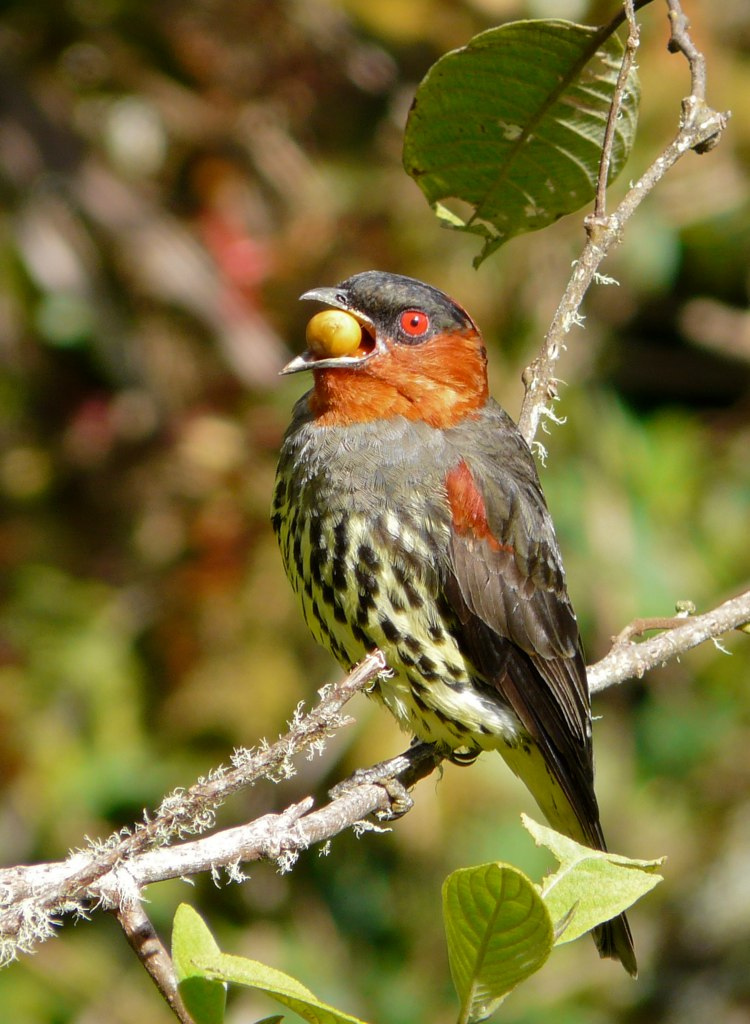

Birds Similar to the Turquoise Cotinga
These species are often confused with the Turquoise Cotinga due to similar appearance or overlapping range.

