
African Pipit
Anthus cinnamomeus
Order: Passeriformes / Family: Motacillidae

Wikimedia Commons
About the African Pipit
The African Pipit, Anthus cinnamomeus, is a small passerine bird prevalent across the continent of Africa. A member of the Motacillidae family, this bird thrives in a wide range of open-country habitats from South Africa to the Sahel. Its adaptability to various grassland environments, including savannas and agricultural fields, highlights its ecological significance. As an insectivore, the African Pipit plays a vital role in controlling insect populations, which benefits agriculture and maintains ecological balance. Seasonal behaviors of the African Pipit are influenced by the availability of food and breeding opportunities. During the rainy season, which varies across its range, these birds are more active in breeding, taking advantage of the increased insect activity. In drier months, they may shift locations slightly within their local range to maintain access to food resources. Throughout the year, the African Pipit remains a vital component of its ecosystem, supporting both the food web and the biodiversity of its habitats.
The African Pipit belongs to the family Motacillidae, within the order Passeriformes. These birds typically live average 3-5 years with a maximum recorded of 8 years..
How to Identify a African Pipit
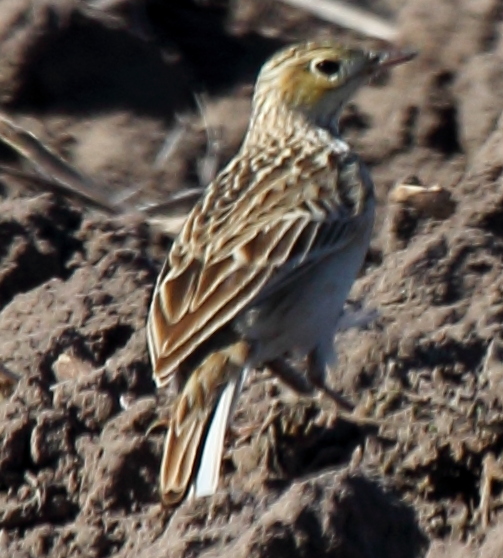
The African Pipit is a small bird, typically measuring around 15 cm in length. Its plumage is predominantly brown with notable streaking, offering excellent camouflage in its grassland environments. The underparts are lighter with a buff hue, and the bird exhibits distinctive white outer tail feathers, visible in flight. Juvenile African Pipits resemble adults but possess more pronounced streaking on their underparts, which fades with maturity. Males and females share similar plumage, though the male may be slightly brighter during the breeding season. When comparing the African Pipit to similar species, such as the Plain-backed Pipit, note the former's more pronounced streaking and slightly smaller size. In flight, the African Pipit's silhouette is characterized by its pointed wings and long tail, which it often flicks as it perches on low shrubs or the ground.
Having trouble telling birds apart? Upload a photo to our bird identification tool for an instant species match.
African Pipit Habitat and Range
Preferred Habitat
The African Pipit inhabits a range of open-country habitats, primarily favoring grasslands, savannas, and agricultural fields. It can be found from sea level up to elevations of 3000 meters, particularly in mountainous regions of East Africa. This adaptable bird also frequents arid regions, including the edges of deserts where vegetation is sparse. While it prefers rural areas, the African Pipit can occasionally be found in urban parks and gardens, especially where grassy patches are present. Seasonal habitat shifts are minimal, with the bird remaining within its local range year-round, although it may move slightly within this range to exploit seasonal food resources.
Geographic Range
African Pipits have a wide distribution across sub-Saharan Africa, encompassing countries such as Kenya, Tanzania, South Africa, Namibia, and Botswana. They breed primarily in the southern regions, such as South Africa and Namibia, where the climate and habitat conditions are favorable. While the African Pipit is generally a resident bird, some populations in more arid regions may undertake short migrations or local movements in response to seasonal changes in food availability. Population density is highest in the grasslands of East and Southern Africa, where the bird is a common sight.
Want to know which birds visit your area? Browse our backyard birds by location guides for region-specific species lists.
What Does the African Pipit Eat?
The diet of the African Pipit primarily consists of insects, including beetles, grasshoppers, and ants. During the breeding season, the bird's diet remains largely consistent, capitalizing on the abundance of insects attracted by the rains. Foraging behavior involves walking or running along the ground with quick, darting movements to capture prey. The African Pipit occasionally supplements its insect diet with seeds, particularly during the dry season when insects become less abundant. The prey size generally ranges from small to medium-sized insects, aligning with the bird's slender bill and agile foraging techniques.
African Pipit Behavior and Social Structure
African Pipits exhibit solitary or paired behavior, particularly during the breeding season when they establish and defend territories. Their territorial displays include singing from elevated perches and performing flight displays. These birds are generally non-aggressive and maintain a low profile, relying on their cryptic plumage for protection. During the day, African Pipits engage in active foraging, primarily in the early morning and late afternoon. They exhibit a characteristic tail-wagging behavior, which is a key identification trait. In response to predators, African Pipits rely on their camouflage and erratic flight patterns to evade capture.
African Pipit Nesting and Reproduction
The nesting behavior of the African Pipit involves building a cup-shaped nest on the ground, often concealed by grass or low vegetation. Nests are constructed using grasses and lined with finer materials for insulation. Clutch size typically ranges from 2 to 4 eggs, which are incubated primarily by the female for approximately 12 to 14 days. Both parents participate in feeding the hatchlings, which fledge after about 14 days. The African Pipit usually raises two broods per year, taking advantage of the seasonal abundance of food during the rainy season.
African Pipit Sounds and Vocalizations
The primary song of the African Pipit is a series of sweet, melodious phrases, often delivered from a perch or during a display flight. The rhythm is lively, with a mix of rising and falling notes. Call notes are short and sharp, serving as communication between mates or an alarm signal. During the dawn chorus, males sing more frequently, marking their territory and attracting mates. The song resembles that of other pipits but is distinguished by its complex structure and varied pitch.
Interesting Facts About the African Pipit
- 1The African Pipit can often be seen performing a unique 'parachute' display flight, where it flutters downward while singing.
- 2Despite its small size, the African Pipit plays a significant role in controlling grasshopper populations in farmland areas.
- 3The African Pipit's tail-wagging behavior is not only for display but also helps to flush out insects from the ground.
- 4They are known to mimic the songs of other bird species, adding complexity to their vocal repertoire.
- 5Studies show that the African Pipit can thrive in moderately disturbed areas, adapting well to changes in habitat.
African Pipit Conservation Status
The African Pipit is currently listed as Least Concern by the IUCN, with stable population trends across its range. Primary threats include habitat loss due to agricultural expansion and urbanization. However, its adaptability to modified landscapes has helped maintain its numbers. Conservation efforts focus on preserving grassland habitats and mitigating the impacts of intensive farming practices. Historical population changes have been minimal, reflecting the species' resilience and adaptability.
Other Motacillidae Species



Birds Similar to the African Pipit
These species are often confused with the African Pipit due to similar appearance or overlapping range.

