
Buffy Pipit
Anthus vaalensis
Order: Passeriformes / Family: Motacillidae

Wikimedia Commons
About the Buffy Pipit
The Buffy Pipit, scientifically known as Anthus vaalensis, is a little gem of the open landscapes, particularly in Africa. This modest bird belongs to the family Motacillidae, which also includes wagtails and other pipits. Known for its subtle beauty and adaptability, the Buffy Pipit thrives in a variety of dry, open habitats, from grasslands to savannas. Observers often spot it across southern Africa, particularly in countries such as South Africa, Namibia, Botswana, and Zimbabwe. The species has adapted well to its environment, playing a critical role in the ecosystem by controlling insect populations. During the breeding season, which coincides with the rainy months, these pipits engage in display flights that are as functional as they are captivating. Despite their wide range, Buffy Pipits are often overlooked due to their camouflaged plumage that blends perfectly with their surroundings. The Buffy Pipit, like many of its relatives, is an insectivore and relies heavily on a diet of small insects and other invertebrates. This feeding behavior not only keeps insect populations in check but also serves as an indicator of the health of their habitat. They are primarily ground-dwellers, and their presence is often more easily detected by their distinctive calls and songs rather than by sight. During the breeding season, the Buffy Pipit builds its nest on the ground, concealed by grasses. The species is known for its resilience and adaptability, managing to thrive despite the challenges of habitat fragmentation and changing land use. As a species, it represents the quintessential grassland bird, perfectly adapted to the rigors and rewards of life in open spaces.
The Buffy Pipit belongs to the family Motacillidae, within the order Passeriformes. These birds typically live average 3-5 years..
How to Identify a Buffy Pipit
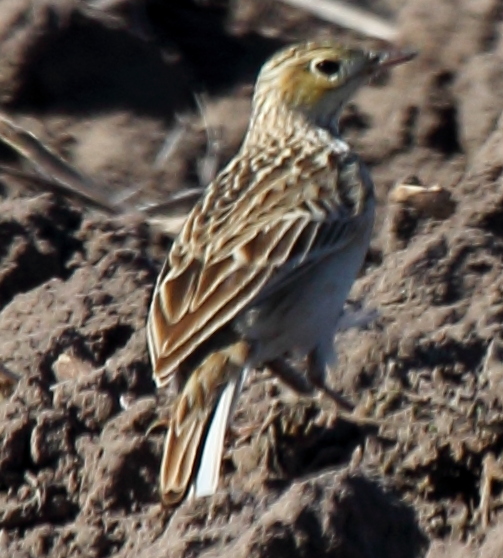
Identifying the Buffy Pipit requires a keen eye, particularly because its plumage offers excellent camouflage against the dry grasses of its habitat. Adult Buffy Pipits feature buff-colored underparts, which are their most distinctive trait, along with pale brown upperparts that help them blend into their surroundings. Juveniles tend to have more pronounced streaking compared to adults, which can help differentiate them. Males and females look alike, making it difficult to distinguish between the sexes in the field. While observing Buffy Pipits, birders should note their relatively long legs and slender build, typical of pipits. The bird's flight pattern is another key identifier, with undulating movements typical of pipits. When perched, Buffy Pipits often exhibit a horizontal posture, as they tend to stand erect on the ground. Their song, a series of high-pitched 'see-see-see' notes, is a valuable clue for identification. In terms of potential confusion with similar species, the Buffy Pipit can be mistaken for the Plain-backed Pipit. However, the latter lacks the distinctive buff underparts that characterize the Buffy Pipit.
Having trouble telling birds apart? Upload a photo to our bird identification tool for an instant species match.
Buffy Pipit Habitat and Range
Preferred Habitat
The Buffy Pipit primarily inhabits open grasslands, savannas, and arid scrublands, preferring areas with sparse vegetation where it can forage effectively. It is most commonly found at elevations ranging from sea level to about 2,000 meters. In terms of seasonal habitat shifts, Buffy Pipits show some degree of local movement in response to rainfall patterns, seeking out areas where insect prey is abundant. Unlike many urban-adapted species, the Buffy Pipit rarely ventures into developed areas, maintaining a preference for rural settings. This preference highlights the species' reliance on natural grassland ecosystems for survival.
Geographic Range
The Buffy Pipit is widely distributed across the southern African subcontinent. Its breeding range includes South Africa, Namibia, Botswana, and Zimbabwe, with some populations extending into southern Angola and Mozambique. During non-breeding seasons, these birds may exhibit some local movement within this range, though they are primarily resident rather than migratory. Population density varies, with higher concentrations in regions where grasslands remain intact and unaffected by intensive agriculture. The species is considered most abundant in areas like the Highveld grasslands of South Africa, where it can exploit the rich insect life.
Want to know which birds visit your area? Browse our backyard birds by location guides for region-specific species lists.
What Does the Buffy Pipit Eat?
The diet of the Buffy Pipit consists mainly of small insects and other invertebrates, making it an insectivore. It feeds on ants, beetles, grasshoppers, and caterpillars, which it captures on the ground through a methodical picking and probing technique. Seasonal changes influence its diet, with an increase in prey diversity during the rainy season when insects are more abundant. The Buffy Pipit forages throughout the day, often seen walking purposefully across the ground in search of food. Its feeding technique includes a distinct head-bobbing motion, which aids in spotting and capturing prey.
Buffy Pipit Behavior and Social Structure
Buffy Pipits display a solitary or loosely gregarious nature outside of the breeding season, often seen alone or in pairs. During the breeding season, males become territorial, engaging in display flights to mark their territory and attract mates. These displays involve fluttering, undulating flights accompanied by song. Courting involves a combination of aerial displays and ground chases. When faced with predators, Buffy Pipits rely on camouflage and stealth, often freezing to avoid detection. Their daily activity peaks during cooler morning and late afternoon hours, as they avoid the midday heat.
Buffy Pipit Nesting and Reproduction
The Buffy Pipit constructs a simple yet effective nest on the ground, usually in a shallow depression lined with grass and other plant material. Nest locations are often well-concealed in tufts of grass or low shrubbery to protect from predators. The typical clutch consists of 3 to 4 eggs. Both parents share incubation duties, which last about 13 to 15 days. Once hatched, chicks remain in the nest for approximately two weeks before fledging. Parental care continues post-fledging as the young learn to forage independently. Buffy Pipits usually raise one to two broods per year, depending on environmental conditions.
Buffy Pipit Sounds and Vocalizations
The Buffy Pipit's song is a series of high-pitched 'see-see-see' notes, delivered with a rapid rhythm. It often sings from a prominent perch or during its display flight, the song being a key component of its territorial behavior. Calls include a soft 'pip' or 'pitt' sound, used for communication between mates or to signal alarm. During the dawn chorus, Buffy Pipits join the symphony of early morning birds, their song standing out for its clarity and simplicity.
Interesting Facts About the Buffy Pipit
- 1The Buffy Pipit can often be heard rather than seen, thanks to its cryptic plumage blending seamlessly into grassland environments.
- 2Despite its unassuming appearance, the Buffy Pipit performs intricate flight displays during the breeding season to attract mates.
- 3The Buffy Pipit is a ground-nesting bird, which increases its vulnerability to habitat disturbances and predation.
- 4Buffy Pipits contribute to pest control by consuming significant numbers of insects, benefiting agricultural landscapes.
- 5This species exhibits a unique head-bobbing motion when foraging, aiding in its search for ground-dwelling insects.
- 6The Buffy Pipit's territorial song plays a crucial role in mate selection and territory defense during the breeding season.
- 7These birds are capable of short, rapid flights, often remaining low to the ground to exploit their habitat efficiently.
Buffy Pipit Conservation Status
The IUCN currently lists the Buffy Pipit as a species of Least Concern, with populations generally considered stable. However, habitat loss due to agricultural expansion poses a significant threat. Conservation efforts focus on preserving grassland habitats and promoting sustainable land-use practices. Historical data suggest some fluctuations in population size, with declines in areas of intense land conversion. Protecting key habitats remains crucial for the long-term survival of this adaptable species.
Other Motacillidae Species



Birds Similar to the Buffy Pipit
These species are often confused with the Buffy Pipit due to similar appearance or overlapping range.

