
Kimberley Pipit
Anthus pseudosimilis
Order: Passeriformes / Family: Motacillidae

Wikimedia Commons
About the Kimberley Pipit
The Kimberley Pipit, scientifically known as Anthus pseudosimilis, is a captivating species that embodies the adaptability and resilience of grassland birds. Found primarily in the Kimberley region of northwestern Australia, this pipit thrives in open landscapes where its pale plumage allows it to blend seamlessly into its grassy surroundings. Its presence is significant, as it serves as both an indicator of the health of grassland ecosystems and a contributor to the biodiversity of these habitats.
Ecologically, the Kimberley Pipit plays a vital role in controlling insect populations, thus maintaining the balance within its ecosystem. This bird is a ground forager, primarily preying on insects and other small invertebrates. During the breeding season, which coincides with the austral spring and summer, the Kimberley Pipit becomes particularly active, using its melodious song to establish territory and attract mates.
Known for its intricate vocalizations, the Kimberley Pipit participates in a dawn chorus that fills the grasslands with sound. The bird's behavior changes with the seasons; during the dry season, it might be seen in denser vegetation or near water sources where insects are more abundant. The Kimberley Pipit is a solitary bird outside the breeding season, but its presence is an indicator of a well-functioning grassland ecosystem. Its ecological role, combined with its melodic presence, makes it a species of interest for both ornithologists and bird watchers.
The Kimberley Pipit belongs to the family Motacillidae, within the order Passeriformes. These birds typically live estimated average lifespan is around 3 years..
How to Identify a Kimberley Pipit
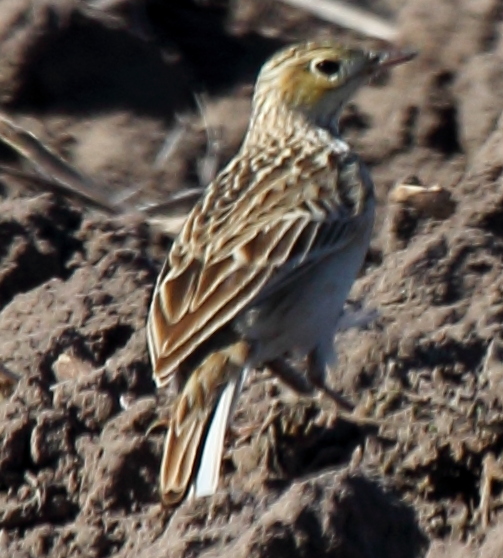
The Kimberley Pipit is a small, slender bird, approximately 15 to 17 centimeters in length, with a wingspan ranging from 25 to 30 centimeters. Its plumage is predominantly brown with intricate streaking along the head, back, and wings, which serves as camouflage against the grassy terrain. The underparts are a lighter, buff color, providing a subtle contrast to its darker back. Adult males and females are similar in appearance, though females might exhibit slightly duller plumage.
Juveniles resemble adults but tend to have more pronounced streaking and a somewhat fluffier appearance due to fresher feathers. This species can be confused with other pipits, such as the Richard's Pipit, but the Kimberley Pipit is generally smaller with a more delicate build. In flight, it reveals a distinctive silhouette characterized by a bouncing flight pattern, often with a series of quick wing beats followed by short glides.
When perched, the Kimberley Pipit displays a characteristic upright posture on its slender legs, often accompanied by tail wagging. This bird's call, a series of high-pitched, tinkling notes, is another distinguishing feature that sets it apart from similar species.
Having trouble telling birds apart? Upload a photo to our bird identification tool for an instant species match.
Kimberley Pipit Habitat and Range
Preferred Habitat
The Kimberley Pipit thrives in open grasslands and savannas, preferring areas with sparse tree cover and a dense understory of grasses. It is often found in regions characterized by rolling plains and low-lying vegetation. In the Kimberley, where this pipit gets its name, it occupies elevations from sea level to modest upland areas, typically not exceeding 500 meters.
During the wet season, the Kimberley Pipit may venture into areas that are temporarily flooded, exploiting the abundance of insects. While it predominantly inhabits rural and remote areas, it can occasionally be found in the outskirts of small towns where suitable grassland habitat persists. Despite its adaptability, urbanization poses a threat to its preferred habitats, which are increasingly being converted for agriculture or development.
Geographic Range
The Kimberley Pipit is endemic to Australia, with its primary range restricted to the northwestern regions, particularly within the Kimberley region. During the breeding season, it is most commonly observed in the open grasslands and savannas of this area. Its breeding range does not extend significantly beyond this region, making it a species of interest for conservationists focused on localized biodiversity.
There is some evidence to suggest that during the non-breeding season, the Kimberley Pipit may disperse slightly southward, though it tends not to migrate long distances. Migration corridors, if they exist, are poorly defined due to the bird's largely sedentary nature. Population density is highest in pristine grassland habitats, where human disturbance is minimal.
Want to know which birds visit your area? Browse our backyard birds by location guides for region-specific species lists.
What Does the Kimberley Pipit Eat?
The diet of the Kimberley Pipit consists primarily of insects, which it forages for on the ground. Its diet includes beetles, grasshoppers, ants, and other invertebrates, which it captures with quick, darting movements. During the wet season, it takes advantage of the abundance of insects resulting from increased vegetation growth and moisture.
In the dry season, when insect populations decrease, the Kimberley Pipit may supplement its diet with seeds and small grains. Its foraging technique involves walking or running through grassland while scanning the ground for prey, occasionally using its bill to flick aside debris. This bird typically feeds during the cooler parts of the day, such as early morning and late afternoon, to avoid the midday heat.
Kimberley Pipit Behavior and Social Structure
The Kimberley Pipit is a solitary bird, particularly outside the breeding season, where it exhibits strong territorial behavior. During the breeding season, males establish territories and use song as a primary means of defending these areas and attracting mates. Their courtship displays involve both song and visual displays, such as fluttering flight patterns designed to showcase plumage.
Social structure among Kimberley Pipits is relatively simple, as they do not form large flocks. However, they may be seen in loose aggregations when food is plentiful. The bird's response to predators includes a series of alarm calls and evasive maneuvers, often dropping to the ground and remaining motionless to avoid detection.
Daily activity patterns are influenced by temperature and food availability, with most activity occurring in the cooler morning and late afternoon periods. The Kimberley Pipit is generally active throughout the day, though peak vocal activity occurs during the early morning hours, coinciding with the dawn chorus.
Kimberley Pipit Nesting and Reproduction
The Kimberley Pipit's nesting habits reflect its grassland habitat preferences. It constructs its nest on the ground, often concealed among tufts of grass. The nest itself is a simple cup made of grass and other fine plant materials, lined with softer fibers to cushion the eggs.
The typical clutch size ranges from three to five eggs, which are incubated primarily by the female. The incubation period lasts approximately 12 to 14 days. Once hatched, both parents participate in feeding the chicks, which fledge around 14 days after hatching. The Kimberley Pipit usually raises one brood per year, though favorable conditions may occasionally allow for a second.
Kimberley Pipit Sounds and Vocalizations
The primary song of the Kimberley Pipit is a series of melodious, tinkling notes that rise and fall in pitch. The rhythm is generally even, with a slightly rolling quality that makes it both distinctive and pleasant to the ear. In addition to its song, the bird emits call notes that are short and sharp, used primarily for communication between individuals.
Alarm calls are higher-pitched and more insistent, serving to warn of potential danger. The Kimberley Pipit participates in the dawn chorus, where its song is most prominent, contributing to the vibrant soundscape of the grasslands. Its vocalizations are reminiscent of those of other pipits, yet possess a unique tonal quality that birdwatchers and ornithologists can learn to recognize.
Interesting Facts About the Kimberley Pipit
- 1The Kimberley Pipit can perform a unique fluttering display flight during courtship, showcasing intricate aerobatics.
- 2Despite its small size, the Kimberley Pipit can be heard singing from distances over 100 meters, thanks to its powerful voice.
- 3This species is named after the Kimberley region in Australia, where it was first discovered and still predominantly resides.
- 4The Kimberley Pipit uses its streaked plumage to blend into its environment, effectively avoiding predators.
- 5Researchers have identified subtle dialect differences in songs between populations of Kimberley Pipits in different areas.
- 6Unlike many birds, the Kimberley Pipit forages primarily on the ground, rarely taking flight to catch prey.
- 7Observations suggest that Kimberley Pipits might be sensitive indicators of grassland ecosystem health due to their habitat specificity.
Kimberley Pipit Conservation Status
According to the IUCN, the Kimberley Pipit is currently listed as a species of least concern, with a stable population trend. However, ongoing threats such as habitat loss due to agriculture and urban expansion pose risks to its long-term survival. Conservation efforts focus on preserving grassland habitats and monitoring population dynamics. Historically, the Kimberley Pipit's population has fluctuated in response to environmental pressures, but recent conservation efforts have helped stabilize numbers. Continued habitat conservation and responsible land management are crucial for ensuring the species' future.
Other Motacillidae Species



Birds Similar to the Kimberley Pipit
These species are often confused with the Kimberley Pipit due to similar appearance or overlapping range.
