
Nicholson's Pipit
Anthus nicholsoni
Order: Passeriformes / Family: Motacillidae

Wikimedia Commons
About the Nicholson's Pipit
Nicholson's Pipit, scientifically known as Anthus nicholsoni, is a small passerine bird belonging to the family Motacillidae. It is primarily found in the grasslands and open fields of southern Africa, where its melodious song can be heard echoing across the plains. This species plays a crucial role in its ecosystem as both a consumer of insects and as prey for larger birds and mammals. Its presence in the grasslands is indicative of a healthy environment, as it thrives in areas with minimal human disturbance. The Nicholson's Pipit is of particular interest to ornithologists due to its specialized habitat preferences and its relatively restricted range compared to other pipits. During the breeding season, which spans from September to March, Nicholson's Pipit engages in elaborate aerial displays. Males perform these displays to attract females and establish territories. The bird's song, a series of high-pitched whistles and trills, becomes more frequent and fervent during this period, serving as both a mating call and a declaration of territory. Outside the breeding season, Nicholson's Pipit is less conspicuous, often blending into the dry grasses that dominate its habitat. Its role as an insectivore is critical in controlling pest populations, and by foraging on the ground, it helps aerate the soil, promoting plant growth. Its seasonal movements are influenced by rainfall and the availability of food, making it an important indicator species for environmental changes in the region. Although its population is currently stable, ongoing habitat destruction and climate change pose potential threats to its survival. Conservation efforts aimed at preserving grassland habitats are essential to ensuring the continued presence of Nicholson's Pipit in southern Africa's vibrant ecosystems.
The Nicholson's Pipit belongs to the family Motacillidae, within the order Passeriformes. These birds typically live average 4-6 years, with some living up to 8 years.
How to Identify a Nicholson's Pipit
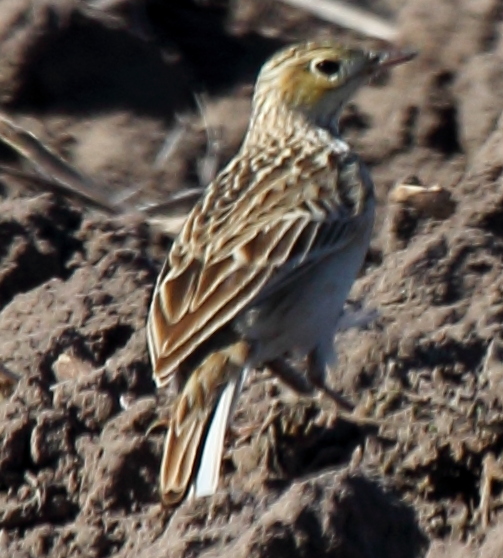
Nicholson's Pipit is a medium-sized pipit, measuring approximately 16 to 18 centimeters in length. Its plumage is predominantly brown with streaks of darker brown across the back and wings, providing excellent camouflage against the grassland terrain. The underparts are pale with fine streaking on the breast, while the belly is typically white. Juvenile Nicholson's Pipits resemble adults but with more pronounced streaking and a slightly duller appearance. Males and females are similar in appearance, making it challenging to differentiate between sexes in the field. In flight, Nicholson's Pipit exhibits a distinctive undulating pattern, characteristic of many pipit species. Its tail is relatively long with white outer feathers, which are often visible in flight. When perched, the bird stands upright, often on elevated grasses or rocks, providing a clear view of its surroundings. Confusion may arise with other pipit species in the region, such as the African Pipit. However, Nicholson's Pipit can be distinguished by its habitat preference and vocalizations. Its song is more melodic and complex compared to the simpler calls of related species.
Having trouble telling birds apart? Upload a photo to our bird identification tool for an instant species match.
Nicholson's Pipit Habitat and Range
Preferred Habitat
Nicholson's Pipit predominantly inhabits open grasslands and savannas in southern Africa. It prefers areas with sparse vegetation where it can forage for insects on the ground. This species is most commonly found at elevations ranging from sea level to 1,500 meters. During the breeding season, Nicholson's Pipit seeks out territories that offer a combination of tall grasses and open ground, which are optimal for both nesting and foraging. In the non-breeding season, it may move to areas with more cover, such as shrublands, to escape predators. While Nicholson's Pipit is primarily associated with rural landscapes, it can occasionally be found on the outskirts of urban areas where suitable grassland patches exist.
Geographic Range
The breeding range of Nicholson's Pipit is concentrated in southern Africa, particularly in countries such as South Africa, Namibia, Botswana, and Zimbabwe. It is a resident species, meaning it does not undertake long-distance migrations but may exhibit local movements in response to seasonal changes in food availability. During the non-breeding season, Nicholson's Pipit may expand its range slightly as it seeks out favorable conditions. It is most abundant in regions with consistent grassland habitats and is considered relatively common within its limited range. Population density is highest in areas with minimal agricultural development and low levels of human disturbance.
Want to know which birds visit your area? Browse our backyard birds by location guides for region-specific species lists.
What Does the Nicholson's Pipit Eat?
Nicholson's Pipit primarily feeds on insects and other small invertebrates. Its diet includes beetles, grasshoppers, caterpillars, and ants, which it catches by foraging on the ground. The bird uses a characteristic run-and-pause technique to capture prey, quickly darting across open areas before stopping to pick up insects. During the breeding season, its diet is supplemented by a higher proportion of insects to meet the increased energy demands of courtship and chick-rearing. In the dry season, Nicholson's Pipit may rely more heavily on seeds and plant material, adapting its diet to what is available. The bird's foraging activity is primarily diurnal, with peak periods in the early morning and late afternoon when insects are most active.
Nicholson's Pipit Behavior and Social Structure
Nicholson's Pipit exhibits a solitary or loosely territorial social structure during the breeding season, when males establish territories and perform aerial displays to attract females. These displays involve rapid ascents followed by a descent with fluttering wings while singing, showcasing their prowess and fitness. Outside of the breeding season, Nicholson's Pipit is more tolerant of conspecifics and may form small flocks, especially when feeding. The bird's territorial behavior is less pronounced during this time, although individuals may still defend rich feeding areas. In response to predators, Nicholson's Pipit employs a combination of cryptic plumage and evasive flight to avoid detection and capture. Its daily activity pattern includes active foraging during daylight hours, interspersed with periods of rest and preening.
Nicholson's Pipit Nesting and Reproduction
Nicholson's Pipit constructs a cup-shaped nest on the ground, often hidden among tall grasses or under small shrubs to provide camouflage from predators. The nest is made from grasses, rootlets, and other fine plant materials, lined with softer materials such as feathers or animal hair. The female typically lays a clutch of 3 to 4 eggs, which she incubates for approximately 13 to 15 days. Both parents participate in feeding the chicks, which fledge at about 14 to 16 days after hatching. Nicholson's Pipit may produce two broods per breeding season, depending on environmental conditions and food availability. The nesting success of this species is highly dependent on the availability of suitable habitat and protection from ground-based predators.
Nicholson's Pipit Sounds and Vocalizations
The primary song of Nicholson's Pipit is a series of melodious whistles and trills, delivered with a rising and falling rhythm. This song is most commonly heard during the breeding season, as males use it to attract mates and establish territories. In addition to its song, Nicholson's Pipit issues a variety of call notes, including a sharp 'tsip' that serves as an alarm call when disturbed. These calls help maintain contact with mates and alert others to potential threats. The bird's vocalizations are most prominent during the early morning and late afternoon, often contributing to the dawn chorus in its habitat. Compared to other pipits, its song is more complex and musical, making it a distinctive presence in the grassland soundscape.
Interesting Facts About the Nicholson's Pipit
- 1Nicholson's Pipit is named after the ornithologist who first described it, highlighting its unique presence in the avian world.
- 2This species performs elaborate flight displays during courtship, showcasing its agility and stamina.
- 3Despite its unassuming appearance, Nicholson's Pipit plays a vital role in controlling insect populations in grasslands.
- 4It is one of the few bird species that can thrive in the often harsh and dry environments of southern Africa's grasslands.
- 5Nicholson's Pipit can adjust its diet with seasonal changes, demonstrating remarkable adaptability.
- 6The bird's flight is characterized by a distinctive, undulating pattern, making it easily recognizable in the field.
- 7Nicholson's Pipit's song stands out for its complexity and clarity among the grassland bird community.
Nicholson's Pipit Conservation Status
Nicholson's Pipit is currently listed as Least Concern by the IUCN, with a stable population trend. However, habitat destruction due to agricultural expansion and urban development poses a significant threat to its grassland habitats. Conservation efforts focus on preserving these habitats through protected areas and sustainable land management practices. Historical population changes have been minimal, but continuous monitoring is necessary to detect any future declines. Advocacy for grassland conservation and awareness campaigns are crucial for ensuring the long-term survival of Nicholson's Pipit and other grassland species.
Other Motacillidae Species



Birds Similar to the Nicholson's Pipit
These species are often confused with the Nicholson's Pipit due to similar appearance or overlapping range.

