
Philadelphia Vireo
Vireo philadelphicus
Order: Passeriformes / Family: Vireonidae

Wikimedia Commons
About the Philadelphia Vireo
The Philadelphia Vireo (Vireo philadelphicus) is a small passerine bird belonging to the family Vireonidae. This species is an intriguing subject for birders due to its subtleties in appearance and its intriguing ecological role. Found primarily in North America, the Philadelphia Vireo makes its summer home across a broad range from the northeastern United States through southern Canada. During the breeding season, this bird is most often found in deciduous and mixed woodlands, including areas of secondary growth and young forests where it plays a significant role in controlling insect populations. As insectivores, Philadelphia Vireos help maintain a balanced ecosystem by reducing the numbers of leaf-eating insects, thus preserving the health of the forests they inhabit. During the spring and summer, this vireo can be observed actively foraging for insects, often in the canopy where it is less visible than on lower branches. The Philadelphia Vireo is migratory, with a range that extends from its breeding grounds in the north to wintering habitats in Central America, particularly in countries like Honduras and Nicaragua. This seasonal migration is crucial not only for the bird’s survival but also for the dispersal of seeds and control of insect populations across its migratory route. During migration, these birds rely on stopover sites to refuel and rest, highlighting the importance of maintaining these habitats across North America and into Central America. The Philadelphia Vireo’s presence in a given area can indicate a healthy, insect-rich environment, making it an important species for ecological assessments.
The Philadelphia Vireo belongs to the family Vireonidae, within the order Passeriformes. These birds typically live typically around 5 years, with a maximum recorded lifespan of 7 years..
How to Identify a Philadelphia Vireo
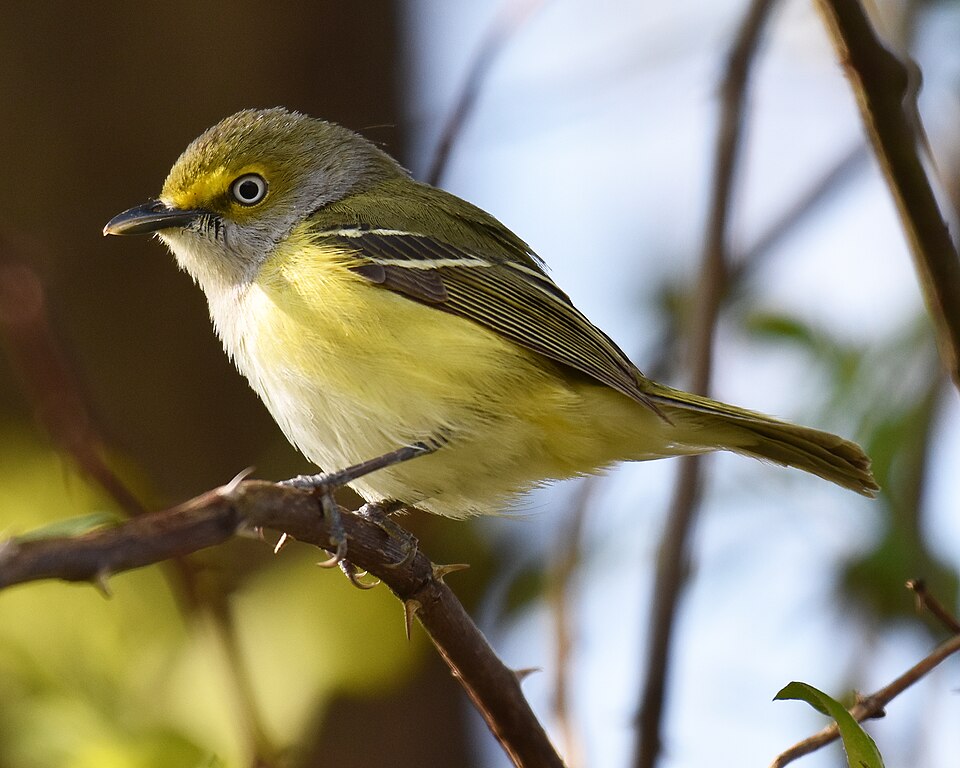
The Philadelphia Vireo is a small songbird, measuring approximately 11-13 cm in length with a wingspan of 18-19 cm. Its distinctive olive-green coloration on the back and bright yellow underparts make it an easy species to identify for those familiar with vireos. Adults exhibit a subtle contrast between the grayish crown and the more vibrant yellow throat and breast. The eyes are dark with a faint whitish eye line, which can be a useful field mark when distinguishing it from similar species. Juveniles resemble adults but tend to have duller plumage. Both male and female Philadelphia Vireos look similar in plumage, making sex differentiation in the field difficult without close observation. One common identification challenge is distinguishing the Philadelphia Vireo from the similar-looking Warbling Vireo. The Philadelphia Vireo typically shows a brighter yellow wash on the underparts and a more pronounced contrast between the throat and belly. In flight, the Philadelphia Vireo displays a compact silhouette with rapid wingbeats, while its perching posture often involves a slightly upright stance when foraging or scanning for prey. These characteristics, combined with its vocalizations, provide a reliable means of identifying this vibrant yet elusive vireo in its natural habitat.
Having trouble telling birds apart? Upload a photo to our bird identification tool for an instant species match.
Philadelphia Vireo Habitat and Range
Preferred Habitat
Philadelphia Vireos inhabit deciduous and mixed woodlands, favoring areas with young, dense trees and shrubs. They are typically found at elevations ranging from sea level to about 2,000 feet, though they may venture higher during migration. These birds prefer forest edges, clearings, or places where new growth is abundant, which provide ample food resources and nesting sites. During the breeding season, they are most commonly observed in rural landscapes with a substantial tree cover, but they can also be found in urban parks or suburban areas with suitable vegetation. As migratory birds, Philadelphia Vireos exhibit notable habitat shifts, moving from their breeding grounds in North America to the tropics of Central America. In winter, they occupy a range of habitats, including tropical forests, coffee plantations, and other areas with abundant foliage. Their adaptability to different environments highlights their ecological resilience and the importance of habitat conservation across their range.
Geographic Range
The breeding range of the Philadelphia Vireo extends from the northeastern United States through southern Canada, particularly in the provinces of Ontario, Quebec, and the eastern parts of Manitoba. In the U.S., they breed primarily in states like New York, Vermont, and Maine. During migration, this vireo travels through the eastern and central United States, with notable flyways including the Mississippi and Atlantic corridors. These birds migrate to Central America for the winter, with a significant population wintering in countries such as Honduras, Nicaragua, and Costa Rica. Some populations may extend as far south as Panama. Within their range, Philadelphia Vireos are generally more common in the northern parts of their breeding grounds, with density hotspots in areas of dense deciduous woodland. During migration, they can be found in a variety of habitats, highlighting their adaptability and the necessity of preserving migration corridors that provide essential resources.
Want to know which birds visit your area? Browse our backyard birds by location guides for region-specific species lists.
What Does the Philadelphia Vireo Eat?
Philadelphia Vireos primarily feed on insects, which constitute the bulk of their diet during the breeding season. They are adept at gleaning insects from foliage, focusing on caterpillars, beetles, and various arthropods. Their foraging technique often involves moving methodically through tree canopies and shrubbery, picking off insects from leaves and branches. During migration and in their winter habitat, the diet of the Philadelphia Vireo may expand to include small fruits and berries, which provide essential energy for their long journeys. These birds may also consume spiders and other small invertebrates as supplementary food sources. The vireo's feeding schedule is largely diurnal, with peak foraging activity occurring in the early morning and late afternoon when insects are most active. This dietary flexibility allows them to thrive in a range of environments and seasons, underscoring their ecological versatility.
Philadelphia Vireo Behavior and Social Structure
Philadelphia Vireos exhibit a variety of intriguing behaviors that reflect their adaptability and ecological role. These birds are generally solitary during the breeding season, with males establishing and defending territories through song and display. The males sing frequently, especially in the morning, to establish dominance and attract mates. Courtship involves a series of calls and displays in which the male attempts to catch the female's attention through vocalizations and subtle wing flicking. Once paired, Philadelphia Vireos show a strong pair bond, working together to build nests and raise their young. During migration, these vireos may join mixed-species flocks, which provide safety in numbers and increase foraging efficiency. Philadelphia Vireos respond to predators with alarm calls and evasive flight patterns, often retreating to dense foliage for cover. Their daily activity patterns are primarily diurnal, with most of their foraging, singing, and social interactions occurring in daylight hours. These behaviors underline the bird's adaptability and its ability to thrive across a wide range of ecosystems.
Philadelphia Vireo Nesting and Reproduction
Philadelphia Vireos construct cup-shaped nests, often located in the fork of a slender tree branch, typically six to fifteen feet above the ground. The nests are woven from grass, bark strips, and plant fibers, bound together with spider silk. The female primarily undertakes nest building, although the male may assist by bringing materials. The typical clutch size for the Philadelphia Vireo ranges from three to five eggs, which are white with sparse brownish spots. The incubation period lasts approximately 12-14 days, with both parents sharing the responsibility. After hatching, the altricial young are fed by both parents and remain in the nest for about 10-12 days before fledging. Philadelphia Vireos usually raise one brood per year, although in some instances, a second brood may be attempted if conditions are favorable. Parental care extends beyond fledging, with adults continuing to feed and protect the young until they are independent.
Philadelphia Vireo Sounds and Vocalizations
The Philadelphia Vireo's primary song is a series of short, melodic phrases that can be described as sweet and cheerful. The song consists of a repetitive sequence of two to three-syllable phrases, often likened to the Warbling Vireo but typically shorter and more deliberate. These phrases are delivered with a clear, ringing quality that can carry through the canopy. In addition to its song, the Philadelphia Vireo also emits various call notes, including a sharp 'chip' used for communication between mates or as an alarm signal when predators are near. During the dawn chorus, the male's song is most prominent, serving to establish territory and attract a mate. The vocalizations of the Philadelphia Vireo are an essential aspect of its behavior, providing insight into its social interactions and environmental awareness.
Interesting Facts About the Philadelphia Vireo
- 1Philadelphia Vireos are named after Philadelphia, Pennsylvania, where the first specimen was collected, although the city itself is not within their typical range.
- 2Despite their name, Philadelphia Vireos are more common in Canada than in the United States during the breeding season.
- 3These birds are known for their ability to mimic the calls of other bird species, adding complexity to their vocal repertoire.
- 4Philadelphia Vireos can be difficult to spot due to their preference for high canopy foraging, making them a challenging find for birders.
- 5The species was first described by John Cassin in the mid-19th century, adding to the growing list of known North American birds.
- 6Philadelphia Vireos are closely related to the Red-eyed Vireo, sharing many behavioral and ecological traits.
- 7Their migration route spans thousands of miles, showcasing their stamina and adaptability to diverse environments.
Philadelphia Vireo Conservation Status
The Philadelphia Vireo is currently listed as a species of Least Concern by the IUCN, with a stable population trend reported. However, like many migratory birds, it faces threats from habitat loss, particularly in its breeding and wintering grounds. Deforestation and land conversion for agriculture pose significant risks to the habitats this vireo relies on. Conservation efforts focus on preserving and restoring forest habitats, both in North America and Central America, to ensure sustainable environments for breeding, migration, and wintering. Monitoring population trends and conducting research on migration patterns help guide conservation actions. Historically, the Philadelphia Vireo population has remained relatively stable, but ongoing conservation initiatives aim to mitigate future threats and maintain the health of its populations across its range.
Other Vireonidae Species


Birds Similar to the Philadelphia Vireo
These species are often confused with the Philadelphia Vireo due to similar appearance or overlapping range.


